Electrochemistry — Concept Maps
Madhya Pradesh Board · Class 12 · Chemistry
4 concept maps of Electrochemistry for Madhya Pradesh Board Class 12 Chemistry, each also written out as a text outline.
Interactive on Super Tutor
Studying Electrochemistry? Get the full interactive chapter.
Quizzes, flashcards, AI doubt-solver and a step-by-step study plan — built for concept maps and more.
Free trial, no card needed.
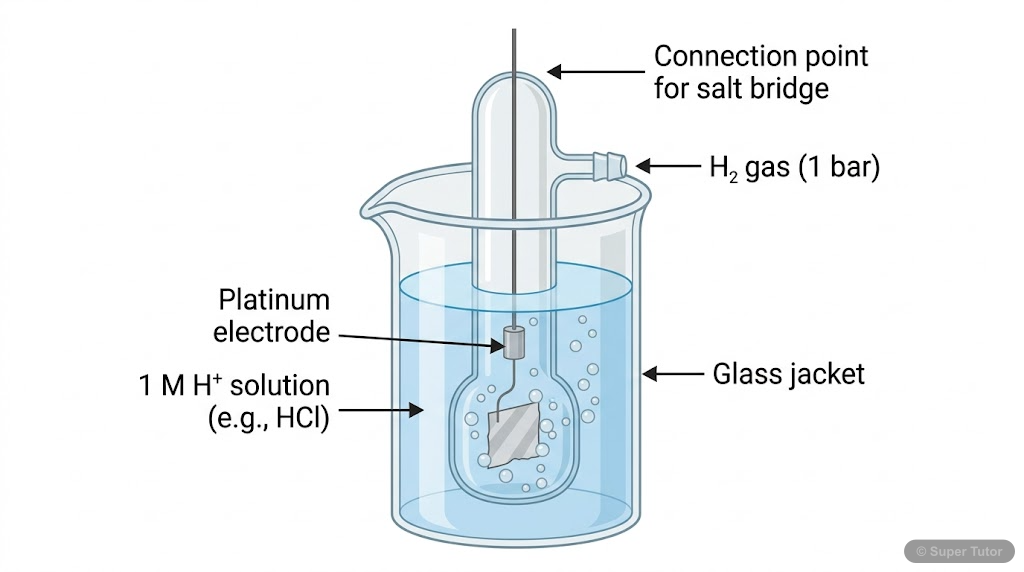
Learn better with visuals Super Tutor pairs illustrations like this with notes and quizzes for Electrochemistry.
Galvanic vs Electrolytic Cell: Correct Electrode Polarity and Ion/Electron Flow
The map in words
- Electrochemical Cell Types
- Galvanic Cell
- Anode is NEGATIVE
- Oxidation occurs here
- Zn to Zn2+ plus 2e-
- Electrons flow Anode to Cathode via wire
- Current flows Cathode to Anode
- Electrons flow Anode to Cathode via wire
- Zn to Zn2+ plus 2e-
- Oxidation occurs here
- Cathode is POSITIVE
- Reduction occurs here
- Cu2+ plus 2e- to Cu
- Reduction occurs here
- Anode is NEGATIVE
- Electrolytic Cell
- Anode is POSITIVE
- Connected to positive terminal of battery
- Opposite to Galvanic Cell
- Connected to positive terminal of battery
- Cathode is NEGATIVE
- Connected to negative terminal of battery
- Anode is POSITIVE
- Galvanic Cell
Electrochemistry - Complete Chapter Mind Map
The map in words
- Electrochemistry
- Electrochemical Cells
- Galvanic Cell
- Spontaneous Redox
- Produces Electricity
- Daniell Cell
- Electrolytic Cell
- Non-Spontaneous
- Uses Electricity
- External Voltage
- Components
- Anode Oxidation
- Cathode Reduction
- Salt Bridge
- Electrolyte
- Galvanic Cell
- Electrode Potential
- Standard Hydrogen Electrode
- Zero Reference
- 1 bar H2 Pressure
- 1M H+ Concentration
- Standard Electrode Potential
- Reduction Potential
- IUPAC Convention
- Table of Values
- Cell EMF
- E cell = E right minus E left
- Positive for Spontaneous
- Standard Hydrogen Electrode
- Nernst Equation
- E cell = E0 minus RT by nF ln Q
- At 298K Factor 0.059 by n
- Applications
- pH Measurement
- Equilibrium Constant
- Solubility Product
- Gibbs Energy
- Delta G = minus nFE
- Delta G0 = minus RT ln K
- Conductance
- Resistance R
- Ohm Unit
- Wheatstone Bridge
- Resistivity rho
- SI Unit Ohm metre
- Conductivity kappa
- SI Unit S per metre
- Decreases on Dilution
- Molar Conductivity
- Lambda m = kappa by c
- S cm2 per mol
- Increases on Dilution
- Kohlrausch Law
- Independent Migration
- Strong Electrolytes
- Linear with sqrt c
- Lambda m0 by Extrapolation
- Weak Electrolytes
- Steep Increase
- Lambda m0 by Kohlrausch
- Degree of Dissociation
- Resistance R
- Electrolysis
- Faradays First Law
- Proportional to Charge
- Faradays Second Law
- Equivalent Weights
- Charge Q = I times t
- Faraday Constant
- 96500 C per mol
- Products
- Inert Electrodes
- Reactive Electrodes
- Overpotential Effect
- Industrial Uses
- Sodium Metal
- Chlorine Gas
- Aluminium
- Electroplating
- Faradays First Law
- Batteries
- Primary Batteries
- Dry Cell Leclanche
- Zn Anode
- C Graphite Cathode
- 1.5 V
- Mercury Cell
- Zn Hg Amalgam Anode
- HgO Cathode
- 1.35 V
- Dry Cell Leclanche
- Secondary Batteries
- Lead Storage
- Pb Anode
- PbO2 Cathode
- H2SO4 Electrolyte
- Rechargeable
- Nickel Cadmium
- Longer Life
- Rechargeable
- Lead Storage
- Primary Batteries
- Fuel Cells
- H2 O2 Fuel Cell
- Porous Carbon Electrodes
- KOH Electrolyte
- Pt Pd Catalyst
- 70 Percent Efficiency
- Pollution Free
- Hydrogen Economy
- H2 O2 Fuel Cell
- Corrosion
- Electrochemical Process
- Rusting of Iron
- Anode Fe to Fe2+ plus 2e
- Cathode O2 plus H+ Reduction
- Hydrated Fe2O3 Rust
- Prevention
- Paint Coating
- Metal Coating
- Sacrificial Electrode
- Galvanisation
- Electrochemical Cells
Electrochemistry — Chapter Overview
The map in words
- Electrochemistry
- Electrochemical Cells
- Galvanic Cell
- Daniell Cell
- EMF and Cell Potential
- Standard Electrode Potential
- Electrolytic Cell
- Electrolysis
- Faradays Laws
- Products of Electrolysis
- Galvanic Cell
- Electrode Potential
- Standard Hydrogen Electrode
- Nernst Equation
- Gibbs Energy Relation
- Conductance
- Resistivity and Conductivity
- Molar Conductivity
- Kohlrauschs Law
- Variation with Concentration
- Applications
- Primary Batteries
- Secondary Batteries
- Fuel Cells
- Corrosion
- Electrochemical Cells
Electrochemistry
The map in words
- Electrochemistry
- Electrochemical cells
- Nernst equation and thermodynamics
- Conductance of electrolytic solutions
- Variation of conductivity with concentration
- Kohlrausch law
- Electrolysis
- Batteries
- Corrosion
Explore these maps interactively
Explore DiagramsFrequently Asked Questions
What are the important topics in Electrochemistry for Madhya Pradesh Board Class 12 Chemistry?
What do the concept maps for Electrochemistry show?
How should I revise Electrochemistry for the Madhya Pradesh Board Class 12 board exam?
Sources & Official References
Content is aligned to the official syllabus. Refer to the board website for the latest curriculum.
More resources for Electrochemistry
Practice Quiz
Test yourself with a quick quiz
Important Questions
Exam-style questions with answers
Revision Notes
Key points for last-minute revision
Formula Sheet
The chapter's formulas in one place
Chapter Summary
Understand the chapter at a glance
Study Plan
Step-by-step plan for this chapter
Flashcards
Quick-fire cards for active recall
Syllabus
What topics to cover
NCERT Solutions
Every textbook question solved step by step
For serious students
Get the full Electrochemistry chapter — start free.
Quizzes, flashcards, an AI doubt solver and a study plan for Madhya Pradesh Board Class 12 Chemistry. Free to start, no card needed.