Electrochemistry — Important Questions
Madhya Pradesh Board · Class 12 · Chemistry
91 important questions from Electrochemistry for Madhya Pradesh Board Class 12 Chemistry, with answers. Written for the board exams 2027.
Interactive on Super Tutor
Studying Electrochemistry? Get the full interactive chapter.
Quizzes, flashcards, AI doubt-solver and a step-by-step study plan — built for important questions and more.
Free trial, no card needed.
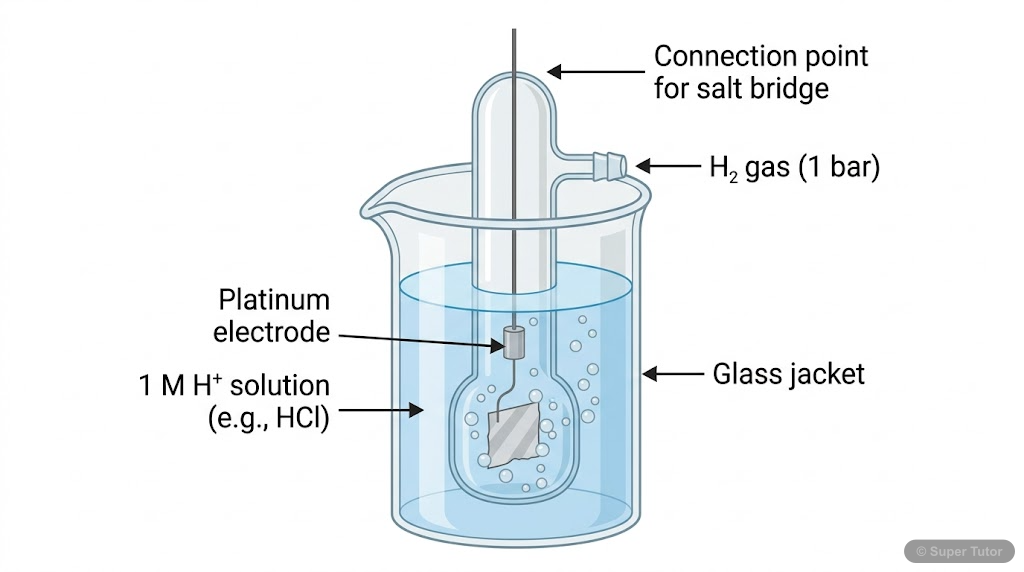
Learn better with visuals Super Tutor pairs illustrations like this with notes and quizzes for Electrochemistry.
Important Questions from Electrochemistry
Which of the following are characteristics of electrolytic conductivity? (Select all correct answers)
Show answer
It increases with increase in temperature, It depends on the nature of the electrolyte, It is due to movement of ions
Electrolytic conductivity increases with temperature as ions move faster, depends on the electrolyte type, and is caused by ion movement. Conductivity actually increases with concentration (up to a point) and is affected by solvent viscosity.
Which of the following factors affect the conductivity of an electrolytic solution? (Select all correct answers)
Show answer
Nature of the electrolyte, Size of ions and their solvation, Concentration of the electrolyte, Nature of the solvent
Conductivity depends on the type of electrolyte, ion size and solvation (which affects mobility), concentration of ions, and solvent properties like viscosity. The color of the solution does not affect conductivity.
The unit of molar conductivity is:
Show answer
S cm² mol⁻¹
Molar conductivity (Λm) has units of S cm² mol⁻¹ (siemens square centimeter per mole). It is calculated as κ/c, where κ has units S cm⁻¹ and c has units mol cm⁻³, giving the result in S cm² mol⁻¹.
According to Kohlrausch's law, the molar conductivity at infinite dilution is:
Show answer
Sum of individual ionic conductivities
Kohlrausch's law states that the limiting molar conductivity (at infinite dilution) of an electrolyte is the sum of the limiting molar conductivities of its constituent ions: Λ°m = λ°+ + λ°-
+87 more questions on Electrochemistry (Madhya Pradesh Board Class 12 Chemistry)
Practise AllFrequently Asked Questions
What are the important topics in Electrochemistry for Madhya Pradesh Board Class 12 Chemistry?
How many important questions are there in Electrochemistry?
Sources & Official References
Content is aligned to the official syllabus. Refer to the board website for the latest curriculum.
More resources for Electrochemistry
Practice Quiz
Test yourself with a quick quiz
Revision Notes
Key points for last-minute revision
Formula Sheet
The chapter's formulas in one place
Chapter Summary
Understand the chapter at a glance
Concept Maps
See how topics connect
Study Plan
Step-by-step plan for this chapter
Flashcards
Quick-fire cards for active recall
Syllabus
What topics to cover
NCERT Solutions
Every textbook question solved step by step
For serious students
Get the full Electrochemistry chapter — start free.
Quizzes, flashcards, an AI doubt solver and a study plan for Madhya Pradesh Board Class 12 Chemistry. Free to start, no card needed.