The d-and f-Block Elements — Concept Maps
Madhya Pradesh Board · Class 12 · Chemistry
4 concept maps of The d-and f-Block Elements for Madhya Pradesh Board Class 12 Chemistry, each also written out as a text outline.
Interactive on Super Tutor
Studying The d-and f-Block Elements? Get the full interactive chapter.
Quizzes, flashcards, AI doubt-solver and a step-by-step study plan — built for concept maps and more.
Free trial, no card needed.
One of 16 illustrations for The d-and f-Block Elements in Super Tutor — alongside flashcards, concept maps and practice questions.
Complete Concept Map: d- and f-Block Elements
The map in words
- d and f Block Elements
- d Block Transition Metals
- Position Groups 3 to 12
- Electronic Config n-1 d 1-10 ns 1-2
- 4 Series
- 3d Series Sc to Zn
- 4d Series Y to Cd
- 5d Series La Hf to Hg
- 6d Series Ac Rf to Cn
- Exceptions
- Cr 3d5 4s1
- Cu 3d10 4s1
- Pd 4d10 5s0
- Not True Transition
- Zn Cd Hg d10 config
- General Properties
- Physical Properties
- High MP and BP
- High Enthalpy Atomisation
- Max at d5 in each series
- Density increases Ti to Cu
- Lanthanoid Contraction
- 5d radii similar to 4d
- Zr 160pm Hf 159pm
- Ionisation Enthalpy
- Gradual increase across series
- Extra stability d5 and d10
- Exchange energy effect
- Oxidation States
- Variable OS differ by 1
- Mn plus2 to plus7
- Max OS equals group no upto Mn
- F and O stabilise highest OS
- Pi acceptor ligands give low OS
- Electrode Potential
- M2plus M trend less negative
- Cu positive E not noble
- Mn Ni Zn more negative
- Mn3plus Co3plus strong oxidants
- Physical Properties
- Special Characteristics
- Magnetic Properties
- Paramagnetism unpaired e
- Spin only formula
- Ferromagnetism extreme
- Mn2plus d5 5 unpaired
- Zn2plus d10 diamagnetic
- Coloured Ions
- d to d transitions
- d0 and d10 colourless
- Colour depends on ligands
- Ti3plus purple Cu2plus blue
- Complex Formation
- Small size high charge
- d orbitals available
- Fe CN6 3minus 4minus
- Cu NH3 4 2plus
- Catalytic Properties
- Multiple OS enable catalysis
- V2O5 Contact Process
- Fe Haber Process
- Ni Hydrogenation
- Interstitial Compounds
- H C N in lattice
- TiC Mn4N Fe3H
- Very hard high MP
- Metallic conductivity
- Alloy Formation
- Similar radii within 15 percent
- Ferrous alloys steels
- Brass Cu Zn
- Bronze Cu Sn
- Magnetic Properties
- Important Compounds
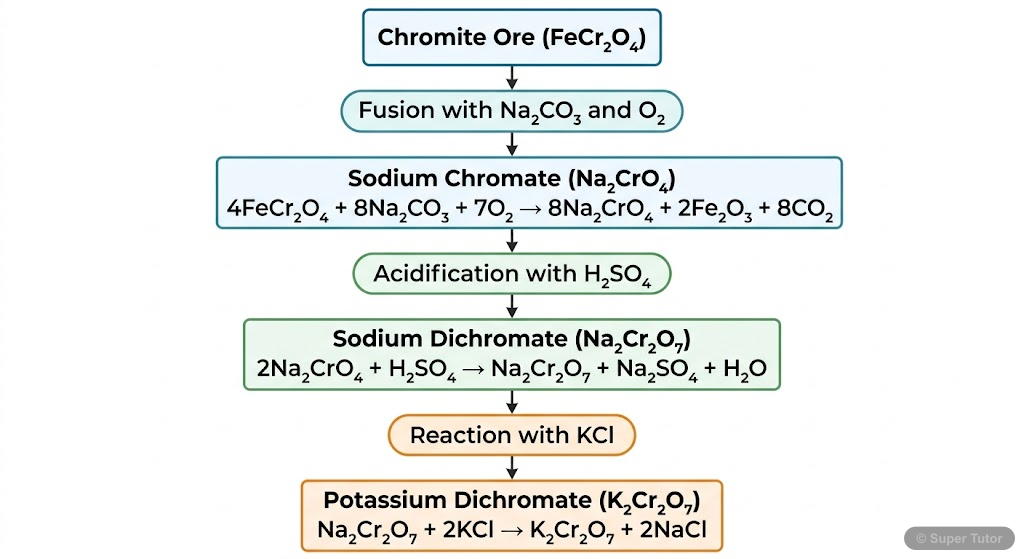
- K2Cr2O7
- From chromite ore FeCr2O4
- Cr in plus6 state
- Chromate dichromate pH equilibrium
- Strong oxidant acidic medium
- Oxidises Fe2plus I minus Sn2plus
- KMnO4
- From MnO2 fusion KOH
- Mn in plus7 state
- Tetrahedral ion intense purple
- Oxidises in acid neutral alkaline
- Acidic Mn2plus neutral MnO2
- K2Cr2O7
- f Block Inner Transition
- Lanthanoids
- Ce to Lu Z 58 to 71
- 4f orbitals filling
- Config Xe 4fn 5d 6s2
- OS plus3 main plus2 plus4 occasional
- Lanthanoid Contraction
- Coloured paramagnetic Ln3plus ions
- Mischmetall alloy steels phosphors
- Actinoids
- Th to Lr Z 90 to 103
- 5f orbitals filling
- All radioactive
- Wide OS plus3 to plus7
- 5f electrons participate bonding
- Actinoid Contraction
- U Th nuclear energy sources
- Lanthanoids
- d Block Transition Metals
Overview of d-Block Transition Elements — Key Characteristics
The map in words
- d-Block Elements
- Electronic Config
- General Formula
- n-1 d 1to10 ns 1to2
- Exceptions
- Cr is 3d5 4s1
- Cu is 3d10 4s1
- Not Transition
- Zn Cd Hg have d10
- General Formula
- Physical Properties
- High Melting Points
- Peak at d5 config
- High Density
- Ti to Cu increases
- Lanthanoid Contraction
- Zr and Hf similar size
- High Melting Points
- Oxidation States
- Variable States
- Mn shows plus2 to plus7
- Maximum equals Group No
- Valid upto Group 7
- Zero State
- Ni CO 4 and Fe CO 5
- Variable States
- Characteristic Properties
- Colour
- d1 to d9 are coloured
- d0 and d10 colourless
- Paramagnetism
- Spin only formula
- Max at d5 5unpaired
- Catalysis
- Variable oxidation states
- V2O5 Fe Ni catalysts
- Complex Formation
- Small size high charge
- Empty d orbitals
- Interstitial Compounds
- H C N in lattice
- Non stoichiometric
- Alloy Formation
- Similar radii
- Steel Brass Bronze
- Colour
- Electronic Config
Is It a Transition Metal? — Decision Flowchart
The map in words
- Element in d-block Groups 3 to 12
- B
- Yes: Transition Metal
- Examples: Fe, Cu, Cr, Mn, Co, Ni
- H
- Examples: Fe, Cu, Cr, Mn, Co, Ni
- No: D
- No: E
- Examples: Zn d10, Cd d10, Hg d10
- I
- Examples: Zn d10, Cd d10, Hg d10
- No: E
- Yes: Transition Metal
- B
- incomplete
- Only
- Form
- Paramagnetic
- Diamagnetic
- Fixed
d-and f-Block Elements
The map in words
- d-and f-Block Elements
- Position in periodic table
- Electronic configuration
- Transition metals
- Physical properties
- Atomic and ionic sizes
- Ionisation enthalpy and exchange energy
- Oxidation states
- Electrode potentials and redox behavior
Explore these maps interactively
Explore DiagramsFrequently Asked Questions
What are the important topics in The d-and f-Block Elements for Madhya Pradesh Board Class 12 Chemistry?
What do the concept maps for The d-and f-Block Elements show?
How should I revise The d-and f-Block Elements for the Madhya Pradesh Board Class 12 board exam?
Sources & Official References
Content is aligned to the official syllabus. Refer to the board website for the latest curriculum.
More resources for The d-and f-Block Elements
Practice Quiz
Test yourself with a quick quiz
Important Questions
Exam-style questions with answers
Revision Notes
Key points for last-minute revision
Chapter Summary
Understand the chapter at a glance
Study Plan
Step-by-step plan for this chapter
Flashcards
Quick-fire cards for active recall
Syllabus
What topics to cover
NCERT Solutions
Every textbook question solved step by step
For serious students
Get the full The d-and f-Block Elements chapter — start free.
Quizzes, flashcards, an AI doubt solver and a study plan for Madhya Pradesh Board Class 12 Chemistry. Free to start, no card needed.