Electrochemistry — Chapter Summary
Madhya Pradesh Board · Class 12 · Chemistry
Summary of Electrochemistry for Madhya Pradesh Board Class 12 Chemistry. Part of the Madhya Pradesh Board Class 12 Chemistry syllabus.
Interactive on Super Tutor
Studying Electrochemistry? Get the full interactive chapter.
Quizzes, flashcards, AI doubt-solver and a step-by-step study plan — built for chapter summary and more.
Free trial, no card needed.
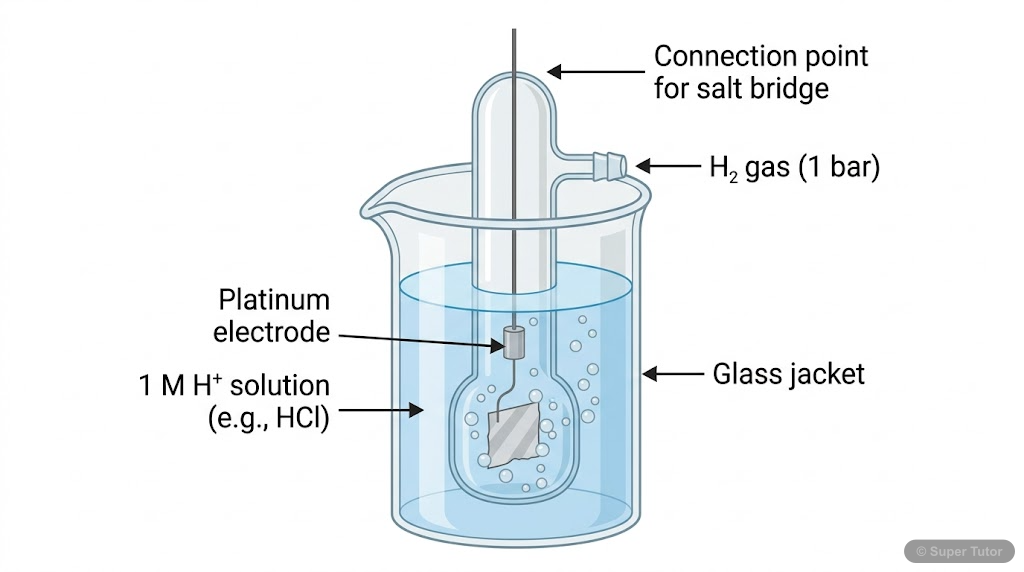
Learn better with visuals Super Tutor pairs illustrations like this with notes and quizzes for Electrochemistry.
Overview
Electrochemistry is the study of production of electricity from energy released during spontaneous chemical reactions and the use of electrical energy to bring about non-spontaneous chemical transformations. It connects redox reactions, cell potential, conductivity, electrolysis, batteries, fuel cel
Key Concepts
A galvanic or voltaic cell converts
A galvanic or voltaic cell converts the chemical energy of a spontaneous redox reaction into electrical energy. In the Daniell cell, zinc is oxidised
An electrolytic cell uses external electrical
An electrolytic cell uses external electrical energy to drive a non-spontaneous chemical reaction. When the applied opposing voltage becomes greater t
Standard electrode potential is the electrode
Standard electrode potential is the electrode potential measured when all species in the half-cell are at unit concentration. The standard hydrogen el
The Nernst equation gives the electrode
The Nernst equation gives the electrode potential or cell potential at non-standard concentrations. For a cell reaction, Ecell = Ecell° - (RT/nF) ln Q
The standard cell potential is related
The standard cell potential is related to standard Gibbs energy by ΔrG° = -nFEcell° and to equilibrium constant by Ecell° = (2.303RT/nF) log Kc. For t
Learning Objectives
- Describe electrochemical cells and distinguish between galvanic and electrolytic cells
- Apply the Nernst equation to calculate emf of a cell and understand standard electrode potential
- Relate standard cell potential with Gibbs energy and equilibrium constant
- Define resistivity, conductivity, and molar conductivity of ionic solutions
- Differentiate between ionic and electronic conductance
Frequently Asked Questions
What are the important topics in Electrochemistry for Madhya Pradesh Board Class 12 Chemistry?
How should I revise Electrochemistry for the Madhya Pradesh Board Class 12 board exam?
Sources & Official References
Content is aligned to the official syllabus. Refer to the board website for the latest curriculum.
More resources for Electrochemistry
Practice Quiz
Test yourself with a quick quiz
Important Questions
Exam-style questions with answers
Revision Notes
Key points for last-minute revision
Formula Sheet
The chapter's formulas in one place
Concept Maps
See how topics connect
Study Plan
Step-by-step plan for this chapter
Flashcards
Quick-fire cards for active recall
Syllabus
What topics to cover
NCERT Solutions
Every textbook question solved step by step
For serious students
Get the full Electrochemistry chapter — start free.
Quizzes, flashcards, an AI doubt solver and a study plan for Madhya Pradesh Board Class 12 Chemistry. Free to start, no card needed.