Aldehydes, Ketones and Carboxylic Acids — Important Questions
Madhya Pradesh Board · Class 12 · Chemistry
121 important questions from Aldehydes, Ketones and Carboxylic Acids for Madhya Pradesh Board Class 12 Chemistry, with answers.
Interactive on Super Tutor
Studying Aldehydes, Ketones and Carboxylic Acids? Get the full interactive chapter.
Quizzes, flashcards, AI doubt-solver and a step-by-step study plan — built for important questions and more.
Free trial, no card needed.
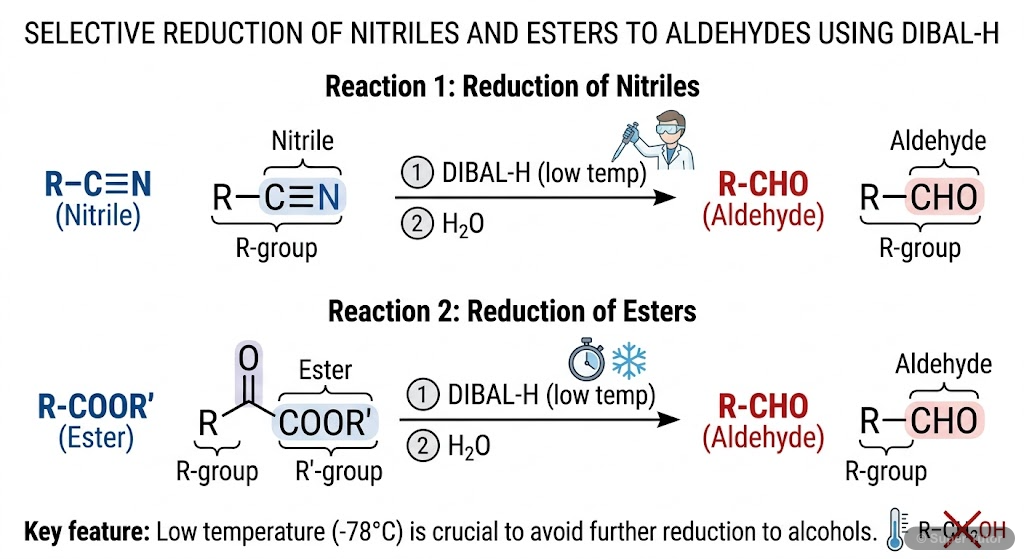
One of 27 illustrations for Aldehydes, Ketones and Carboxylic Acids in Super Tutor — alongside flashcards, concept maps and practice questions.
Important Questions from Aldehydes, Ketones and Carboxylic Acids
Which of the following are methods for preparing aldehydes? (Select all correct answers)
Show answer
Oxidation of primary alcohols, Rosenmund reduction of acyl chlorides, Stephen reaction from nitriles
Aldehydes can be prepared by oxidation of primary alcohols, Rosenmund reduction of acyl chlorides, and Stephen reaction from nitriles. Oxidation of secondary alcohols gives ketones, and Friedel-Crafts acylation is used to prepare ketones.
Fehling's test is used to distinguish between aldehydes and ketones.
Show answer
True
True. Fehling's test is used to distinguish between aldehydes and ketones. Aldehydes give a positive test (reddish brown precipitate of Cu₂O), while ketones do not react with Fehling's reagent under normal conditions.
Which of the following reactions involve nucleophilic addition to the carbonyl group? (Select all correct answers)
Show answer
Addition of HCN, Addition of NaHSO₃, Addition of alcohols, Addition of Grignard reagents
Nucleophilic addition reactions to carbonyl compounds include addition of HCN, NaHSO₃, alcohols, and Grignard reagents. Halogenation is not a nucleophilic addition but an electrophilic substitution reaction.
Aldehydes are generally more reactive than ketones in nucleophilic addition reactions.
Show answer
True
True. Aldehydes are more reactive than ketones due to both steric and electronic factors. Sterically, aldehydes have less hindrance around the carbonyl carbon. Electronically, the single alkyl group in aldehydes provides less electron density to the carbonyl carbon compared to two alkyl groups in ketones.
+117 more questions on Aldehydes, Ketones and Carboxylic Acids (Madhya Pradesh Board Class 12 Chemistry)
Practise AllFrequently Asked Questions
What are the important topics in Aldehydes, Ketones and Carboxylic Acids for Madhya Pradesh Board Class 12 Chemistry?
How many important questions are there in Aldehydes, Ketones and Carboxylic Acids?
Sources & Official References
Content is aligned to the official syllabus. Refer to the board website for the latest curriculum.
More resources for Aldehydes, Ketones and Carboxylic Acids
Practice Quiz
Test yourself with a quick quiz
Revision Notes
Key points for last-minute revision
Formula Sheet
The chapter's formulas in one place
Chapter Summary
Understand the chapter at a glance
Concept Maps
See how topics connect
Study Plan
Step-by-step plan for this chapter
Flashcards
Quick-fire cards for active recall
Syllabus
What topics to cover
NCERT Solutions
Every textbook question solved step by step
For serious students
Get the full Aldehydes, Ketones and Carboxylic Acids chapter — start free.
Quizzes, flashcards, an AI doubt solver and a study plan for Madhya Pradesh Board Class 12 Chemistry. Free to start, no card needed.