Aldehydes, Ketones and Carboxylic Acids — NCERT Solutions
Madhya Pradesh Board · Class 12 · Chemistry
NCERT Solutions for Aldehydes, Ketones and Carboxylic Acids, Madhya Pradesh Board Class 12 Chemistry: 27 textbook questions solved step by step.
Interactive on Super Tutor
Studying Aldehydes, Ketones and Carboxylic Acids? Get the full interactive chapter.
Quizzes, flashcards, AI doubt-solver and a step-by-step study plan — built for NCERT solutions and more.
Free trial, no card needed.
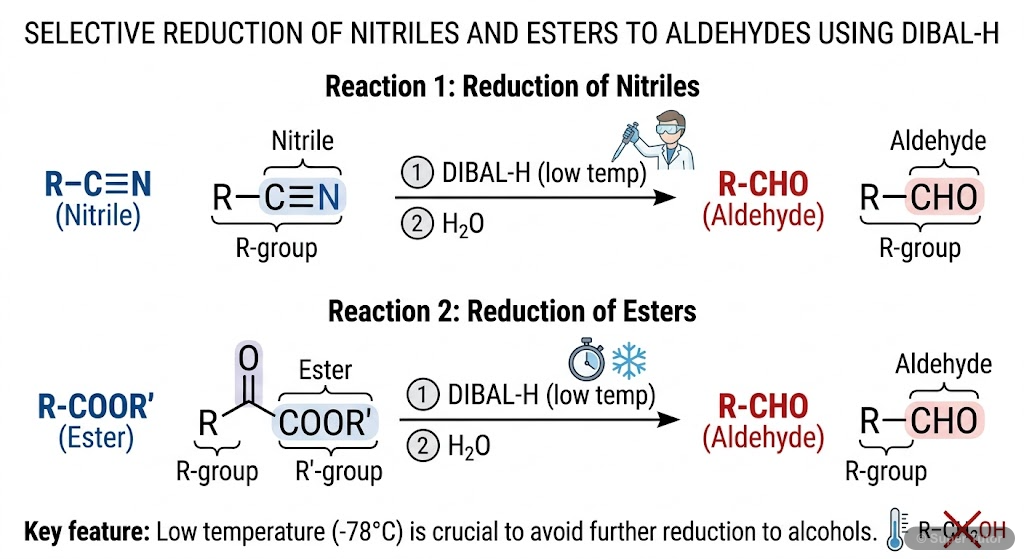
One of 27 illustrations for Aldehydes, Ketones and Carboxylic Acids in Super Tutor — alongside flashcards, concept maps and practice questions.
The first 14 solutions are open to read. The other 13 are free with a Super Tutor account.
Intext Question 8.1
8.1Write the structures of the following compounds.
(i) α-Methoxypropionaldehyde
(ii) 3-Hydroxybutanal
(iii) 2-Hydroxycyclopentane carbaldehyde
(iv) 4-Oxopentanal
(v) Di-sec. butyl ketone
(vi) 4-FluoroacetophenoneShow solution
(i) α-Methoxypropionaldehyde
α-carbon is C-2 of propionaldehyde (propanal). A methoxy (–OCH₃) group is attached at C-2.
Structure: CH₃–CH(OCH₃)–CHO
(ii) 3-Hydroxybutanal
Butanal with –OH at C-3.
Structure: CH₃–CH(OH)–CH₂–CHO
(iii) 2-Hydroxycyclopentane carbaldehyde
A cyclopentane ring with –CHO at C-1 and –OH at C-2.
Structure: Cyclopentane ring with –CHO substituent at C-1 and –OH at C-2 (both on adjacent carbons of the ring).
(iv) 4-Oxopentanal
A five-carbon chain with an aldehyde (–CHO) at C-1 and a keto (=O) group at C-4.
Structure: OHC–CH₂–CH₂–CO–CH₃
(v) Di-sec. butyl ketone
sec-Butyl group = CH₃CH₂CH(CH₃)–
Two sec-butyl groups on either side of the carbonyl.
Structure: (CH₃CH₂CHCH₃)–CO–(CHCH₃CH₂CH₃)
(vi) 4-Fluoroacetophenone
Acetophenone (methyl phenyl ketone) with –F at the para position of the benzene ring.
Structure: p-F–C₆H₄–CO–CH₃
Intext Question 8.2
8.2Write the structures of products of the following reactions (reactions involve figures that cannot be fully reproduced from OCR, but the standard reactions referred to are given below):
(i) Oxidation of a primary alcohol to aldehyde (PCC)
(ii) Ozonolysis of an alkene
(iii) Hydration of an alkyne
(iv) Friedel-Crafts acylationShow solution
Note: The exact reagents/structures in the figures (img_3 to img_6) cannot be read from the OCR. The following are the standard products based on the context of Section 8.2 (Preparation of Aldehydes and Ketones).
(i) PCC oxidation of a primary alcohol → Aldehyde
PCC (Pyridinium chlorochromate) oxidises a primary alcohol to the corresponding aldehyde without further oxidation to carboxylic acid.
(ii) Ozonolysis of an alkene → Aldehydes/Ketones
Ozonolysis followed by Zn/H₂O cleaves the C=C double bond to give carbonyl compounds.
(iii) Hydration of an alkyne → Ketone (Markovnikov addition)
Hydration of a terminal alkyne (except acetylene) in the presence of H₂SO₄/HgSO₄ gives a methyl ketone.
(iv) Friedel-Crafts acylation → Aryl ketone
Benzene reacts with an acyl chloride in the presence of anhydrous AlCl₃ to give an aryl ketone.
Intext Question 8.4
8.4Arrange the following compounds in increasing order of their reactivity in nucleophilic addition reactions.
(i) Ethanal, Propanal, Propanone, Butanone.
(ii) Benzaldehyde, p-Tolualdehyde, p-Nitrobenzaldehyde, Acetophenone.Show solution
Concept: Reactivity in nucleophilic addition depends on:
- Steric effect: More bulky groups around carbonyl carbon → less reactive.
- Electronic effect: Electron-withdrawing groups increase electrophilicity of carbonyl carbon → more reactive. Electron-donating groups decrease electrophilicity → less reactive.
(i) Ethanal, Propanal, Propanone, Butanone
- Ketones (Propanone, Butanone) are less reactive than aldehydes (Ethanal, Propanal) due to two alkyl groups (steric + inductive electron donation).
- Among aldehydes: Ethanal (CH₃CHO) has one methyl group; Propanal (CH₃CH₂CHO) has a larger ethyl group → Propanal is slightly less reactive than Ethanal.
- Among ketones: Butanone has a larger alkyl group than Propanone → Butanone is less reactive.
Increasing order of reactivity:
(ii) Benzaldehyde, p-Tolualdehyde, p-Nitrobenzaldehyde, Acetophenone
- Acetophenone is a ketone → least reactive (steric + electronic).
- p-Tolualdehyde: –CH₃ is electron-donating (EDG) → decreases electrophilicity → less reactive than benzaldehyde.
- Benzaldehyde: no substituent on ring.
- p-Nitrobenzaldehyde: –NO₂ is electron-withdrawing (EWG) → increases electrophilicity of carbonyl carbon → most reactive.
Increasing order of reactivity:
Intext Question 8.5
8.5Predict the products of the following reactions (reactions involve figures; standard nucleophilic addition reactions of aldehydes/ketones are addressed below).Show solution
Note: The exact structures in img_14 cannot be read from OCR. The following covers the standard nucleophilic addition reactions typically asked in this context.
(i) Reaction with HCN (Cyanohydrin formation):
Product: α-hydroxynitrile (cyanohydrin)
(ii) Reaction with NaHSO₃ (Sodium bisulphite addition):
Product: Sodium bisulphite addition compound
(iii) Reaction with NH₂OH (Hydroxylamine → Oxime):
Product: Oxime
(iv) Reaction with RMgX (Grignard reagent) followed by H₃O⁺:
Product: Secondary alcohol
Intext Question 8.6
8.6Give the IUPAC names of the following compounds:
(i) PhCH₂CH₂COOH
(ii) (CH₃)₃C=CHCOOH
(iii) CH₃COOH
(iv) and (v) [structures from figures img_17 and img_18 — cyclic/aromatic carboxylic acids]Show solution
(i) PhCH₂CH₂COOH
Parent chain: 3 carbons with –COOH at C-1, phenyl group at C-3.
IUPAC name: 3-Phenylpropanoic acid
(ii) (CH₃)₃C=CHCOOH
Parent chain: pent-2-enoic acid backbone.
The double bond is between C-2 and C-3; a tert-butyl-like group is present.
Actually: (CH₃)₂C=CHCOOH would be 3-methylbut-2-enoic acid.
For (CH₃)₃C=CHCOOH: The carbon bearing three methyl groups and double bond — this is 3,3-dimethylbut-2-enoic acid.
IUPAC name: 3,3-Dimethylbut-2-enoic acid
(iii) CH₃COOH
Two-carbon carboxylic acid.
IUPAC name: Ethanoic acid (Common name: Acetic acid)
(iv) [Cyclic structure — assumed to be cyclohexane carboxylic acid based on context]
IUPAC name: Cyclohexanecarboxylic acid
(v) [Aromatic structure — assumed to be benzoic acid based on context]
IUPAC name: Benzenecarboxylic acid (Common name: Benzoic acid)
Intext Question 8.7
8.7Show how each of the following compounds can be converted to benzoic acid.
(i) Ethylbenzene
(ii) Acetophenone
(iii) Bromobenzene
(iv) Phenylethene (Styrene)Show solution
(i) Ethylbenzene → Benzoic acid
Ethylbenzene is oxidised by acidic KMnO₄ (or K₂Cr₂O₇/H⁺). The alkyl side chain is oxidised to –COOH regardless of chain length.
(ii) Acetophenone → Benzoic acid
Acetophenone (C₆H₅COCH₃) is oxidised by alkaline KMnO₄ followed by acidification. The –COCH₃ group is oxidised to –COOH.
(iii) Bromobenzene → Benzoic acid
Step 1: Convert bromobenzene to Grignard reagent.
Step 2: React with CO₂ followed by hydrolysis.
(iv) Phenylethene (Styrene) → Benzoic acid
Styrene (C₆H₅CH=CH₂) is oxidised by acidic/alkaline KMnO₄. The vinyl side chain is oxidised to –COOH.
Intext Question 8.8
8.8Which acid of each pair shown here would you expect to be stronger?
(i) CH₃CO₂H or CH₂FCO₂H
(ii) CH₂FCO₂H or CH₂ClCO₂H
(iii) CH₂FCH₂CH₂CO₂H or CH₃CHFCH₂CO₂H
(iv) F₃C–COOH or H₃C–COOHShow solution
Concept: Electron-withdrawing groups (–I effect) stabilise the carboxylate anion (conjugate base) → increase acid strength. The closer and more electronegative the substituent, the stronger the acid.
(i) CH₃CO₂H or CH₂FCO₂H
–F is strongly electron-withdrawing (–I effect), stabilises COO⁻ more than –CH₃ (which is electron-donating).
Stronger acid: CH₂FCO₂H (fluoroacetic acid)
(ii) CH₂FCO₂H or CH₂ClCO₂H
Both F and Cl are electron-withdrawing, but F is more electronegative than Cl → F withdraws electrons more effectively → better stabilisation of carboxylate.
Stronger acid: CH₂FCO₂H (fluoroacetic acid)
(iii) CH₂FCH₂CH₂CO₂H or CH₃CHFCH₂CO₂H
In CH₃CHFCH₂CO₂H, the –F is at C-3 (β-carbon, closer to –COOH) compared to CH₂FCH₂CH₂CO₂H where –F is at C-4 (γ-carbon, farther from –COOH). Closer the EWG to –COOH, stronger the inductive effect.
Stronger acid: CH₃CHFCH₂CO₂H (F at β-position, i.e., 3-fluorobutanoic acid)
(iv) F₃C–COOH or H₃C–COOH
Three fluorine atoms in –CF₃ exert a very strong combined –I effect, greatly stabilising the carboxylate anion.
Stronger acid: F₃C–COOH (trifluoroacetic acid)
Exercises
8.1What is meant by the following terms? Give an example of the reaction in each case.
(i) Cyanohydrin
(ii) Acetal
(iii) Semicarbazone
(iv) Aldol
(v) Hemiacetal
(vi) Oxime
(vii) Ketal
(viii) Imine
(ix) 2,4-DNP-derivative
(x) Schiff's baseShow solution
(i) Cyanohydrin:
A cyanohydrin is a compound containing both a hydroxyl (–OH) and a cyano (–CN) group on the same carbon atom. It is formed by the nucleophilic addition of HCN to an aldehyde or ketone.
(Acetaldehyde cyanohydrin / Lactonitrile)
(ii) Acetal:
An acetal is a compound with two alkoxy (–OR) groups on the same carbon atom. It is formed by the reaction of an aldehyde with two equivalents of a monohydric alcohol in the presence of an acid catalyst.
(Acetaldehyde dimethyl acetal)
(iii) Semicarbazone:
A semicarbazone is formed by the condensation of an aldehyde or ketone with semicarbazide (H₂N–NH–CO–NH₂) in the presence of a weak acid.
(iv) Aldol:
Aldol is a β-hydroxy carbonyl compound (β-hydroxy aldehyde or β-hydroxy ketone) formed by the aldol condensation of aldehydes or ketones having α-hydrogen in the presence of a dilute base or acid.
(3-Hydroxybutanal — the aldol)
(v) Hemiacetal:
A hemiacetal is a compound containing one –OH and one –OR group on the same carbon. It is formed by the addition of one molecule of alcohol to an aldehyde.
(vi) Oxime:
An oxime is formed by the condensation of an aldehyde or ketone with hydroxylamine (NH₂OH) in the presence of a weak acid.
(Acetaldoxime)
(vii) Ketal:
A ketal is a compound with two alkoxy (–OR) groups on the same carbon derived from a ketone (analogous to acetal from aldehyde). It is formed by the reaction of a ketone with a diol or two equivalents of alcohol in the presence of an acid catalyst.
(viii) Imine:
An imine (Schiff's base) is a compound containing a C=N– bond. It is formed by the condensation of an aldehyde or ketone with a primary amine.
(ix) 2,4-DNP derivative:
The 2,4-dinitrophenylhydrazone is formed by the reaction of an aldehyde or ketone with 2,4-dinitrophenylhydrazine (Brady's reagent). It gives a yellow/orange/red precipitate and is used to identify carbonyl compounds.
(x) Schiff's base:
Schiff's base is an imine (R–CH=N–R') formed by the condensation of an aldehyde with a primary amine. (Same as imine above.)
(Benzylideneaniline)
8.2Name the following compounds according to IUPAC system of nomenclature:
(i) CH₃CH(CH₃)CH₂CH₂CHO
(ii) CH₃CH₂COCH(C₂H₅)CH₂CH₂Cl
(iii) CH₃CH=CHCHO
(iv) CH₃COCH₂COCH₃
(v) CH₃CH(CH₃)CH₂C(CH₃)₂COCH₃
(vi) (CH₃)₄CCH₂COOH
(vii) OHCC₆H₄CHO-pShow solution
(i) CH₃CH(CH₃)CH₂CH₂CHO
Longest chain containing –CHO: 5 carbons → pentanal.
Methyl branch at C-4 (numbering from –CHO end).
IUPAC name: 4-Methylpentanal
(ii) CH₃CH₂COCH(C₂H₅)CH₂CH₂Cl
Longest chain containing C=O: number to give lowest locant to ketone.
Chain: CH₃CH₂–CO–CH(C₂H₅)–CH₂–CH₂Cl
Count: C1(CH₃)–C2(CH₂)–C3(CO)–C4(CH)–C5(CH₂)–C6(CH₂Cl) → hexan-3-one
Substituents: ethyl at C-4, chloro at C-6.
IUPAC name: 6-Chloro-4-ethylhexan-3-one
(iii) CH₃CH=CHCHO
Four-carbon chain with –CHO at C-1 and double bond between C-2 and C-3.
IUPAC name: But-2-enal
(iv) CH₃COCH₂COCH₃
Five-carbon chain with two keto groups at C-2 and C-4.
IUPAC name: Pentane-2,4-dione
(v) CH₃CH(CH₃)CH₂C(CH₃)₂COCH₃
Longest chain containing C=O:
CH₃–CO–C(CH₃)₂–CH₂–CH(CH₃)–CH₃
Numbering from ketone end: C1(CH₃)–C2(CO)–C3(C(CH₃)₂)–C4(CH₂)–C5(CH(CH₃))–C6(CH₃)
This gives hexan-2-one with 3,3-dimethyl and 5-methyl substituents.
IUPAC name: 2,2,4-Trimethylhexan-5-one
(Alternatively numbered: 3,3,5-trimethylhexan-2-one — numbering from the methyl end gives lower locants to substituents: C1(CH₃)–C2(CO)–C3(C(CH₃)₂)–C4(CH₂)–C5(CH(CH₃))–C6(CH₃) → 3,3,5-trimethylhexan-2-one)
IUPAC name: 3,3,5-Trimethylhexan-2-one
(vi) (CH₃)₄CCH₂COOH
Parent chain: 3 carbons → propanoic acid (–COOH at C-1, –CH₂– at C-2, C(CH₃)₃ at C-3).
Substituent: tert-butyl [C(CH₃)₃] at C-3? Actually the longest chain through –COOH:
COOH–CH₂–C(CH₃)₃: 3 carbons in main chain = propanoic acid; C(CH₃)₃ at C-3 means three methyl groups at C-3.
IUPAC name: 3,3-Dimethylbutanoic acid
(Main chain: COOH–CH₂–C(CH₃)₂–CH₃ = 4 carbons = butanoic acid; two methyls at C-3)
(vii) OHC–C₆H₄–CHO (para)
Benzene-1,4-dicarbaldehyde.
IUPAC name: Benzene-1,4-dicarbaldehyde
8.3Draw the structures of the following compounds.
(i) 3-Methylbutanal
(ii) p-Nitropropiophenone
(iii) p-Methylbenzaldehyde
(iv) 4-Methylpent-3-en-2-one
(v) 4-Chloropentan-2-one
(vi) 3-Bromo-4-phenylpentanoic acid
(vii) p,p'-Dihydroxybenzophenone
(viii) Hex-2-en-4-ynoic acidShow solution
(i) 3-Methylbutanal
(CH₃)₂CHCH₂CHO
(ii) p-Nitropropiophenone
Propiophenone = C₆H₅–CO–CH₂CH₃; nitro group at para position.
(iii) p-Methylbenzaldehyde
(iv) 4-Methylpent-3-en-2-one
C1(CH₃)–C2(CO)–C3(=CH)–C4(C(CH₃)=)–C5(CH₃)
(v) 4-Chloropentan-2-one
CH₃COCH₂CHClCH₃
(vi) 3-Bromo-4-phenylpentanoic acid
C1(COOH)–C2(CH₂)–C3(CHBr)–C4(CH(C₆H₅))–C5(CH₃)
(vii) p,p'-Dihydroxybenzophenone
Benzophenone with –OH at para position of each phenyl ring.
(viii) Hex-2-en-4-ynoic acid
C1(COOH)–C2(=CH)–C3(CH=)–C4(C≡)–C5(≡C)–C6(CH₃)
8.4Write the IUPAC names of the following ketones and aldehydes. Wherever possible, give also common names.
(i) CH₃CO(CH₂)₄CH₃
(ii) CH₃CH₂CHBrCH₂CH(CH₃)CHO
(iii) CH₃(CH₂)₅CHO
(iv) Ph–CH=CH–CHO
(v) [cyclopentanone structure from figure]
(vi) PhCOPhShow solution
(i) CH₃CO(CH₂)₄CH₃
Longest chain: C1(CH₃)–C2(CO)–C3(CH₂)–C4(CH₂)–C5(CH₂)–C6(CH₂)–C7(CH₃) = heptan-2-one
IUPAC name: Heptan-2-one
Common name: Methyl n-amyl ketone
(ii) CH₃CH₂CHBrCH₂CH(CH₃)CHO
Longest chain containing –CHO: 6 carbons.
C1(CHO)–C2(CH(CH₃))–C3(CH₂)–C4(CHBr)–C5(CH₂)–C6(CH₃)
IUPAC name: 4-Bromo-2-methylhexanal
(iii) CH₃(CH₂)₅CHO
Seven-carbon chain with –CHO at C-1.
IUPAC name: Heptanal
Common name: Heptaldehyde (Enanthaldehyde)
(iv) Ph–CH=CH–CHO
Three-carbon chain with –CHO at C-1, double bond at C-2, phenyl at C-3.
IUPAC name: 3-Phenylprop-2-enal
Common name: Cinnamaldehyde
(v) [Cyclopentanone — figure not readable; assumed cyclopentanone]
IUPAC name: Cyclopentanone
Common name: Cyclopentanone
(vi) PhCOPh
Two phenyl groups on either side of carbonyl.
IUPAC name: Diphenylmethanone
Common name: Benzophenone
8.5Draw structures of the following derivatives.
(i) The 2,4-dinitrophenylhydrazone of benzaldehyde
(ii) Cyclopropanone oxime
(iii) Acetaldehyde dimethyl acetal
(iv) The semicarbazone of cyclobutanone
(v) The ethylene ketal of hexan-3-one
(vi) The methyl hemiacetal of formaldehydeShow solution
(i) 2,4-Dinitrophenylhydrazone of benzaldehyde:
Benzaldehyde reacts with 2,4-dinitrophenylhydrazine:
(C₆H₅–CH=N–NH–C₆H₃(NO₂)₂ where NO₂ groups are at 2 and 4 positions of the phenyl ring)
(ii) Cyclopropanone oxime:
Cyclopropanone reacts with NH₂OH:
Cyclopropane ring with =NOH replacing =O.
(Three-membered ring with C=N–OH at the carbonyl carbon)
(iii) Acetaldehyde dimethyl acetal:
CH₃CHO + 2CH₃OH → CH₃CH(OCH₃)₂ + H₂O
(iv) Semicarbazone of cyclobutanone:
Cyclobutanone reacts with semicarbazide (H₂NNHCONH₂):
Cyclobutane ring with C=N–NH–CO–NH₂ replacing C=O.
(v) Ethylene ketal of hexan-3-one:
Hexan-3-one (CH₃CH₂COCH₂CH₂CH₃) reacts with ethylene glycol (HOCH₂CH₂OH) in the presence of acid:
The C=O is replaced by a 1,3-dioxolane ring.
where the two oxygens are bridged by –CH₂CH₂– (five-membered 1,3-dioxolane ring at C-3 of hexane).
(vi) Methyl hemiacetal of formaldehyde:
HCHO + CH₃OH → HOCH₂OCH₃
(Hydroxymethyl methyl ether)
8.6Predict the products formed when cyclohexanecarbaldehyde reacts with following reagents.
(i) PhMgBr and then H₃O⁺
(ii) Tollens' reagent
(iii) Semicarbazide and weak acid
(iv) Excess ethanol and acid
(v) Zinc amalgam and dilute hydrochloric acidShow solution
Cyclohexanecarbaldehyde = Cyclohexane ring with –CHO substituent.
(i) PhMgBr and then H₃O⁺ (Grignard reaction):
The Grignard reagent (PhMgBr) acts as a nucleophile and adds to the carbonyl carbon of –CHO. After hydrolysis with H₃O⁺, a secondary alcohol is formed.
Product: Cyclohexyl(phenyl)methanol — a secondary alcohol.
(ii) Tollens' reagent (ammoniacal AgNO₃):
Aldehydes are oxidised by Tollens' reagent to carboxylic acids (as ammonium salt); silver mirror is deposited.
Product: Cyclohexanecarboxylic acid (ammonium salt) + silver mirror.
(iii) Semicarbazide and weak acid:
Condensation reaction gives semicarbazone.
Product: Cyclohexanecarbaldehyde semicarbazone.
(iv) Excess ethanol and acid (Acetal formation):
Aldehyde reacts with two equivalents of ethanol in the presence of dry HCl to form an acetal.
Product: Cyclohexanecarbaldehyde diethyl acetal.
(v) Zinc amalgam and dilute HCl (Clemmensen reduction):
The carbonyl group (–CHO) is reduced to –CH₃ (methylene/methyl group).
Product: Methylcyclohexane.
8.7Which of the following compounds would undergo aldol condensation, which the Cannizzaro reaction and which neither? Write the structures of the expected products of aldol condensation and Cannizzaro reaction.
(i) Methanal
(ii) 2-Methylpentanal
(iii) Benzaldehyde
(iv) Benzophenone
(v) Cyclohexanone
(vi) 1-Phenylpropanone
(vii) Phenylacetaldehyde
(viii) Butan-1-ol
(ix) 2,2-DimethylbutanalShow solution
Key rules:
- Aldol condensation: Requires at least one α-hydrogen (in aldehyde or ketone).
- Cannizzaro reaction: Aldehydes with NO α-hydrogen undergo disproportionation in conc. NaOH.
- Neither: Ketones without α-H, or alcohols.
(i) Methanal (HCHO):
No α-hydrogen → Cannizzaro reaction
(Methanol + Sodium formate)
(ii) 2-Methylpentanal (CH₃CH₂CH₂CH(CH₃)CHO):
Has α-hydrogen (at C-2) → Aldol condensation
(β-hydroxy aldehyde product)
(iii) Benzaldehyde (C₆H₅CHO):
No α-hydrogen → Cannizzaro reaction
(Benzyl alcohol + Sodium benzoate)
(iv) Benzophenone (C₆H₅COC₆H₅):
Ketone with no α-hydrogen → Neither (Cannizzaro requires aldehyde; no α-H so no aldol)
(v) Cyclohexanone:
Has α-hydrogen → Aldol condensation
(β-hydroxy ketone — the ketol product)
(vi) 1-Phenylpropanone (C₆H₅COCH₂CH₃):
Has α-hydrogen (–CH₂– adjacent to C=O) → Aldol condensation
(β-hydroxy ketone)
(vii) Phenylacetaldehyde (C₆H₅CH₂CHO):
Has α-hydrogen (–CH₂– at α-position) → Aldol condensation
(β-hydroxy aldehyde)
(viii) Butan-1-ol:
Not an aldehyde or ketone → Neither
(ix) 2,2-Dimethylbutanal (CH₃CH₂C(CH₃)₂CHO):
No α-hydrogen (the α-carbon C-2 bears two methyl groups and an ethyl group — all four positions occupied, no H at α-carbon) → Cannizzaro reaction
(i) Butane-1,3-diol
(ii) But-2-enal
(iii) But-2-enoic acid
Free with a Super Tutor account
Free with a Super Tutor account
Free with a Super Tutor account
Free with a Super Tutor account
(i) Acetaldehyde, Acetone, Di-tert-butyl ketone, Methyl tert-butyl ketone (reactivity towards HCN)
(ii) CH₃CH₂CH(Br)COOH, CH₃CH(Br)CH₂COOH, (CH₃)₂CHCOOH, CH₃CH₂CH₂COOH (acid strength)
(iii) Benzoic acid, 4-Nitrobenzoic acid, 3,4-Dinitrobenzoic acid, 4-Methoxybenzoic acid (acid strength)
Free with a Super Tutor account
(i) Propanal and Propanone
(ii) Acetophenone and Benzophenone
(iii) Phenol and Benzoic acid
(iv) Benzoic acid and Ethyl benzoate
(v) Pentan-2-one and Pentan-3-one
(vi) Benzaldehyde and Acetophenone
(vii) Ethanal and Propanal
Free with a Super Tutor account
(i) Methyl benzoate
(ii) m-Nitrobenzoic acid
(iii) p-Nitrobenzoic acid
(iv) Phenylacetic acid
(v) p-Nitrobenzaldehyde
Free with a Super Tutor account
(i) Propanone to Propene
(ii) Benzoic acid to Benzaldehyde
(iii) Ethanol to 3-Hydroxybutanal
(iv) Benzene to m-Nitroacetophenone
(v) Benzaldehyde to Benzophenone
(vi) Bromobenzene to 1-Phenylethanol
(vii) Benzaldehyde to 3-Phenylpropan-1-ol
(viii) Benzaldehyde to α-Hydroxyphenylacetic acid
(ix) Benzoic acid to m-Nitrobenzyl alcohol
Free with a Super Tutor account
(i) Acetylation
(ii) Cannizzaro reaction
(iii) Cross aldol condensation
(iv) Decarboxylation
Free with a Super Tutor account
(i) [figure] → ?
(ii) C₆H₅CHO + H₂NCONHNH₂ → ?
(iii) C₆H₅CHO + H₂NCONHNH₂ → ?
(iv) [figure]
(v) C₆H₅CHO → (dil. NaOH) → (NaCN/HCl) → ?
(vi) CH₃CH₂COO⁻ → (Δ) → (i) NaBH₄, (ii) H⁺ → ?
(vii) C₆H₅CH → CH₃CH₂CHO
(ix) OH → (CrO₃) → ?
(x) CH₂ → CHO
(xi) (i) O₃, (ii) Zn·H₂O → 2 O=O
Free with a Super Tutor account
(i) Cyclohexanone forms cyanohydrin in good yield but 2,2,6-trimethylcyclohexanone does not.
(ii) There are two –NH₂ groups in semicarbazide. However, only one is involved in the formation of semicarbazones.
(iii) During the preparation of esters from a carboxylic acid and an alcohol in the presence of an acid catalyst, the water or the ester should be removed as soon as it is formed.
Free with a Super Tutor account
Free with a Super Tutor account
Free with a Super Tutor account
13 more solved questions in Aldehydes, Ketones and Carboxylic Acids
They are free with a Super Tutor account, along with practice quizzes and flashcards for this chapter. Free to start, no card needed.
Frequently Asked Questions
What are the important topics in Aldehydes, Ketones and Carboxylic Acids for Madhya Pradesh Board Class 12 Chemistry?
Are these NCERT Solutions for Aldehydes, Ketones and Carboxylic Acids free?
How should I revise Aldehydes, Ketones and Carboxylic Acids for the Madhya Pradesh Board Class 12 board exam?
Sources & Official References
Content is aligned to the official syllabus. Refer to the board website for the latest curriculum.
More resources for Aldehydes, Ketones and Carboxylic Acids
Practice Quiz
Test yourself with a quick quiz
Important Questions
Exam-style questions with answers
Revision Notes
Key points for last-minute revision
Formula Sheet
The chapter's formulas in one place
Chapter Summary
Understand the chapter at a glance
Concept Maps
See how topics connect
Study Plan
Step-by-step plan for this chapter
Flashcards
Quick-fire cards for active recall
Syllabus
What topics to cover
For serious students
Get the full Aldehydes, Ketones and Carboxylic Acids chapter — start free.
Quizzes, flashcards, an AI doubt solver and a study plan for Madhya Pradesh Board Class 12 Chemistry. Free to start, no card needed.