The d-and f-Block Elements — Syllabus
Madhya Pradesh Board · Class 12 · Chemistry
What The d-and f-Block Elements covers in Madhya Pradesh Board Class 12 Chemistry: 4 topics, for the 2026-27 session.
Interactive on Super Tutor
Studying The d-and f-Block Elements? Get the full interactive chapter.
Quizzes, flashcards, AI doubt-solver and a step-by-step study plan — built for syllabus and more.
Free trial, no card needed.
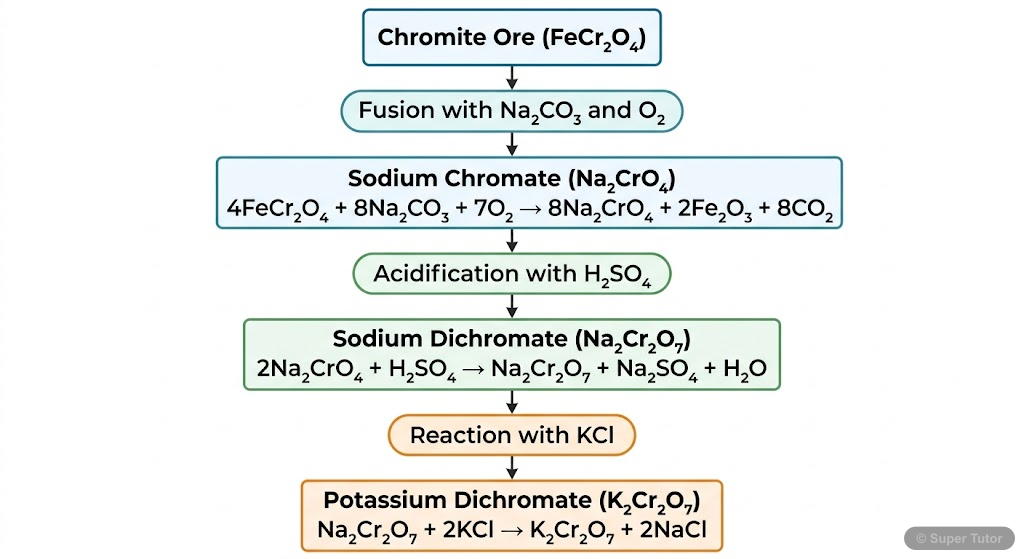
One of 16 illustrations for The d-and f-Block Elements in Super Tutor — alongside flashcards, concept maps and practice questions.
Topics in The d-and f-Block Elements
Position, Series and Electronic Configurations
- The d-block consists of groups 3 to 12 and forms the middle block of the periodic table.
- There are four transition series: 3d from Sc to Zn, 4d from Y to Cd, 5d from La and Hf to Hg, and 6d from Ac and Rf to Cn.
- The f-block contains the 4f series, called lanthanoids, from Ce to Lu, and the 5f series, called actinoids, from Th to Lr.
Atomic Size, Density and Lanthanoid Contraction
- Atomic and ionic radii decrease gradually across a transition series because nuclear charge increases while d-electron shielding is poor.
- Transition-metal ions of the same charge show progressive decrease in radius with increasing atomic number.
- Atomic radii increase from the first to the second transition series.
Ionisation Enthalpy, Exchange Energy and Magnetic Moment
- Ionisation enthalpy generally increases from left to right in a transition series, but the increase is less steep than in main-group elements.
- Successive ionisation enthalpies rise, but irregularities appear because of electronic stability factors.
- Exchange energy is approximately proportional to the total number of possible pairs of parallel spins in degenerate orbitals.
Oxidation States and Redox Behaviour
- Transition elements show a wide variety of oxidation states because both ns and (n-1)d electrons can take part in bonding.
- Oxidation states of transition elements often differ by unity.
- The greatest number of oxidation states is found near the middle of the series, especially manganese.
Key Concepts
Central concept: d-and f-Block Elements
Work through every topic in The d-and f-Block Elements with notes and quizzes
Start This ChapterFrequently Asked Questions
What are the important topics in The d-and f-Block Elements for Madhya Pradesh Board Class 12 Chemistry?
How should I revise The d-and f-Block Elements for the Madhya Pradesh Board Class 12 board exam?
Sources & Official References
Content is aligned to the official syllabus. Refer to the board website for the latest curriculum.
More resources for The d-and f-Block Elements
Practice Quiz
Test yourself with a quick quiz
Important Questions
Exam-style questions with answers
Revision Notes
Key points for last-minute revision
Chapter Summary
Understand the chapter at a glance
Concept Maps
See how topics connect
Study Plan
Step-by-step plan for this chapter
Flashcards
Quick-fire cards for active recall
NCERT Solutions
Every textbook question solved step by step
For serious students
Get the full The d-and f-Block Elements chapter — start free.
Quizzes, flashcards, an AI doubt solver and a study plan for Madhya Pradesh Board Class 12 Chemistry. Free to start, no card needed.