The d-and f-Block Elements — Revision Notes
Madhya Pradesh Board · Class 12 · Chemistry
The d-and f-Block Elements revision notes for Madhya Pradesh Board Class 12 Chemistry: 4 topics in quick points.
Interactive on Super Tutor
Studying The d-and f-Block Elements? Get the full interactive chapter.
Quizzes, flashcards, AI doubt-solver and a step-by-step study plan — built for revision notes and more.
Free trial, no card needed.
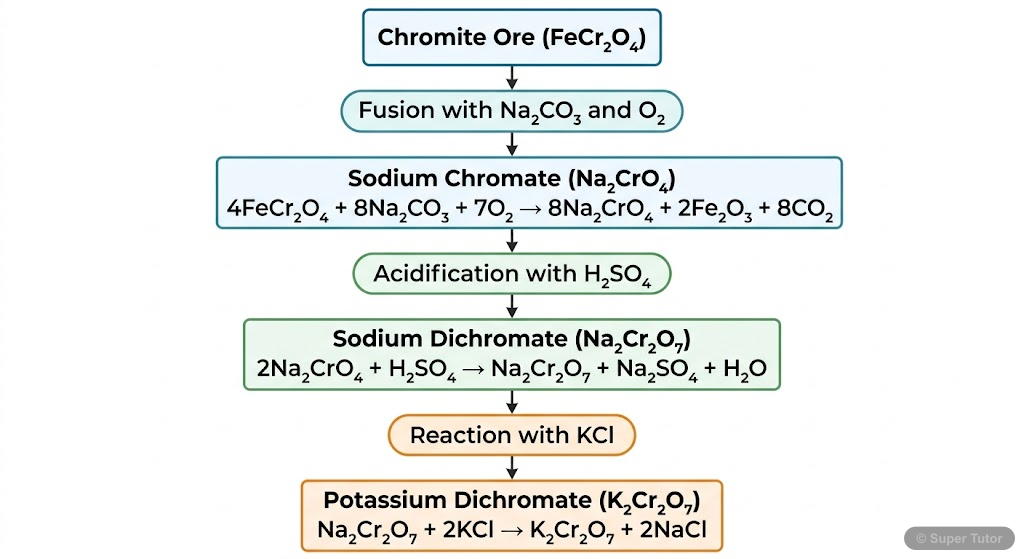
One of 16 illustrations for The d-and f-Block Elements in Super Tutor — alongside flashcards, concept maps and practice questions.
Key Topics to Revise
Position, Series and Electronic Configurations
- The d-block consists of groups 3 to 12 and forms the middle block of the periodic table.
- There are four transition series: 3d from Sc to Zn, 4d from Y to Cd, 5d from La and Hf to Hg, and 6d from Ac and Rf to Cn.
- The f-block contains the 4f series, called lanthanoids, from Ce to Lu, and the 5f series, called actinoids, from Th to Lr.
Atomic Size, Density and Lanthanoid Contraction
- Atomic and ionic radii decrease gradually across a transition series because nuclear charge increases while d-electron shielding is poor.
- Transition-metal ions of the same charge show progressive decrease in radius with increasing atomic number.
- Atomic radii increase from the first to the second transition series.
Ionisation Enthalpy, Exchange Energy and Magnetic Moment
- Ionisation enthalpy generally increases from left to right in a transition series, but the increase is less steep than in main-group elements.
- Successive ionisation enthalpies rise, but irregularities appear because of electronic stability factors.
- Exchange energy is approximately proportional to the total number of possible pairs of parallel spins in degenerate orbitals.
Oxidation States and Redox Behaviour
- Transition elements show a wide variety of oxidation states because both ns and (n-1)d electrons can take part in bonding.
- Oxidation states of transition elements often differ by unity.
- The greatest number of oxidation states is found near the middle of the series, especially manganese.
Get complete notes with diagrams and examples
Full NotesKey Concepts
Frequently Asked Questions
What are the important topics in The d-and f-Block Elements for Madhya Pradesh Board Class 12 Chemistry?
How should I revise The d-and f-Block Elements for the Madhya Pradesh Board Class 12 board exam?
Sources & Official References
Content is aligned to the official syllabus. Refer to the board website for the latest curriculum.
More resources for The d-and f-Block Elements
Practice Quiz
Test yourself with a quick quiz
Important Questions
Exam-style questions with answers
Chapter Summary
Understand the chapter at a glance
Concept Maps
See how topics connect
Study Plan
Step-by-step plan for this chapter
Flashcards
Quick-fire cards for active recall
Syllabus
What topics to cover
NCERT Solutions
Every textbook question solved step by step
For serious students
Get the full The d-and f-Block Elements chapter — start free.
Quizzes, flashcards, an AI doubt solver and a study plan for Madhya Pradesh Board Class 12 Chemistry. Free to start, no card needed.