The d-and f-Block Elements — NCERT Solutions
Madhya Pradesh Board · Class 12 · Chemistry
NCERT Solutions for The d-and f-Block Elements, Madhya Pradesh Board Class 12 Chemistry: 47 textbook questions solved step by step.
Interactive on Super Tutor
Studying The d-and f-Block Elements? Get the full interactive chapter.
Quizzes, flashcards, AI doubt-solver and a step-by-step study plan — built for NCERT solutions and more.
Free trial, no card needed.
One of 16 illustrations for The d-and f-Block Elements in Super Tutor — alongside flashcards, concept maps and practice questions.
The first 24 solutions are open to read. The other 23 are free with a Super Tutor account.
Intext Questions
4.1Silver atom has completely filled orbitals () in its ground state. How can you say that it is a transition element?Show solution
Given: Silver (Ag, Z = 47) has ground state electronic configuration [Kr] .
Concept: A transition element is defined as one which has an incompletely filled orbital in its ground state OR in any of its commonly occurring oxidation states.
Working:
Although Ag has completely filled orbitals in its ground state, it can exhibit a +2 oxidation state (Ag²⁺). In the +2 state, the electronic configuration becomes [Kr] , which has an incompletely filled orbital.
Conclusion: Since Ag can exist in the +2 oxidation state with an incompletely filled subshell, it qualifies as a transition element.
4.2In the series Sc () to Zn (), the enthalpy of atomisation of zinc is the lowest, i.e., . Why?Show solution
Given: Zn has the lowest enthalpy of atomisation (126 kJ mol⁻¹) in the 3d series.
Concept: Enthalpy of atomisation depends on the strength of metallic bonding, which in turn depends on the number of electrons available for metallic bonding (including electrons).
Explanation:
Zinc has the electronic configuration [Ar] . Its orbitals are completely filled. Therefore, no electrons from the orbitals are available for metallic bonding — only the two electrons participate.
In all other metals of the 3d series (Sc to Cu), electrons from the orbitals are also involved in metallic bonding, resulting in stronger interatomic interactions and higher enthalpies of atomisation.
Conclusion: Since Zn uses only electrons for metallic bonding (no electron involvement), its interatomic interaction is the weakest, giving it the lowest enthalpy of atomisation.
4.3Which of the 3d series of the transition metals exhibits the largest number of oxidation states and why?Show solution
Answer: Manganese (Mn, Z = 25) exhibits the largest number of oxidation states.
Electronic configuration of Mn: [Ar]
Reason:
Manganese has the maximum number of unpaired electrons in its atom (five unpaired electrons + two electrons = 7 electrons available for bonding). It can therefore lose electrons ranging from 1 to 7, giving oxidation states from +1 to +7 (i.e., +2, +3, +4, +5, +6, +7 are all known).
The elements at the beginning of the series (Sc, Ti) have too few electrons to show many oxidation states, while elements at the end (Cu, Zn) have too many filled electrons. Mn, being near the middle with a half-filled configuration, can exhibit the widest range of oxidation states.
4.4The value for copper is positive (+0.34 V). What is the possible reason for this? (Hint: consider its high and low )Show solution
Given: (positive value).
Concept: The standard electrode potential for depends on:
- Enthalpy of atomisation () — energy required to convert solid metal to gaseous atoms.
- Sum of first and second ionisation enthalpies () — energy to form .
- Hydration enthalpy () — energy released when is hydrated.
Explanation:
Copper has a high enthalpy of atomisation and relatively high sum of ionisation enthalpies. The energy required to transform Cu(s) to Cu²⁺(aq) is very large. This large energy input is NOT sufficiently compensated by the hydration enthalpy of Cu²⁺, which is comparatively less negative (low ).
As a result, the overall process is energetically unfavourable, making positive.
Consequence: A positive means Cu cannot liberate from dilute acids; only oxidising acids (like or hot conc. ) react with Cu.
4.5How would you account for the irregular variation of ionisation enthalpies (first and second) in the first series of the transition elements?Show solution
Concept: Ionisation enthalpy depends on nuclear charge, atomic radius, and the stability of the electronic configuration.
Explanation of irregular variation:
- General trend: As we move from Sc to Zn, nuclear charge increases, so ionisation enthalpies generally increase. However, the increase is not regular.
- Shielding by 3d electrons: As electrons are added to the inner orbitals, they shield the outer electrons from the increasing nuclear charge more effectively than outer electrons shield each other. This reduces the rate of increase of ionisation enthalpy.
- Stability of specific configurations: Certain -configurations are exceptionally stable:
- (empty), (half-filled), (completely filled) configurations have extra stability.
- For example, Mn has configuration. Its first ionisation enthalpy is higher than expected because removing an electron disturbs the stable half-filled arrangement.
- Similarly, Zn ( ) has a higher ionisation enthalpy due to the stability of completely filled orbitals.
- Second ionisation enthalpy: The second ionisation enthalpy shows a break at Mn²⁺ (d⁵) and Fe³⁺ (d⁵) because these ions have extra stable half-filled configurations, making removal of the next electron more difficult.
Conclusion: The irregular variation is mainly due to the varying degree of stability of different configurations (, , , are exceptionally stable), which affects the ease of electron removal.
4.6Why is the highest oxidation state of a metal exhibited in its oxide or fluoride only?Show solution
Concept: The ability of a non-metal to oxidise the transition metal to its highest oxidation state depends on the electronegativity and size of the non-metal.
Explanation:
Oxygen and fluorine are the two most electronegative elements with very small atomic sizes. Due to these properties:
- High electronegativity: Both O and F can attract electrons strongly from the metal, thereby oxidising it to its highest possible oxidation state.
- Small size: Their small size allows them to accommodate around the metal ion and form stable compounds even with metals in very high oxidation states.
- Multiple bonding (for oxygen): Oxygen can form multiple bonds (double bonds) with metals (e.g., in , ), which further stabilises the high oxidation state. This ability exceeds that of fluorine.
Example: The highest Mn fluoride is (Mn in +4 state), whereas the highest oxide is (Mn in +7 state).
Conclusion: Because of their small size and high electronegativity, oxygen and fluorine can oxidise metals to their highest oxidation states, which other non-metals cannot achieve.
4.7Which is a stronger reducing agent or and why?Show solution
Answer: is a stronger reducing agent than .
Electronic configurations:
- : [Ar] — oxidised to : [Ar]
- : [Ar] — oxidised to : [Ar]
Reason:
When is oxidised to , the configuration changes from to . The configuration has a half-filled level (in octahedral field), which is particularly stable. This extra stability of the product () drives the oxidation of readily, making it a strong reducing agent.
In contrast, when () is oxidised to (), the product has a half-filled configuration which is stable, but the driving force is less compared to because (half-filled ) provides greater crystal field stabilisation energy.
Conclusion: is a stronger reducing agent because its oxidation to () is more favourable than the oxidation of to ().
4.8Calculate the 'spin only' magnetic moment of ion ().Show solution
Given: is Cobalt (Co). The ion is .
Step 1: Electronic configuration of Co (Z = 27):
Step 2: Electronic configuration of Co²⁺:
Remove 2 electrons from first:
Step 3: Find number of unpaired electrons in :
Filling orbitals using Hund's rule:
Number of unpaired electrons,
Step 4: Apply spin-only formula:
4.10Actinoid contraction is greater from element to element than lanthanoid contraction. Why?Show solution
Concept: Lanthanoid contraction and actinoid contraction both arise due to imperfect shielding of one electron by another in the same subshell ( and respectively).
Explanation:
- In lanthanoids, electrons are added successively. The orbitals are deeply buried inside the atom and are well shielded by the outer electrons. However, electrons themselves provide poor shielding to each other from the nuclear charge.
- In actinoids, electrons are added. The orbitals are more diffuse (larger and more extended in space) compared to orbitals. As a result, electrons are even less effective at shielding each other from the nuclear charge than electrons.
- Because of poorer shielding by electrons, the effective nuclear charge experienced by the outer electrons increases more sharply from one actinoid to the next compared to lanthanoids.
Conclusion: Since electrons provide poorer shielding than electrons, the increase in effective nuclear charge per element is greater in actinoids, leading to a greater contraction in atomic/ionic size from element to element in the actinoid series compared to the lanthanoid series.
Exercises
4.1Write down the electronic configuration of: (i) (ii) (iii) (iv) (v) (vi) (vii) (viii) Show solution
Method: Write the ground state configuration of the neutral atom, then remove electrons starting from the outermost shell ( before ; before for lanthanoids/actinoids).
(i) (Z = 24):
Neutral Cr: [Ar]
Remove 3 electrons (1 from , 2 from ):
(ii) (Z = 61):
Neutral Pm: [Xe]
Remove 3 electrons (2 from , 1 from ):
(iii) (Z = 29):
Neutral Cu: [Ar]
Remove 1 electron (from ):
(iv) (Z = 58):
Neutral Ce: [Xe]
Remove 4 electrons (2 from , 1 from , 1 from ):
(i.e., same as Xenon core — no electrons)
(v) (Z = 27):
Neutral Co: [Ar]
Remove 2 electrons (from ):
(vi) (Z = 71):
Neutral Lu: [Xe]
Remove 2 electrons (from ):
(vii) (Z = 25):
Neutral Mn: [Ar]
Remove 2 electrons (from ):
(viii) (Z = 90):
Neutral Th: [Rn]
Remove 4 electrons (2 from , 2 from ):
(same as Radon core — no or electrons)
4.2Why are compounds more stable than towards oxidation to their +3 state?Show solution
Electronic configurations:
- : [Ar] (half-filled subshell)
- : [Ar]
Explanation:
has a configuration, which is a half-filled subshell. Half-filled subshells have extra stability due to:
- Symmetrical distribution of electrons
- Maximum exchange energy
To oxidise to , one electron must be removed from this stable half-filled configuration, giving . This requires a large amount of energy, making the oxidation difficult.
In contrast, has configuration. Oxidation to gives (half-filled, extra stable). The product is more stable than the reactant , so the oxidation is thermodynamically favourable.
Conclusion: (with stable ) resists oxidation, while is readily oxidised to (stable ). Hence compounds are more stable than towards oxidation.
4.3Explain briefly how +2 state becomes more and more stable in the first half of the first row transition elements with increasing atomic number?Show solution
Elements considered: Sc (Z=21) to Mn (Z=25) — first half of 3d series.
Electronic configurations of M²⁺ ions:
| Element | M²⁺ configuration |
|---|---|
| Sc²⁺ | [Ar] |
| Ti²⁺ | [Ar] |
| V²⁺ | [Ar] |
| Cr²⁺ | [Ar] |
| Mn²⁺ | [Ar] |
Explanation:
As we move from Sc to Mn, the number of electrons in the M²⁺ ion increases from to . The configuration (half-filled) of Mn²⁺ is exceptionally stable due to symmetrical electron distribution and maximum exchange energy.
The successive M²⁺ ions become progressively more stable because:
- Nuclear charge increases, holding the electrons more firmly.
- The electron count increases towards the stable half-filled configuration.
- The third ionisation enthalpy (required to go from +2 to +3 state) increases across the series, making it harder to oxidise M²⁺ further.
Conclusion: The +2 state becomes increasingly stable from Sc to Mn because the configuration of M²⁺ becomes progressively more stable, culminating in the extra-stable half-filled of Mn²⁺.
4.4To what extent do the electronic configurations decide the stability of oxidation states in the first series of the transition elements? Illustrate your answer with examples.Show solution
Concept: The stability of an oxidation state is strongly influenced by the electronic configuration of the resulting ion, particularly the stability of , , and configurations.
Key configurations and their stability:
- configuration (empty subshell): Very stable. Example: ([Ar] ) — Sc almost exclusively shows +3 state.
- configuration (half-filled subshell): Extra stable due to maximum exchange energy and symmetrical distribution. Examples:
- ([Ar] ) — very stable; compounds resist oxidation to .
- ([Ar] ) — stable; is readily oxidised to .
- configuration (completely filled subshell): Extra stable. Example: ([Ar] ) — Cu⁺ is stable in solid state (e.g., , ); ([Ar] ) — Zn exclusively shows +2 state.
- configuration: Relatively stable (half-filled in octahedral field). Example: ([Ar] ) — very stable; Cr³⁺ is the most common and stable state of chromium.
Limitations: Electronic configuration alone does not fully determine stability. Other factors like hydration enthalpy, lattice energy, and ionisation enthalpy also play important roles. For example, is more stable in aqueous solution than despite having the stable configuration, because the much higher hydration enthalpy of compensates for the higher ionisation energy.
Conclusion: Electronic configurations play a major but not exclusive role in deciding the stability of oxidation states.
4.5What may be the stable oxidation state of the transition element with the following electron configurations in the ground state of their atoms: , , and ?Show solution
Method: The ground state configuration of the atom includes electrons. The stable oxidation state corresponds to the ion with a stable configuration.
(i) Atom with configuration:
Ground state of atom: [Ar] → This is Vanadium (V, Z=23).
Losing 2 electrons () gives V²⁺: — but is relatively stable.
Losing 3 electrons gives V³⁺: .
Losing 5 electrons gives V⁵⁺: — also stable.
Most stable oxidation state: +3 (V³⁺ with ) or +5 (common for V).
Note: The element is V and its most characteristic stable state is +3.
(ii) Atom with configuration:
Ground state: [Ar] → This is Manganese (Mn, Z=25).
Losing 2 electrons gives Mn²⁺: — half-filled, extra stable.
Most stable oxidation state: +2 (Mn²⁺ with ).
(iii) Atom with configuration:
Ground state: [Ar] → This is Nickel (Ni, Z=28).
Losing 2 electrons gives Ni²⁺: .
Most stable oxidation state: +2 (Ni²⁺ with ).
(iv) Atom with configuration:
Ground state: [Ar] → This is Copper (Cu, Z=29) — but Cu actually has . If we take the configuration as given ( ), losing 2 electrons gives M²⁺: .
Most stable oxidation state: +2 (Cu²⁺ with ).
Summary:
- : +3
- : +2
- : +2
- : +2
4.6Name the oxometal anions of the first series of the transition metals in which the metal exhibits the oxidation state equal to its group number.Show solution
Concept: The oxidation state of the metal in the oxoanion equals its group number.
Identification:
| Metal | Group | Oxidation State = Group No. | Oxometal Anion |
|---|---|---|---|
| V (Vanadium) | 5 | +5 | (vanadate) |
| Cr (Chromium) | 6 | +6 | (dichromate) or (chromate) |
| Mn (Manganese) | 7 | +7 | (permanganate) |
Verification:
- In : Let V = ; ✓ (Group 5)
- In : ✓ (Group 6)
- In : ✓ (Group 7)
Answer: The oxometal anions are vanadate (), chromate/dichromate (/), and permanganate ().
4.7What is lanthanoid contraction? What are the consequences of lanthanoid contraction?Show solution
Definition of Lanthanoid Contraction:
The gradual decrease in the atomic and ionic radii of the lanthanoid elements with increasing atomic number (from La to Lu) is called lanthanoid contraction.
Cause:
As we move from La (Z=57) to Lu (Z=71), electrons are successively added to the inner orbitals. The electrons have poor shielding effect on each other (due to the shape of orbitals). Therefore, the effective nuclear charge experienced by the outer electrons increases progressively, causing a gradual contraction in size.
Consequences of Lanthanoid Contraction:
- Similarity in properties of 4d and 5d transition metals:
Due to lanthanoid contraction, the elements of the second (4d) and third (5d) transition series in the same group have nearly identical atomic radii and ionic radii. For example:
- Zr (4d) and Hf (5d) have almost the same radius (~160 pm).
- This makes their separation very difficult.
- Difficulty in separation of lanthanoids:
The lanthanoid elements themselves have very similar sizes and chemical properties, making their separation from each other extremely difficult. Techniques like ion-exchange chromatography are required.
- Basicity of lanthanoid hydroxides:
As the ionic radius decreases from La to Lu, the basic character of the hydroxides decreases. is the most basic and is the least basic among lanthanoid hydroxides.
- Effect on post-lanthanoid elements:
The elements following the lanthanoids (Hf, Ta, W, etc.) have smaller radii than expected due to lanthanoid contraction, which affects their chemical properties.
4.8What are the characteristics of the transition elements and why are they called transition elements? Which of the -block elements may not be regarded as the transition elements?Show solution
Why called Transition Elements:
Transition elements are those elements which have incompletely filled orbitals in their ground state or in any of their commonly occurring oxidation states. They are called 'transition' elements because they occupy a transitional position between the highly electropositive -block metals and the less electropositive -block metals in the periodic table.
Characteristics of Transition Elements:
- Variable oxidation states: They exhibit multiple oxidation states due to the availability of both and electrons for bonding.
- Formation of coloured ions: Most transition metal ions are coloured in solution due to – electronic transitions.
- Paramagnetic behaviour: Most transition metals and their compounds are paramagnetic due to the presence of unpaired electrons.
- High melting and boiling points: Due to strong metallic bonding involving electrons.
- Formation of complex compounds: Transition metals have small ionic size, high charge, and available empty orbitals, enabling complex formation.
- Catalytic properties: Many transition metals and their compounds act as catalysts (e.g., Fe in Haber process, V₂O₅ in Contact process).
- Formation of interstitial compounds: Small atoms like H, C, N can occupy interstitial sites in the metallic lattice.
- Alloy formation: Transition metals readily form alloys with each other due to similar atomic sizes.
- High enthalpies of atomisation: Due to strong interatomic bonding.
-Block Elements NOT Regarded as Transition Elements:
Zinc (Zn, ), Cadmium (Cd, ), and Mercury (Hg, ) are NOT transition elements because they have completely filled orbitals in both their ground state and in their common oxidation state (+2), giving configuration in all cases. They do not satisfy the definition of transition elements.
4.9In what way is the electronic configuration of the transition elements different from that of the non transition elements?Show solution
Electronic Configuration of Transition Elements:
Transition elements (d-block) have the general electronic configuration:
The distinguishing feature is the presence of partially filled orbitals (in ground state or in common oxidation states).
Electronic Configuration of Non-Transition Elements:
- -block elements: (outermost orbital being filled)
- -block elements: (outermost orbital being filled)
Key Differences:
| Feature | Transition Elements | Non-Transition Elements |
|---|---|---|
| Orbital being filled | Inner orbitals | Outermost or orbitals |
| electrons | Partially filled orbitals | Either empty (-block) or completely filled orbitals (some -block) |
| Valence electrons | Both and electrons | Only or electrons |
Example:
- Fe (transition): [Ar] — inner being filled
- Ca (non-transition, -block): [Ar] — outermost being filled
- Cl (non-transition, -block): [Ne] — outermost being filled
4.10What are the different oxidation states exhibited by the lanthanoids?Show solution
Principal Oxidation State:
The most common and characteristic oxidation state of all lanthanoids is +3.
This is because the sum of the first three ionisation enthalpies is low enough to be compensated by the lattice energy or hydration energy, making the +3 state stable for all lanthanoids.
Other Oxidation States:
- +4 oxidation state: Exhibited by Ce (Z=58), Pr (Z=59), Nd (Z=60), and Tb (Z=65).
- Ce⁴⁺ is the most stable +4 ion (configuration becomes [Xe] — noble gas configuration).
- +2 oxidation state: Exhibited by Sm (Z=62), Eu (Z=63), and Yb (Z=70).
- Eu²⁺ is relatively stable (configuration: [Xe] — half-filled).
- Yb²⁺ is stable (configuration: [Xe] — completely filled).
Summary:
The +4 and +2 states are exhibited only by a few lanthanoids where the resulting configuration is particularly stable (, , or ).
4.11Explain giving reasons: (i) Transition metals and many of their compounds show paramagnetic behaviour. (ii) The enthalpies of atomisation of the transition metals are high. (iii) The transition metals generally form coloured compounds. (iv) Transition metals and their many compounds act as good catalyst.Show solution
(i) Paramagnetic behaviour:
Reason: Paramagnetism arises due to the presence of unpaired electrons. Transition metals have incompletely filled orbitals containing one or more unpaired electrons. When placed in a magnetic field, these unpaired electrons (with their spin magnetic moments) are attracted towards the field, causing paramagnetic behaviour.
The magnetic moment is given by: BM, where = number of unpaired electrons.
Example: Fe²⁺ () has 4 unpaired electrons and is paramagnetic.
(ii) High enthalpies of atomisation:
Reason: Enthalpy of atomisation is a measure of the strength of metallic bonding. In transition metals, both the outer electrons AND the inner electrons participate in metallic bonding. The large number of unpaired electrons leads to stronger interatomic interactions (stronger metallic bonds).
The maxima in enthalpies of atomisation occur near the middle of each transition series (around ), where the number of unpaired electrons is maximum, confirming that unpaired electrons contribute significantly to metallic bonding.
(iii) Formation of coloured compounds:
Reason: Transition metal ions have incompletely filled orbitals. When ligands (like water) surround the metal ion, the orbitals split into two sets of different energies (crystal field splitting). An electron from the lower energy orbital can be excited to the higher energy orbital by absorbing visible light (– transition). The colour observed is the complementary colour of the absorbed light.
Example: () absorbs red light and appears blue.
Note: Ions with (Sc³⁺) or (Zn²⁺) configurations are colourless as no – transition is possible.
(iv) Catalytic properties:
Reason: Transition metals act as good catalysts due to:
- Variable oxidation states: They can form intermediate compounds with reactants by changing their oxidation state, providing an alternative reaction pathway with lower activation energy.
- Ability to adsorb reactants: Transition metals have the ability to adsorb reactant molecules on their surface (due to partially filled orbitals), bringing them close together and facilitating the reaction (heterogeneous catalysis).
Examples: Fe in Haber process, in Contact process, Ni in hydrogenation of oils.
4.12What are interstitial compounds? Why are such compounds well known for transition metals?Show solution
Definition of Interstitial Compounds:
Interstitial compounds are those formed when small atoms such as hydrogen (H), carbon (C), nitrogen (N), or boron (B) are trapped inside the voids (interstitial sites) of the metallic crystal lattice of transition metals without displacing any metal atoms.
Examples: TiC, Mn₄N, Fe₃H, TiH₂, VH₀.₅₆
Properties of Interstitial Compounds:
- They are chemically inert compared to the parent metal.
- They have high melting points, higher than the pure metal.
- They are very hard (e.g., steel is harder than iron due to interstitial carbon).
- They retain metallic conductivity.
- They are non-stoichiometric in nature.
Why well known for transition metals:
Transition metals form interstitial compounds readily because:
- Suitable atomic radii: Transition metals have large atomic radii with interstitial voids of appropriate size to accommodate small atoms like H, C, N, and B.
- Partially filled orbitals: The empty or partially filled orbitals of transition metals can interact with the electrons of the small atoms (H, C, N), providing some bonding character that stabilises the interstitial compound.
- Metallic crystal structure: Transition metals have close-packed metallic structures (bcc, hcp, ccp) with well-defined interstitial sites.
Non-transition metals generally do not form such compounds because their atomic sizes and electronic structures are not suitable.
4.13How is the variability in oxidation states of transition metals different from that of the non transition metals? Illustrate with examples.Show solution
Variability in Oxidation States — Comparison:
Transition Metals:
- Transition metals show a wide range of oxidation states because both and electrons are available for bonding.
- The oxidation states differ by unity (i.e., by 1).
- Example: Vanadium shows +2, +3, +4, +5 oxidation states (differ by 1).
- Example: Manganese shows +2, +3, +4, +5, +6, +7 oxidation states.
- The variable oxidation states arise from the involvement of electrons, which have similar energies to electrons.
Non-Transition Metals:
- Non-transition metals (mainly -block) also show variable oxidation states, but the states differ by two (due to the inert pair effect).
- Example: Tin (Sn) shows +2 and +4 oxidation states (differ by 2).
- Example: Lead (Pb) shows +2 and +4 oxidation states.
- Example: Sulphur shows +2, +4, +6 oxidation states (differ by 2).
- The variability arises from the involvement of pair (inert pair effect) in heavier -block elements.
Key Difference:
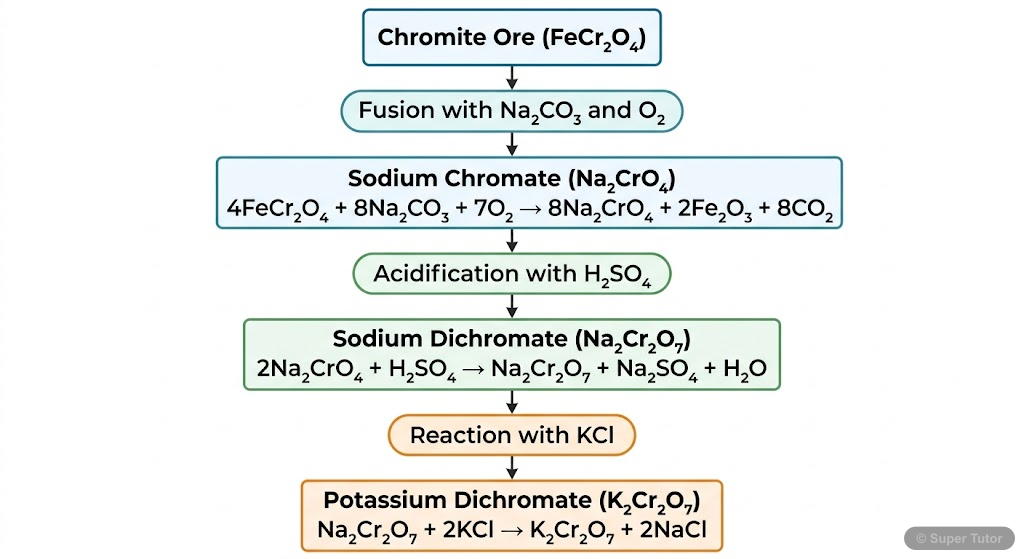
4.14Describe the preparation of potassium dichromate from iron chromite ore. What is the effect of increasing pH on a solution of potassium dichromate?Show solution
Preparation of Potassium Dichromate ():
Step 1: Fusion of chromite ore with alkali in air
Chromite ore () is fused with sodium carbonate () in the presence of air (oxygen) at high temperature:
Yellow sodium chromate () is formed.
Step 2: Filtration and acidification
The yellow solution of sodium chromate is filtered to remove and then acidified with dilute sulphuric acid:
Orange sodium dichromate () crystallises out.
Step 3: Conversion to potassium dichromate
Sodium dichromate is treated with potassium chloride:
Potassium dichromate (less soluble) crystallises out as orange crystals.
Effect of Increasing pH on Potassium Dichromate Solution:
In solution, dichromate (, orange) and chromate (, yellow) ions exist in equilibrium:
On increasing pH (adding alkali, i.e., decreasing ):
- The equilibrium shifts to the right (towards chromate).
- The orange colour of dichromate changes to yellow colour of chromate.
On decreasing pH (adding acid):
- The equilibrium shifts to the left (towards dichromate).
- The yellow colour changes back to orange.
4.15Describe the oxidising action of potassium dichromate and write the ionic equations for its reaction with: (i) iodide (ii) iron(II) solution and (iii) Show solution
Oxidising Action of Potassium Dichromate:
In acidic medium, the dichromate ion () acts as a strong oxidising agent. Chromium is reduced from +6 to +3 state:
(i) Reaction with iodide ions ():
Iodide is oxidised to iodine ( → , change: to , loses 1e⁻ per I):
(ii) Reaction with iron(II) solution ():
Fe²⁺ is oxidised to Fe³⁺ (loses 1e⁻ per Fe):
(iii) Reaction with :
is oxidised to sulphur (S is oxidised from to , loses 2e⁻ per S):
Free with a Super Tutor account
Free with a Super Tutor account
Free with a Super Tutor account
Free with a Super Tutor account
Free with a Super Tutor account
Free with a Super Tutor account
Free with a Super Tutor account
Free with a Super Tutor account
Free with a Super Tutor account
Free with a Super Tutor account
Free with a Super Tutor account
Free with a Super Tutor account
Free with a Super Tutor account
Free with a Super Tutor account
Free with a Super Tutor account
Free with a Super Tutor account
Free with a Super Tutor account
Free with a Super Tutor account
Free with a Super Tutor account
Free with a Super Tutor account
Free with a Super Tutor account
Free with a Super Tutor account
Free with a Super Tutor account
23 more solved questions in The d-and f-Block Elements
They are free with a Super Tutor account, along with practice quizzes and flashcards for this chapter. Free to start, no card needed.
Frequently Asked Questions
What are the important topics in The d-and f-Block Elements for Madhya Pradesh Board Class 12 Chemistry?
Are these NCERT Solutions for The d-and f-Block Elements free?
How should I revise The d-and f-Block Elements for the Madhya Pradesh Board Class 12 board exam?
Sources & Official References
Content is aligned to the official syllabus. Refer to the board website for the latest curriculum.
More resources for The d-and f-Block Elements
Practice Quiz
Test yourself with a quick quiz
Important Questions
Exam-style questions with answers
Revision Notes
Key points for last-minute revision
Chapter Summary
Understand the chapter at a glance
Concept Maps
See how topics connect
Study Plan
Step-by-step plan for this chapter
Flashcards
Quick-fire cards for active recall
Syllabus
What topics to cover
For serious students
Get the full The d-and f-Block Elements chapter — start free.
Quizzes, flashcards, an AI doubt solver and a study plan for Madhya Pradesh Board Class 12 Chemistry. Free to start, no card needed.