The d-and f-Block Elements — Chapter Summary
Madhya Pradesh Board · Class 12 · Chemistry
Summary of The d-and f-Block Elements for Madhya Pradesh Board Class 12 Chemistry. Key concepts: The d, Transition metals are metals and The general outer.
Interactive on Super Tutor
Studying The d-and f-Block Elements? Get the full interactive chapter.
Quizzes, flashcards, AI doubt-solver and a step-by-step study plan — built for chapter summary and more.
Free trial, no card needed.
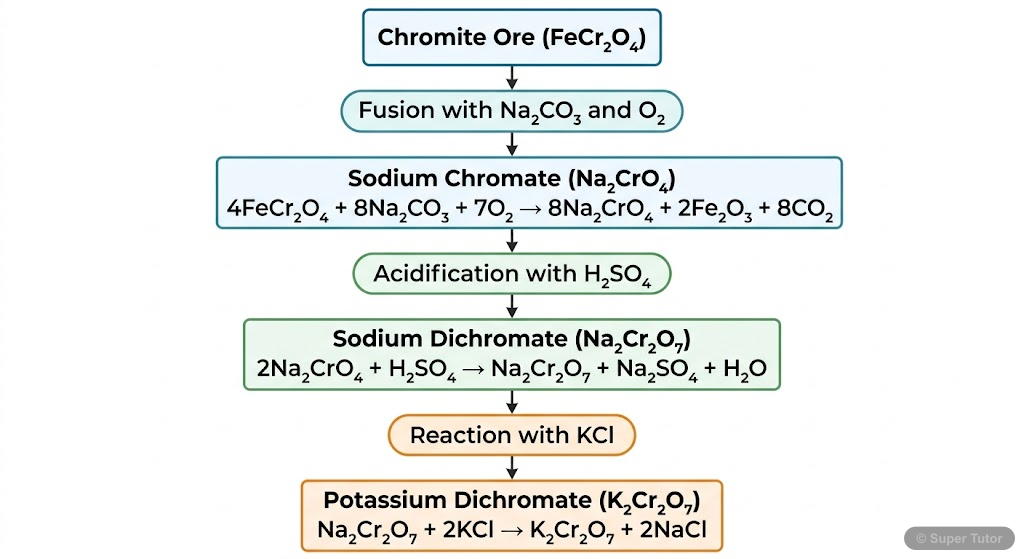
One of 16 illustrations for The d-and f-Block Elements in Super Tutor — alongside flashcards, concept maps and practice questions.
Overview
The d-block contains the elements of Groups 3 to 12 in which d orbitals are progressively filled, while the f-block contains the 4f and 5f series placed separately at the bottom of the periodic table. Transition elements show metallic character, variable oxidation states, coloured ions, complex form
Key Concepts
The d
The d-block occupies the middle of the periodic table and includes four series: 3d, 4d, 5d, and 6d. The f-block contains the lanthanoids, 4f series fr
Transition metals are metals with
Transition metals are metals with an incomplete d subshell in the neutral atom or in one of their ions. Scandium is a transition element because its g
The general outer configuration is (n
The general outer configuration is (n-1)d1-10ns1-2, but chromium has 3d5 4s1, copper has 3d10 4s1, and palladium has 4d10 5s0. These exceptions occur
Transition metals are hard
Transition metals are hard, lustrous, dense, and have high melting and boiling points. Melting points generally rise to a maximum near the middle of t
Ionisation enthalpies increase across a series
Ionisation enthalpies increase across a series, but not smoothly. Exchange energy, d5 stability, and subshell stability cause irregularities. Mn+ and
Learning Objectives
- Understand the position of d- and f-block elements in the periodic table.
- Identify the electronic configurations of transition and inner transition elements.
- Explain why some elements are transition elements and others are not.
- Relate oxidation states and electrode potentials to stability and reactivity.
- Describe the preparation, properties, and uses of potassium dichromate and potassium permanganate.
Frequently Asked Questions
What are the important topics in The d-and f-Block Elements for Madhya Pradesh Board Class 12 Chemistry?
How should I revise The d-and f-Block Elements for the Madhya Pradesh Board Class 12 board exam?
Sources & Official References
Content is aligned to the official syllabus. Refer to the board website for the latest curriculum.
More resources for The d-and f-Block Elements
Practice Quiz
Test yourself with a quick quiz
Important Questions
Exam-style questions with answers
Revision Notes
Key points for last-minute revision
Concept Maps
See how topics connect
Study Plan
Step-by-step plan for this chapter
Flashcards
Quick-fire cards for active recall
Syllabus
What topics to cover
NCERT Solutions
Every textbook question solved step by step
For serious students
Get the full The d-and f-Block Elements chapter — start free.
Quizzes, flashcards, an AI doubt solver and a study plan for Madhya Pradesh Board Class 12 Chemistry. Free to start, no card needed.