Colonialism and the Countryside: Exploring Official Archives — Chapter Summary
Madhya Pradesh Board · Class 12 · History
Summary of Colonialism and the Countryside: Exploring Official Archives for Madhya Pradesh Board Class 12 History.
Interactive on Super Tutor
Studying Colonialism and the Countryside: Exploring Official Archives? Get the full interactive chapter.
Quizzes, flashcards, AI doubt-solver and a step-by-step study plan — built for chapter summary and more.
Free trial, no card needed.
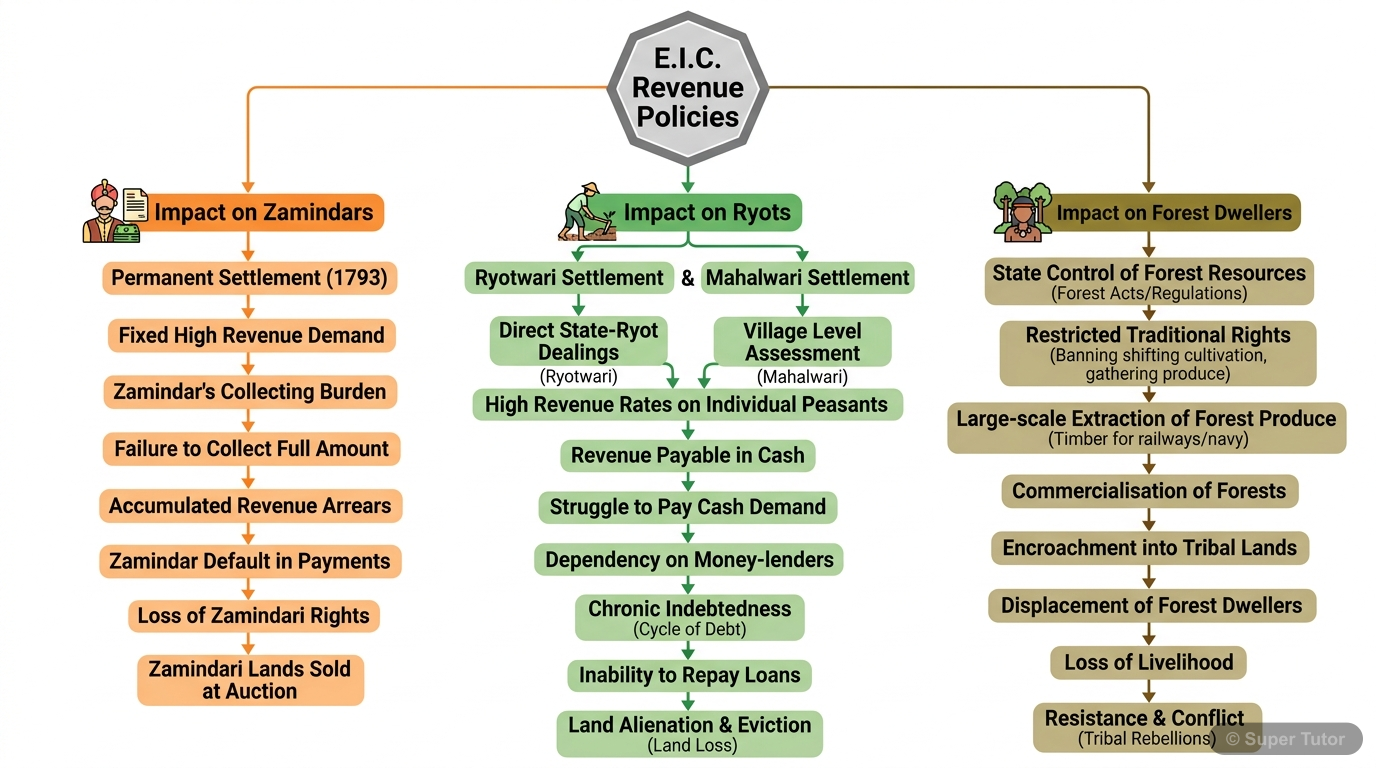
Learn better with visuals Super Tutor pairs illustrations like this with notes and quizzes for Colonialism and the Countryside: Exploring Official Archives.
Overview
Colonial rule in the countryside changed land rights, revenue collection, and rural power relations in Bengal and the Bombay Deccan. The chapter follows three connected settings: Bengal zamindars under the Permanent Settlement, the Paharias and Santhals in the Rajmahal hills, and the Deccan countrys
Key Concepts
The Bengal revenue system introduced
The Bengal revenue system introduced in 1793 under which revenue was fixed in perpetuity. Zamindars had to collect rent from villages and pay a fixed
Under the Permanent Settlement
Under the Permanent Settlement, zamindars were treated as revenue collectors of the state, not as landowners in the village. They often controlled man
Rich peasants in Bengal who held
Rich peasants in Bengal who held large landholdings, controlled local trade and moneylending, and used sharecroppers. They were especially powerful in
Hill folk of the Rajmahal region
Hill folk of the Rajmahal region who practised shifting cultivation, hunting, and food gathering. They depended on forests and resisted outside intrus
Settled plough agriculturists who migrated into
Settled plough agriculturists who migrated into Bengal from the 1780s, were encouraged to clear forests, and were settled in Damin-i-Koh from 1832. Th
Learning Objectives
- Understand how the Permanent Settlement changed rural Bengal and the position of zamindars.
- Explain the rise of jotedars and their role in village politics and land control.
- Describe the life, economy, and resistance of the Paharias in the Rajmahal hills.
- Trace the settlement of the Santhals, the growth of Damin-i-Koh, and the Santhal rebellion of 1855-56.
- Analyse the causes of peasant distress in the Bombay Deccan, including revenue demand, debt, and the cotton boom.
Frequently Asked Questions
What are the important topics in Colonialism and the Countryside: Exploring Official Archives for Madhya Pradesh Board Class 12 History?
How should I revise Colonialism and the Countryside: Exploring Official Archives for the Madhya Pradesh Board Class 12 board exam?
Sources & Official References
Content is aligned to the official syllabus. Refer to the board website for the latest curriculum.
More resources for Colonialism and the Countryside: Exploring Official Archives
Practice Quiz
Test yourself with a quick quiz
Important Questions
Exam-style questions with answers
Revision Notes
Key points for last-minute revision
Concept Maps
See how topics connect
Study Plan
Step-by-step plan for this chapter
Flashcards
Quick-fire cards for active recall
Syllabus
What topics to cover
NCERT Solutions
Every textbook question solved step by step
For serious students
Get the full Colonialism and the Countryside: Exploring Official Archives chapter — start free.
Quizzes, flashcards, an AI doubt solver and a study plan for Madhya Pradesh Board Class 12 History. Free to start, no card needed.