Framing the Constitution: The Beginning of a New Era — Chapter Summary
Madhya Pradesh Board · Class 12 · History
Summary of Framing the Constitution: The Beginning of a New Era for Madhya Pradesh Board Class 12 History. The Constitution of India was framed between.
Interactive on Super Tutor
Studying Framing the Constitution: The Beginning of a New Era? Get the full interactive chapter.
Quizzes, flashcards, AI doubt-solver and a step-by-step study plan — built for chapter summary and more.
Free trial, no card needed.
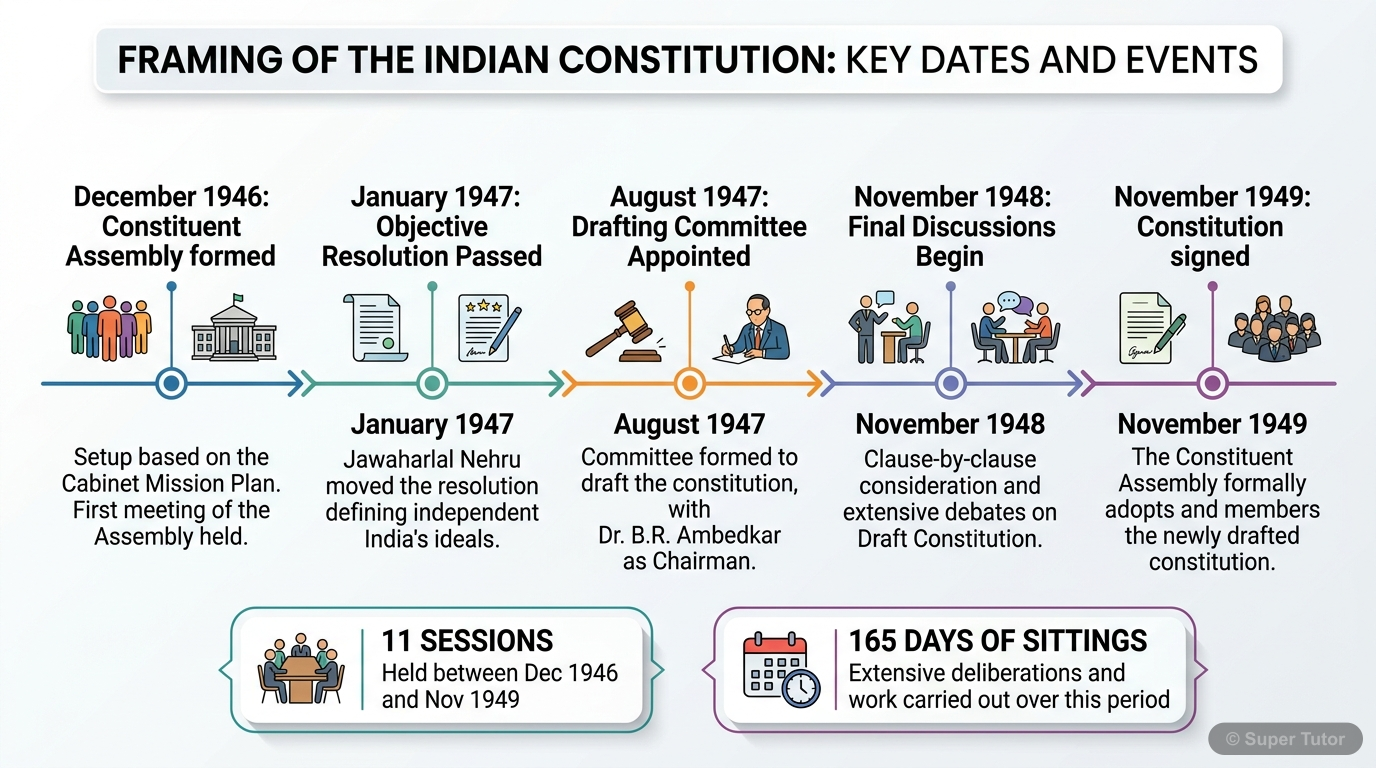
Learn better with visuals Super Tutor pairs illustrations like this with notes and quizzes for Framing the Constitution: The Beginning of a New Era.
Overview
The Constitution of India was framed between December 1946 and November 1949 and came into effect on 26 January 1950. It was a long and carefully debated document because India was large, diverse, and deeply divided at Independence. The Constituent Assembly worked through issues such as democracy, r
Key Concepts
The Constituent Assembly had 300 members
The Constituent Assembly had 300 members, and 82 per cent of them were also Congress members. They were not elected through universal adult franchise;
Jawaharlal Nehru introduced the Objectives Resolution
Jawaharlal Nehru introduced the Objectives Resolution on 13 December 1946. It declared India an independent sovereign republic and promised justice, e
Jawaharlal Nehru
Jawaharlal Nehru, Vallabh Bhai Patel, Rajendra Prasad, B.R. Ambedkar, K.M. Munshi, Alladi Krishnaswamy Aiyar, B.N. Rau, and S.N. Mukherjee played espe
The Constitution granted the vote
The Constitution granted the vote to every adult Indian, an unprecedented step compared to democracies that expanded voting rights gradually. Fundamen
Different groups defined minorities in different
Different groups defined minorities in different ways. B. Pocker Bahadur defended separate electorates for religious minorities. N.G. Ranga said the r
Learning Objectives
- Understand the historical context in which the Constitution was framed.
- Identify the major leaders and committees that shaped constitution-making.
- Explain the key debates on rights, minorities, federal power, and language.
- Recognise how democratic ideas were adapted to Indian conditions.
- Understand how secularism and social justice were built into the Constitution through Fundamental Rights.
Frequently Asked Questions
What are the important topics in Framing the Constitution: The Beginning of a New Era for Madhya Pradesh Board Class 12 History?
How should I revise Framing the Constitution: The Beginning of a New Era for the Madhya Pradesh Board Class 12 board exam?
Sources & Official References
Content is aligned to the official syllabus. Refer to the board website for the latest curriculum.
More resources for Framing the Constitution: The Beginning of a New Era
Practice Quiz
Test yourself with a quick quiz
Important Questions
Exam-style questions with answers
Revision Notes
Key points for last-minute revision
Concept Maps
See how topics connect
Study Plan
Step-by-step plan for this chapter
Flashcards
Quick-fire cards for active recall
Syllabus
What topics to cover
NCERT Solutions
Every textbook question solved step by step
For serious students
Get the full Framing the Constitution: The Beginning of a New Era chapter — start free.
Quizzes, flashcards, an AI doubt solver and a study plan for Madhya Pradesh Board Class 12 History. Free to start, no card needed.