Colonialism and the Countryside: Exploring Official Archives — NCERT Solutions
Madhya Pradesh Board · Class 12 · History
NCERT Solutions for Colonialism and the Countryside: Exploring Official Archives, Madhya Pradesh Board Class 12 History: 12 textbook questions solved step.
Interactive on Super Tutor
Studying Colonialism and the Countryside: Exploring Official Archives? Get the full interactive chapter.
Quizzes, flashcards, AI doubt-solver and a step-by-step study plan — built for NCERT solutions and more.
Free trial, no card needed.
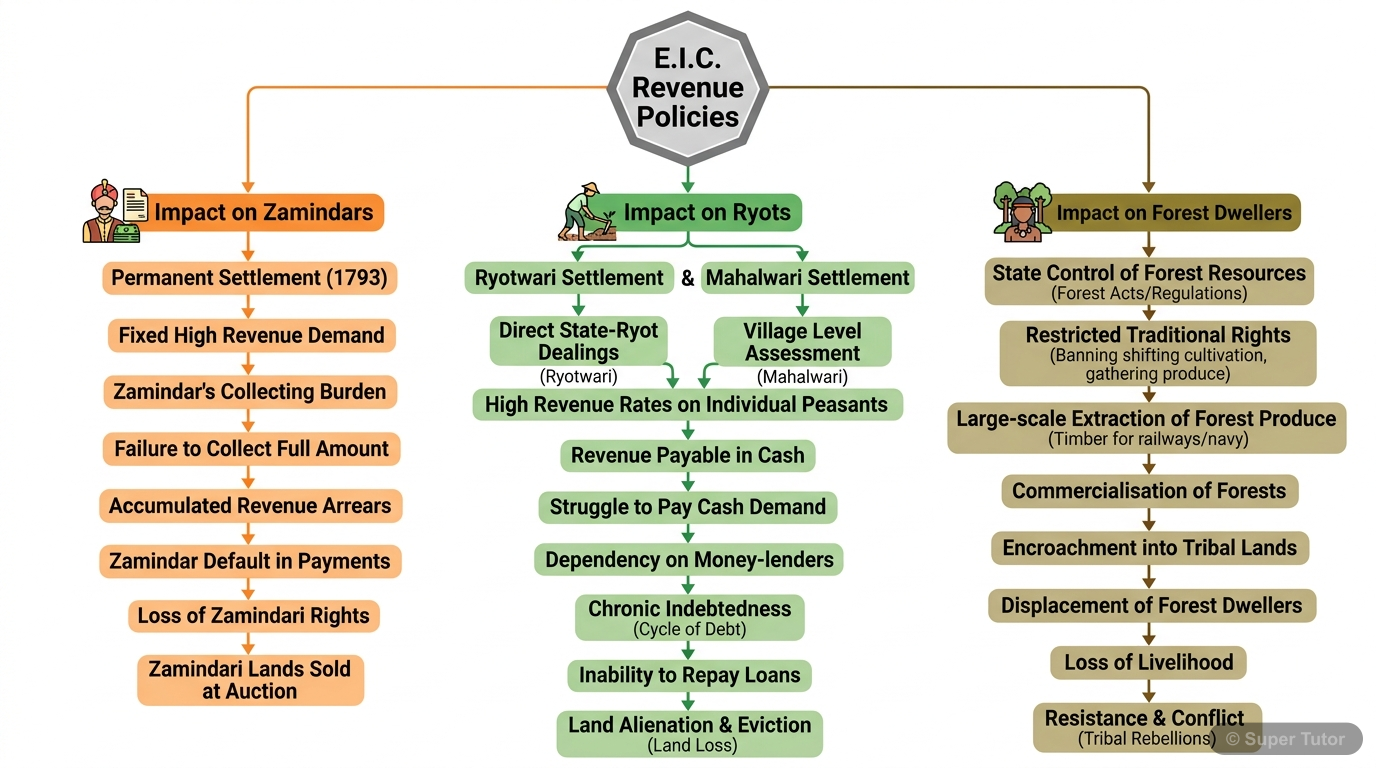
Learn better with visuals Super Tutor pairs illustrations like this with notes and quizzes for Colonialism and the Countryside: Exploring Official Archives.
The first 6 solutions are open to read. The other 6 are free with a Super Tutor account.
Answer in 100-150 Words
1Why was the jotedar a powerful figure in many areas of rural Bengal?Show solution
Given/Context: The jotedar was a rich peasant who emerged as a powerful rural figure in Bengal under colonial rule.
Answer:
The jotedar was a powerful figure in rural Bengal for several reasons:
- Control over land: Jotedars possessed large areas of land — sometimes several thousand acres — which they cultivated through sharecroppers (bargadars/adhiars). This gave them direct economic power over a large number of poor peasants.
- Control over credit: Unlike zamindars who lived in towns, jotedars lived in the villages. They provided loans to poor peasants and thus controlled them through debt.
- Control over local trade: They controlled local markets and trade, making poor peasants dependent on them for buying and selling.
- Resistance to zamindars: As Francis Buchanan noted, jotedars were 'refractory' — they refused to pay revenue on time, held more land than their deeds allowed, and instigated poor ryots not to pay revenue to zamindars. They knew the zamindars had little real power over them.
- Proximity to peasants: Because they lived in villages, they could mobilise local support quickly and effectively resist both zamindars and colonial officials.
Thus, through economic control, local presence, and ability to resist authority, jotedars became the most powerful figures in many areas of rural Bengal.
2How did zamindars manage to retain control over their zamindaris?Show solution
Given/Context: Under the Permanent Settlement of 1793, zamindars who failed to pay revenue on time had their estates auctioned. Despite this, many zamindars devised strategies to retain control.
Answer:
Zamindars used several ingenious strategies to retain control over their zamindaris even when estates were auctioned:
- Fictitious sales: Zamindars transferred their property to women relatives (mothers, wives) since the Company had decreed that women's property would not be seized for revenue arrears. This protected the estate from auction.
- Manipulating auctions: When an estate was put up for auction, the zamindar's agents would bid for it, outbidding others. They would then refuse to pay the purchase money, forcing a re-auction. This process was repeated until other bidders were exhausted, and finally the estate was sold back to the zamindar at a very low price.
- Deliberate default: Zamindars deliberately withheld revenue payments and allowed arrears to accumulate. This was a calculated strategy to trigger auctions that they could then manipulate.
- Social and local influence: Zamindars retained strong social ties with local communities. Even when new purchasers bought estates at auction, they found it difficult to actually collect rents because the old zamindar's men and loyal ryots resisted them.
Through these methods, zamindars ensured that despite the pressures of the Permanent Settlement, their control over rural Bengal was not easily dislodged.
3How did the Paharias respond to the coming of outsiders?Show solution
Given/Context: The Paharias were the original inhabitants of the Rajmahal hills who had a distinct way of life based on forests. From the late 18th century, outsiders — zamindars, jotedars, British officials, and Santhals — began encroaching on their territory.
Answer:
The Paharias responded to the coming of outsiders with resistance and hostility:
- Raids on plains: The Paharias regularly raided the plains where settled agriculturists lived. These raids were a means of asserting power over outsiders, a way of survival in times of scarcity, and a method of negotiating political relations.
- Demanding tribute: Zamindars on the plains had to pay regular tribute to Paharia chiefs to purchase peace. Traders paid a toll to pass through the hill passes controlled by the Paharias.
- Refusal to settle: When the British tried to transform them into settled agriculturists, the Paharias refused. They resisted cutting forests and refused to touch the plough, as these activities were contrary to their way of life.
- Resistance to forest clearance: As the British encouraged forest clearance and zamindars turned uncultivated lands into rice fields, the Paharias resisted this encroachment on their territory, which was the basis of their identity and survival.
- Conflict with Santhals: When the Santhals moved into the lower slopes of the Rajmahal hills around 1800, cleared forests and settled the land, the Paharias were displaced and pushed further into the hills.
Overall, the Paharias fiercely resisted all attempts to change their way of life and encroach upon their forest-based existence.
4Why did the Santhals rebel against British rule?Show solution
Given/Context: The Santhals had been invited to settle in the Rajmahal hills (Damin-i-koh) by the British. By the 1850s, however, they rose in a major rebellion (1855–56) against British rule.
Answer:
The Santhals rebelled against British rule for the following reasons:
- Exploitation by moneylenders and traders: The Santhals had been given land to settle and cultivate. But soon moneylenders (dikus) and traders moved in, charging exorbitant rates of interest and manipulating accounts. Santhals found themselves trapped in a cycle of debt from which there was no escape.
- Exploitation by zamindars: Zamindars began asserting control over the lands that the Santhals had cleared and settled. The Santhals were reduced to the position of serfs, forced to work for zamindars.
- Failure of colonial law: The British legal system, instead of protecting the Santhals, seemed to work in favour of the moneylenders and zamindars. The Santhals felt that the courts and laws were instruments of their oppression.
- Loss of land: As revenue demand increased and debts mounted, Santhals began losing the land they had so painstakingly cleared and cultivated.
- Dream of a just kingdom: The Santhal leaders Sidhu and Kanhu declared that the rule of the dikus (outsiders) and the British would end and a just kingdom (Satyug) would be established where the Santhals would be free.
The Santhal rebellion of 1855–56 was thus a response to the multiple forms of exploitation — by moneylenders, zamindars, and the colonial state — that had destroyed their way of life.
5What explains the anger of the Deccan ryots against the moneylenders?Show solution
Given/Context: In 1875, ryots in the Bombay Deccan rose in revolt against moneylenders (sahukars), burning account books and debt bonds. This anger had been building up over decades.
Answer:
The anger of the Deccan ryots against moneylenders can be explained by the following factors:
- Mounting debt: Ryots had been borrowing heavily from moneylenders to pay revenue and meet household expenses. Interest rates were exorbitant — in one case, Rs 2,000 was charged as interest on a loan of Rs 100. Debts accumulated over generations.
- Violation of customary norms: Traditionally, interest charged could not exceed the principal. Under colonial rule, this norm broke down completely. Moneylenders charged unlimited interest, violating the customary moral economy of the countryside.
- Manipulation of legal instruments: Moneylenders forced ryots to sign new bonds every three years (under the Limitation Law of 1859), adding accumulated interest to the principal each time. They refused to give receipts for repayments, entered fictitious figures in bonds, and took away harvests without crediting them to the ryots' accounts.
- Loss of land and property: When debts became unpayable, ryots lost their land, bullocks and carts to moneylenders. They then had to hire back their own animals, paying rent for what had originally belonged to them.
- Refusal of credit after the cotton boom: After the American Civil War ended (1865), cotton prices fell and moneylenders refused to extend further credit, even as revenue demand increased by 50–100%. This left ryots with no means of survival.
- Deeds and bonds as symbols of oppression: Ryots were made to sign documents they could not read or understand, and these were used against them in courts.
The combination of economic exploitation, violation of traditional norms, and the insensitivity of moneylenders to their plight drove the Deccan ryots to revolt.
Write a Short Essay (250-300 Words)
6Why were many zamindaris auctioned after the Permanent Settlement?Show solution
Introduction:
The Permanent Settlement of 1793 fixed the revenue demand of the East India Company permanently. While this was meant to provide stability, it led to the auction of many zamindaris in the years that followed.
Reasons for auction of zamindaris:
1. Exorbitantly high revenue demand:
The revenue fixed under the Permanent Settlement was very high — set at a level that the Company needed to meet its financial requirements. In many cases, the demand was higher than what zamindars could realistically collect from their tenants. The Company fixed the revenue at about 10/11th of the rental, leaving only 1/11th for the zamindar.
2. Inflexibility of the settlement:
The revenue demand was fixed permanently and had to be paid on a specific date (the 'Sunset Law'). If payment was not made by sunset on the due date, the zamindari was liable to be auctioned. There was no provision for remission in years of flood, drought or other calamities.
3. Falling agricultural prices:
In the early decades of the 19th century, agricultural prices fell. This meant that zamindars collected less rent from their tenants, but their revenue obligation to the Company remained unchanged. The gap between income and obligation widened.
4. Difficulties in collecting rent:
Zamindars faced resistance from jotedars and ryots who refused to pay rent on time. Jotedars in particular were powerful enough to defy zamindars and instigate other peasants not to pay. This made it difficult for zamindars to collect enough to meet the revenue demand.
5. Lack of capital:
Many zamindars lacked the capital to invest in improving their estates or to tide over bad years. They had no financial cushion to fall back on when revenue collection fell short.
Conclusion:
The combination of a high and inflexible revenue demand, falling agricultural prices, resistance from tenants, and lack of capital meant that many zamindars could not pay their dues on time. As a result, their estates were put up for auction. However, as we have seen, many zamindars used ingenious methods — fictitious sales, manipulation of auctions — to retain their zamindaris even after they were formally auctioned.
Free with a Super Tutor account
Free with a Super Tutor account
Free with a Super Tutor account
Map Work
Free with a Super Tutor account
Projects
Free with a Super Tutor account
Free with a Super Tutor account
6 more solved questions in Colonialism and the Countryside: Exploring Official Archives
They are free with a Super Tutor account, along with practice quizzes and flashcards for this chapter. Free to start, no card needed.
Frequently Asked Questions
What are the important topics in Colonialism and the Countryside: Exploring Official Archives for Madhya Pradesh Board Class 12 History?
Are these NCERT Solutions for Colonialism and the Countryside: Exploring Official Archives free?
How should I revise Colonialism and the Countryside: Exploring Official Archives for the Madhya Pradesh Board Class 12 board exam?
Sources & Official References
Content is aligned to the official syllabus. Refer to the board website for the latest curriculum.
More resources for Colonialism and the Countryside: Exploring Official Archives
Practice Quiz
Test yourself with a quick quiz
Important Questions
Exam-style questions with answers
Revision Notes
Key points for last-minute revision
Chapter Summary
Understand the chapter at a glance
Concept Maps
See how topics connect
Study Plan
Step-by-step plan for this chapter
Flashcards
Quick-fire cards for active recall
Syllabus
What topics to cover
For serious students
Get the full Colonialism and the Countryside: Exploring Official Archives chapter — start free.
Quizzes, flashcards, an AI doubt solver and a study plan for Madhya Pradesh Board Class 12 History. Free to start, no card needed.