Rebels and the Raj: 1857 Revolt and its Representations — Chapter Summary
Madhya Pradesh Board · Class 12 · History
Summary of Rebels and the Raj: 1857 Revolt and its Representations for Madhya Pradesh Board Class 12 History. The revolt of 1857 began as a sepoy mutiny.
Interactive on Super Tutor
Studying Rebels and the Raj: 1857 Revolt and its Representations? Get the full interactive chapter.
Quizzes, flashcards, AI doubt-solver and a step-by-step study plan — built for chapter summary and more.
Free trial, no card needed.
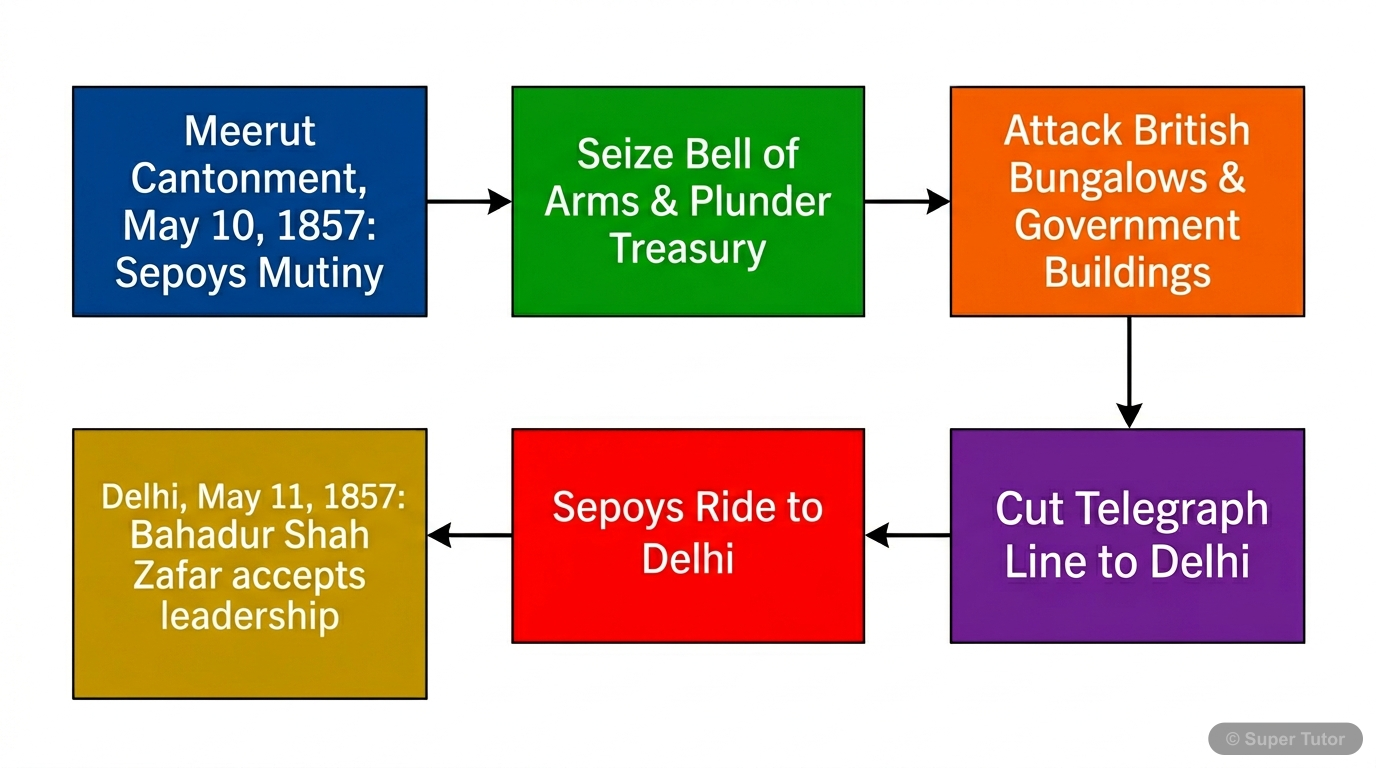
One of 12 illustrations for Rebels and the Raj: 1857 Revolt and its Representations in Super Tutor — alongside flashcards, concept maps and practice questions.
Overview
The revolt of 1857 began as a sepoy mutiny in Meerut on 10 May 1857 and quickly expanded into a wider rebellion across North India. Sepoys, peasants, zamindars, rajas, taluqdars, religious leaders, and townspeople all became involved in different ways. The uprising grew from military grievance, fear
Key Concepts
A mutiny is an uprising
A mutiny is an uprising of soldiers against authority. In 1857, this referred to the sepoys’ armed disobedience in the British Indian army.
A revolt is an uprising
A revolt is an uprising of the civilian population such as peasants, zamindars, rajas, and jagirdars against established authority.
This was a system devised by
This was a system devised by Lord Wellesley in 1798. The ally had to accept British troops, provide resources for them, and follow British advice in e
Awadh became a major centre
Awadh became a major centre of rebellion after its annexation in 1856. Wajid Ali Shah was dethroned and widely mourned, taluqdars were dispossessed, a
Rumours about greased cartridges
Rumours about greased cartridges, cow and pig fat, and a wider British conspiracy spread rapidly. A prophecy also claimed British rule would end on 23
Learning Objectives
- Understand how the revolt began in Meerut and spread to Delhi and other centres.
- Distinguish between mutiny and revolt in the context of 1857.
- Explain why sepoys, peasants, taluqdars, rajas, and religious leaders joined the uprising.
- Analyse the importance of Awadh as a centre of rebellion.
- Identify the role of rumours, prophecies, and communication among rebels.
Frequently Asked Questions
What are the important topics in Rebels and the Raj: 1857 Revolt and its Representations for Madhya Pradesh Board Class 12 History?
How should I revise Rebels and the Raj: 1857 Revolt and its Representations for the Madhya Pradesh Board Class 12 board exam?
Sources & Official References
Content is aligned to the official syllabus. Refer to the board website for the latest curriculum.
More resources for Rebels and the Raj: 1857 Revolt and its Representations
Practice Quiz
Test yourself with a quick quiz
Important Questions
Exam-style questions with answers
Revision Notes
Key points for last-minute revision
Concept Maps
See how topics connect
Study Plan
Step-by-step plan for this chapter
Flashcards
Quick-fire cards for active recall
Syllabus
What topics to cover
NCERT Solutions
Every textbook question solved step by step
For serious students
Get the full Rebels and the Raj: 1857 Revolt and its Representations chapter — start free.
Quizzes, flashcards, an AI doubt solver and a study plan for Madhya Pradesh Board Class 12 History. Free to start, no card needed.