Framing the Constitution: The Beginning of a New Era — NCERT Solutions
Madhya Pradesh Board · Class 12 · History
NCERT Solutions for Framing the Constitution: The Beginning of a New Era, Madhya Pradesh Board Class 12 History: 20 textbook questions solved step by step.
Interactive on Super Tutor
Studying Framing the Constitution: The Beginning of a New Era? Get the full interactive chapter.
Quizzes, flashcards, AI doubt-solver and a step-by-step study plan — built for NCERT solutions and more.
Free trial, no card needed.
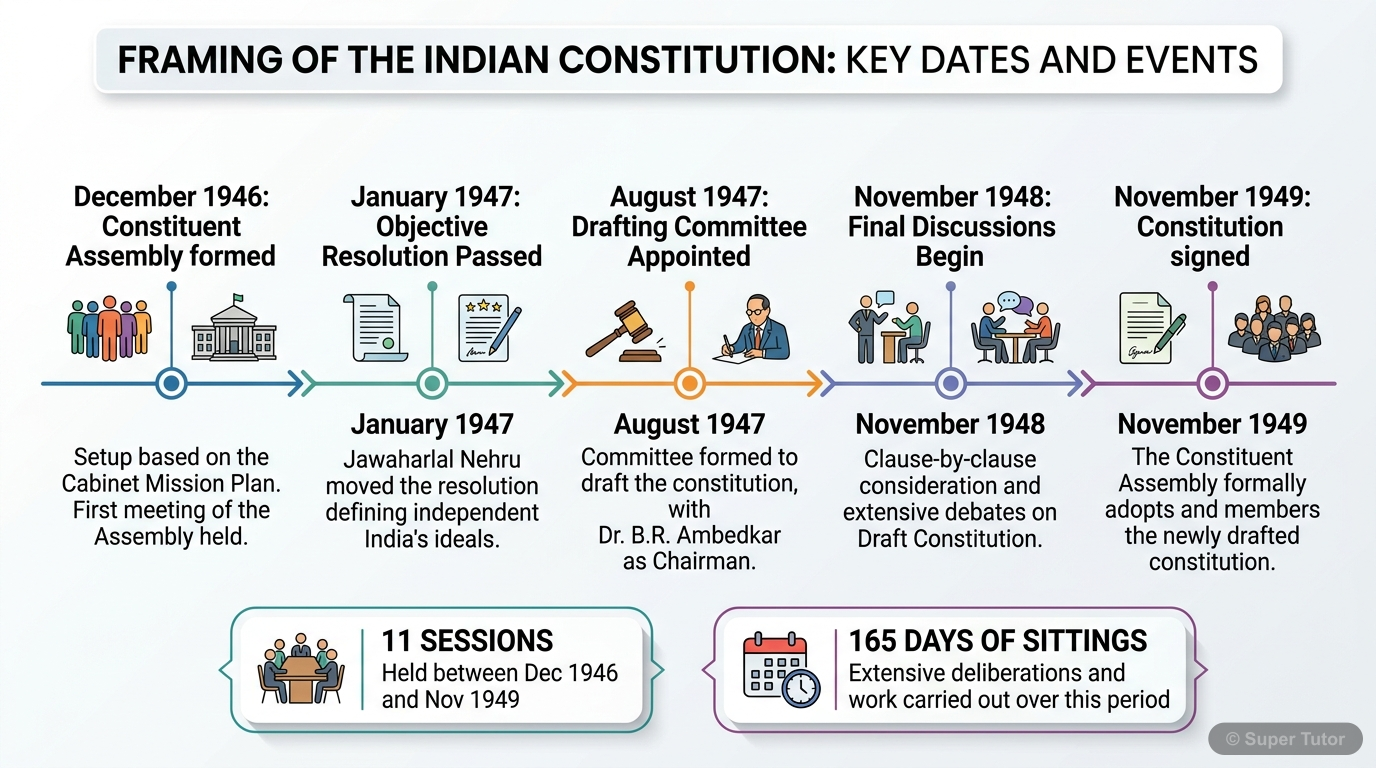
Learn better with visuals Super Tutor pairs illustrations like this with notes and quizzes for Framing the Constitution: The Beginning of a New Era.
The first 10 solutions are open to read. The other 10 are free with a Super Tutor account.
Discuss Questions (In-text)
D1Look again at Chapter 11. Discuss how the political situation of the time may have shaped the nature of the debates within the Constituent Assembly.Show solution
Given: The Constituent Assembly met from December 1946 onwards, at a time of immense political turmoil — the British were still in India, Partition was imminent, communal violence was spreading, and the Muslim League had initially refused to participate.
How the political situation shaped the debates:
- Partition and communal violence: The violence accompanying Partition made members acutely conscious of the need to protect minorities while simultaneously building a unified nation. This shaped debates on separate electorates, minority rights, and the abolition of untouchability.
- Presence of the British: Somnath Lahiri argued that the Assembly was working under British influence. This pushed members like Nehru to emphasise that the Assembly derived its strength from the will of the people, not from British sanction.
- Demand for a strong Centre: The chaos of Partition and the fear of fragmentation led most nationalists to favour a strong central government, reversing earlier Congress positions that had favoured provincial autonomy.
- Urgency of nation-building: The need to integrate a diverse country — with different languages, religions, castes, and regions — made the debates on language, rights, and federalism particularly intense.
- Legacy of colonial constitutional experiments: The Acts of 1909, 1919, and 1935 had given Indians limited experience of representative government, which informed debates about the scope of adult franchise and responsible government.
Conclusion: The political situation of 1946–49 — marked by Partition, communal tension, and the transition from colonial to independent rule — gave the debates their urgency, their caution, and their emphasis on unity, justice, and democratic rights.
D2What explanation does Jawaharlal Nehru give for not using the term 'democratic' in the Objectives Resolution (Source 1)?Show solution
Given: The question refers to Nehru's speech introducing the Objectives Resolution in the Constituent Assembly on 13 December 1946.
Nehru's explanation: Nehru deliberately avoided defining the specific form of democracy in the Objectives Resolution because he did not want to restrict or pre-determine the nature of the democratic system India would adopt. He felt that the exact form of democracy had to be decided through deliberation and debate within the Assembly, and that it should 'fit in with the temper of our people and be acceptable to them.'
He was not suggesting that India should mechanically copy the democratic models of America or France. Instead, he wanted India to learn from the achievements and failures of Western democracies, adapt those ideas creatively, and fuse liberal democratic ideals with socialist ideas of economic justice — all within the Indian context.
In short: By not using the term 'democratic' in a fixed sense, Nehru left open the possibility of creative and contextual thinking about what democracy should mean for India, rather than importing a ready-made Western blueprint.
D3Why does the speaker in Source 2 think that the Constituent Assembly was under the shadow of British guns?Show solution
Given: The speaker referred to is Somnath Lahiri, a Communist member of the Constituent Assembly, speaking in the winter of 1946–47.
Lahiri's argument: Lahiri believed the Constituent Assembly was under the shadow of British guns for the following reasons:
- British were still in India: In the winter of 1946–47, when the Assembly was deliberating, India had not yet achieved independence. The British were still the ruling power.
- Interim Government operated under the Viceroy: Although an interim administration headed by Nehru was in place, it could only function under the directions of the Viceroy and the British Government in London. Real power still rested with the British.
- Assembly was British-made: Lahiri argued that the Constituent Assembly had been created according to a British plan (the Cabinet Mission Plan of 1946) and was therefore working within a framework designed by the British to serve British interests.
- Conditions attached: The British Government had attached certain conditions within which the Assembly had to function, limiting its freedom.
Conclusion: For Lahiri, as long as the British retained political and military power in India, the Assembly could not be truly free or sovereign — it was, in his view, operating under imperial supervision.
D4What were the ideas outlined by Jawaharlal Nehru in his speech on the Objectives Resolution?Show solution
Given: Nehru introduced the Objectives Resolution on 13 December 1946 in the Constituent Assembly.
Key ideas outlined by Nehru:
- Sovereign Independent Republic: India was to be an independent, sovereign republic, free from all external control.
- Democratic governance: The government would be based on the will of the people. Nehru stressed that governments are expressions of the will of the people, not mere state papers.
- Justice — social, economic, and political: The Constitution aimed to secure justice for all citizens, combining liberal democratic ideals with socialist ideas of economic justice.
- Equality and fundamental rights: Every citizen was to be guaranteed equality of status and opportunity, and fundamental rights.
- Protection of minorities and depressed groups: Adequate safeguards were to be provided for minorities, backward and tribal areas, and depressed and other backward classes.
- Learning from history without copying: Nehru referred to the American and French Revolutions to locate India's constitution-making within a longer history of struggle for liberty, but stressed that India should not mechanically copy Western models. The system had to 'fit in with the temper of our people.'
- Creative adaptation: The objective was to fuse liberal democracy with economic justice and re-work these ideas within the Indian context.
Conclusion: The Objectives Resolution was a visionary document that laid down the philosophical foundations of the Indian Constitution — sovereignty, democracy, justice, equality, and the protection of vulnerable groups.
D5Read Sources 3 and 4. What are the different arguments being put forward against separate electorates?Show solution
Given: Source 3 presents B. Pocker Bahadur's plea for separate electorates; Source 4 presents Govind Ballabh Pant's counter-arguments against separate electorates.
Arguments against separate electorates (from Source 4 and the surrounding text):
- Suicidal for minorities: Pant argued that separate electorates would be 'suicidal to the minorities.' By permanently isolating minorities, they would never be able to convert themselves into a majority or play a decisive role in governance.
- Permanent isolation and frustration: If minorities were segregated into air-tight compartments, they would feel permanently excluded from the mainstream, leading to frustration and a sense of helplessness.
- No effective voice: Minorities returned through separate electorates could never have any effective voice in the government because they would always remain a small, isolated group.
- Obstacle to national integration: Separate electorates would create divided loyalties and make it impossible to forge a unified nation. Citizens had to act as equal members of one State, not as members of separate communities.
- Begum Aizaas Rasul's view: She felt separate electorates were self-destructive since they isolated minorities from the majority, making it harder for them to participate effectively in democracy.
- By 1949, Muslim members agreed: Most Muslim members of the Constituent Assembly came to agree that separate electorates were against the interests of minorities, and that active participation in the democratic process was a better way to ensure their voice.
Conclusion: The core argument was that separate electorates would permanently marginalise minorities rather than protect them, and would undermine national unity.
D6How does G.B. Pant define the attributes of a loyal citizen? (Source 5)Show solution
Given: Source 5 is an excerpt from Govind Ballabh Pant's speech in the Constituent Assembly.
Pant's definition of a loyal citizen:
According to Pant, a loyal citizen in a democracy must have the following attributes:
- Self-discipline: A citizen must train himself in the art of self-discipline. Democracy cannot function if individuals only pursue their own interests.
- Concern for others over self: In a democracy, one should 'care less for himself and more for others.' Personal interests must be subordinated to the common good.
- Undivided loyalty to the State: There cannot be any divided loyalty. All loyalties must be exclusively centred around the State. A citizen cannot simultaneously owe loyalty to a community or religious group and to the State — the State must come first.
- Suppression of narrow interests: A citizen must suppress his own 'extravagance' (narrow, selfish, or communal interests) and care for larger interests — the interests of the nation as a whole.
- Avoidance of rival loyalties: Creating rival loyalties — for example, loyalty to one's community over the nation — would doom democracy.
Conclusion: For Pant, a loyal citizen is one who places the nation and the State above community, religion, or self, and participates in democracy with discipline and a sense of collective responsibility.
D7How is the notion of minority defined by Ranga? (Source 6)Show solution
Given: Source 6 is an excerpt from N.G. Ranga's speech welcoming the Objectives Resolution.
Ranga's definition of minority:
N.G. Ranga challenged the conventional understanding of minorities as religious or ethnic groups (such as Muslims, Sikhs, or Hindus in Pakistan provinces). Instead, he defined minorities in economic and social terms.
For Ranga, the real minorities were:
- The masses of India — the poor, the depressed, and the oppressed.
- The tribal people whose lands were being snatched away by merchants despite legal protections.
- The ordinary villagers who were exploited by moneylenders, landlords, zamindars, and malguzars.
- Those who had no access to elementary education and could not take advantage of ordinary civil rights.
Key argument: These groups were minorities not because of their numbers (in fact, they formed the majority of India's population) but because they were systematically marginalised, exploited, and denied the ability to exercise their rights. They were 'so depressed and oppressed and suppressed' that formal constitutional rights meant little to them without concrete economic and social protection.
Conclusion: Ranga redefined 'minority' from a religious/ethnic category to an economic/social one, arguing that the Constitution needed to go beyond formal rights and provide real protection — 'props' and 'a ladder' — to the truly disadvantaged masses.
D8What were the different arguments that Jaipal Singh put forward in demanding protective measures for the tribals?Show solution
Note: The OCR text does not reproduce Jaipal Singh's speech directly; only the 'Discuss' prompt is visible. Based on the chapter's context, the following answer is provided.
Jaipal Singh's arguments for protective measures for tribals:
- Historical exploitation: Tribals had been exploited for centuries — their lands had been taken away, their resources plundered, and they had been reduced to poverty and bondage despite laws meant to protect them.
- Social and economic marginalisation: Tribal communities had been kept at the margins of Indian society, denied education, economic opportunity, and political representation.
- Inability to exercise rights without support: Like Ranga's argument about the poor, Jaipal Singh argued that formal constitutional rights were meaningless for tribals unless they were given concrete support — protection of their lands, access to education, and representation in government.
- Distinct identity and culture: Tribals had their own distinct cultures, traditions, and ways of life that needed to be protected from encroachment by outsiders, including merchants and moneylenders.
- Need for reservations and safeguards: Given their historical disadvantage, tribals needed reserved seats in legislatures and special administrative protections to ensure they could participate meaningfully in the democratic process.
Conclusion: Jaipal Singh argued that protective measures for tribals were not privileges but a necessary corrective to centuries of exploitation and marginalisation.
D9What different arguments were put forward by those advocating a strong Centre?Show solution
Given: The debate on Centre-State relations was a major issue in the Constituent Assembly, especially after Partition.
Arguments in favour of a strong Centre:
- National unity and integrity: After the trauma of Partition and communal violence, a strong Centre was seen as essential to hold the diverse nation together and prevent further fragmentation.
- Prevention of chaos: The violence and disorder accompanying Partition demonstrated the dangers of weak central authority. A strong Centre could forestall chaos and maintain law and order.
- Economic planning and development: Planned economic development required centralised direction and resource allocation. A weak Centre would make coordinated national development impossible.
- Colonial legacy of unitary structure: The British had already established a unitary administrative system. Retaining a strong Centre would build on existing administrative machinery.
- Changed political circumstances: Earlier, Congress had favoured provincial autonomy partly to counter British centralism and to accommodate the Muslim League's demands. After Partition, these political pressures no longer existed, removing the main reason for decentralisation.
- Security concerns: External threats and internal security challenges required a strong central government with control over defence, foreign policy, and communications.
Conclusion: The combination of Partition, communal violence, the need for economic development, and the changed political landscape after 1947 led most members of the Constituent Assembly to support a Constitution with a distinct bias towards the Union of India over the states.
Answer in 100–150 Words
1What were the ideals expressed in the Objectives Resolution?Show solution
Given: The Objectives Resolution was introduced by Jawaharlal Nehru on 13 December 1946 in the Constituent Assembly.
Ideals expressed in the Objectives Resolution:
The Objectives Resolution laid down the philosophical foundations of the Indian Constitution. The key ideals were:
- Sovereignty: India was to be an independent, sovereign republic, free from all external control.
- Democratic governance: The government was to be based on the will of the people. Nehru emphasised that governments are expressions of popular will, not mere legal documents.
- Justice — social, economic, and political: The Constitution aimed to secure justice for all citizens by fusing liberal democratic ideals with socialist ideas of economic equality.
- Equality and fundamental rights: Every citizen was to be guaranteed equality of status and opportunity, along with fundamental rights such as freedom of speech, expression, and association.
- Protection of minorities and marginalised groups: Adequate safeguards were to be provided for minorities, backward and tribal areas, and depressed and other backward classes.
- Creative adaptation, not imitation: Nehru stressed that India should learn from the American and French Revolutions and from Western democracies, but should not mechanically copy their models. The system had to fit the Indian context and be acceptable to the Indian people.
Conclusion: The Objectives Resolution was a visionary statement that combined the ideals of sovereignty, democracy, justice, equality, and the protection of vulnerable groups — forming the moral and political foundation of the Indian Constitution.
Free with a Super Tutor account
Free with a Super Tutor account
Free with a Super Tutor account
Write a Short Essay (250–300 Words)
Free with a Super Tutor account
Free with a Super Tutor account
Free with a Super Tutor account
Free with a Super Tutor account
Map Work and Projects
Free with a Super Tutor account
Free with a Super Tutor account
Free with a Super Tutor account
10 more solved questions in Framing the Constitution: The Beginning of a New Era
They are free with a Super Tutor account, along with practice quizzes and flashcards for this chapter. Free to start, no card needed.
Frequently Asked Questions
What are the important topics in Framing the Constitution: The Beginning of a New Era for Madhya Pradesh Board Class 12 History?
Are these NCERT Solutions for Framing the Constitution: The Beginning of a New Era free?
How should I revise Framing the Constitution: The Beginning of a New Era for the Madhya Pradesh Board Class 12 board exam?
Sources & Official References
Content is aligned to the official syllabus. Refer to the board website for the latest curriculum.
More resources for Framing the Constitution: The Beginning of a New Era
Practice Quiz
Test yourself with a quick quiz
Important Questions
Exam-style questions with answers
Revision Notes
Key points for last-minute revision
Chapter Summary
Understand the chapter at a glance
Concept Maps
See how topics connect
Study Plan
Step-by-step plan for this chapter
Flashcards
Quick-fire cards for active recall
Syllabus
What topics to cover
For serious students
Get the full Framing the Constitution: The Beginning of a New Era chapter — start free.
Quizzes, flashcards, an AI doubt solver and a study plan for Madhya Pradesh Board Class 12 History. Free to start, no card needed.