Framing the Constitution: The Beginning of a New Era — Study Plan
Madhya Pradesh Board · Class 12 · History
A step-by-step study plan for Framing the Constitution: The Beginning of a New Era, Madhya Pradesh Board Class 12 History: what to learn first, what.
Interactive on Super Tutor
Studying Framing the Constitution: The Beginning of a New Era? Get the full interactive chapter.
Quizzes, flashcards, AI doubt-solver and a step-by-step study plan — built for study plan and more.
Free trial, no card needed.
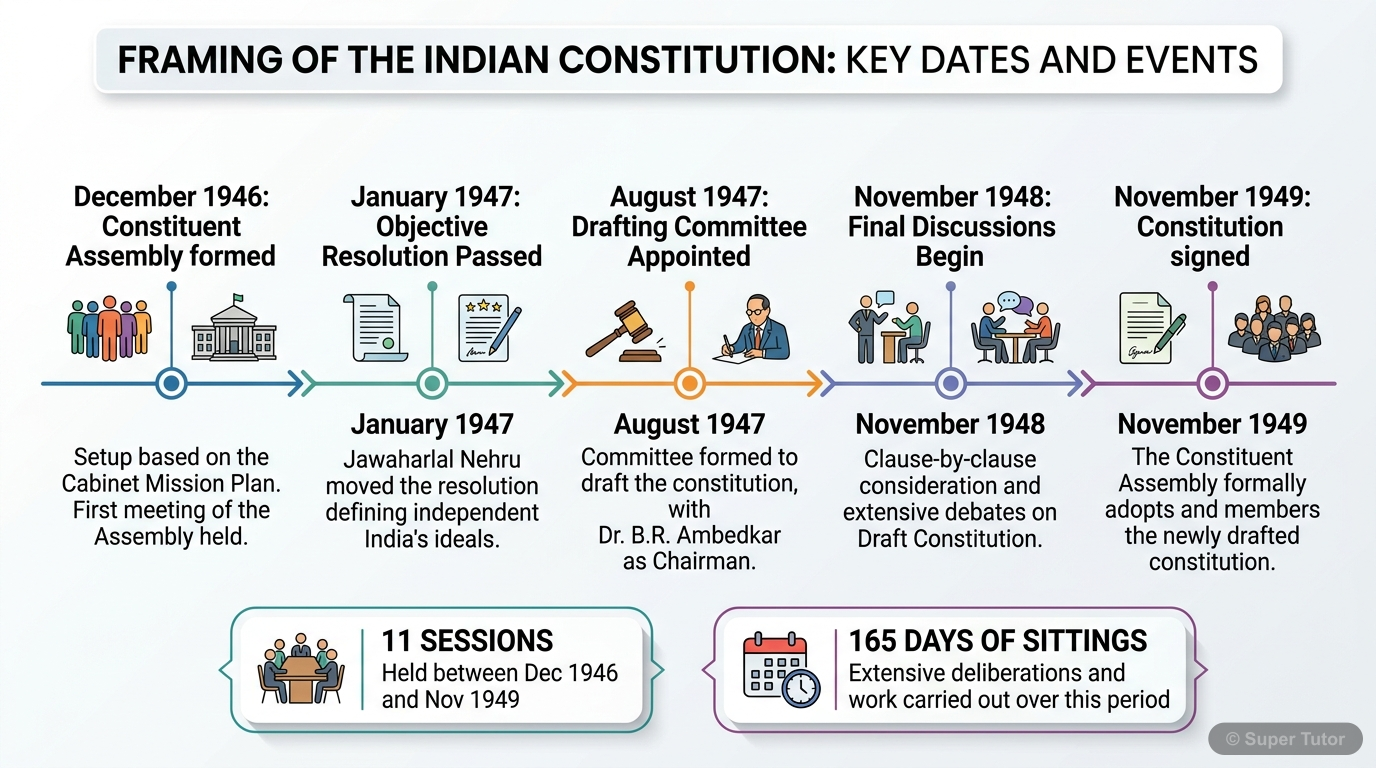
Learn better with visuals Super Tutor pairs illustrations like this with notes and quizzes for Framing the Constitution: The Beginning of a New Era.
Study Plan
Learn the Theory
Read the textbook chapter carefully. Note down definitions, formulas and key ideas. Focus on: 1. Making of the Constituent Assembly, 2. Key leaders and their roles, 3. Vision of the Constitution.
Practise
Solve the textbook exercises and extra practice questions. There are 33 questions available for this chapter.
Revise & Test
Revise key points without looking at your notes. Take a practice quiz and mark weak areas for another pass.
Spaced Revision
Come back to Framing the Constitution: The Beginning of a New Era after a week. Use flashcards for quick recall and try past exam questions on this chapter.
What to Focus On
- The Constitution was framed between December 1946 and November 1949.
- The Constitution came into effect on 26 January 1950.
- The Constituent Assembly had 300 members.
- The Objectives Resolution shaped the ideals of the Constitution.
- It promised justice, equality, and freedom.
- It provided safeguards for minorities, backward and tribal areas, and Depressed and Other Backward Classes.
- Minority could mean religious, social, political, or economic weakness.
- Separate electorates were strongly opposed by most nationalists after Partition.
- The Assembly protected minorities through rights and safeguards, not through separate electorates.
Common Mistakes to Avoid
The Constituent Assembly was elected by universal adult franchise.
Separate electorates were supported by all minority representatives in the Assembly.
B.R. Ambedkar always demanded separate electorates for Depressed Castes.
Memory Tips
Constituent Assembly was not elected by universal adult franchise
The Constitution-making period and final date
Objectives Resolution ideals
Nehru did not use the word democratic in the Resolution
Want a personalised study plan?
Super Tutor builds a day-by-day plan for Madhya Pradesh Board Class 12 History that fits your exam date and pace.
Create My Study PlanFrequently Asked Questions
What are the important topics in Framing the Constitution: The Beginning of a New Era for Madhya Pradesh Board Class 12 History?
How should I revise Framing the Constitution: The Beginning of a New Era for the Madhya Pradesh Board Class 12 board exam?
Sources & Official References
Content is aligned to the official syllabus. Refer to the board website for the latest curriculum.
More resources for Framing the Constitution: The Beginning of a New Era
Practice Quiz
Test yourself with a quick quiz
Important Questions
Exam-style questions with answers
Revision Notes
Key points for last-minute revision
Chapter Summary
Understand the chapter at a glance
Concept Maps
See how topics connect
Flashcards
Quick-fire cards for active recall
Syllabus
What topics to cover
NCERT Solutions
Every textbook question solved step by step
For serious students
Get the full Framing the Constitution: The Beginning of a New Era chapter — start free.
Quizzes, flashcards, an AI doubt solver and a study plan for Madhya Pradesh Board Class 12 History. Free to start, no card needed.