Mahatma Gandhi and the Nationalist Movement: Civil Disobedience and Beyond — Important Questions
Madhya Pradesh Board · Class 12 · History
48 important questions from Mahatma Gandhi and the Nationalist Movement: Civil Disobedience and Beyond for Madhya Pradesh Board Class 12 History.
Interactive on Super Tutor
Studying Mahatma Gandhi and the Nationalist Movement: Civil Disobedience and Beyond? Get the full interactive chapter.
Quizzes, flashcards, AI doubt-solver and a step-by-step study plan — built for important questions and more.
Free trial, no card needed.
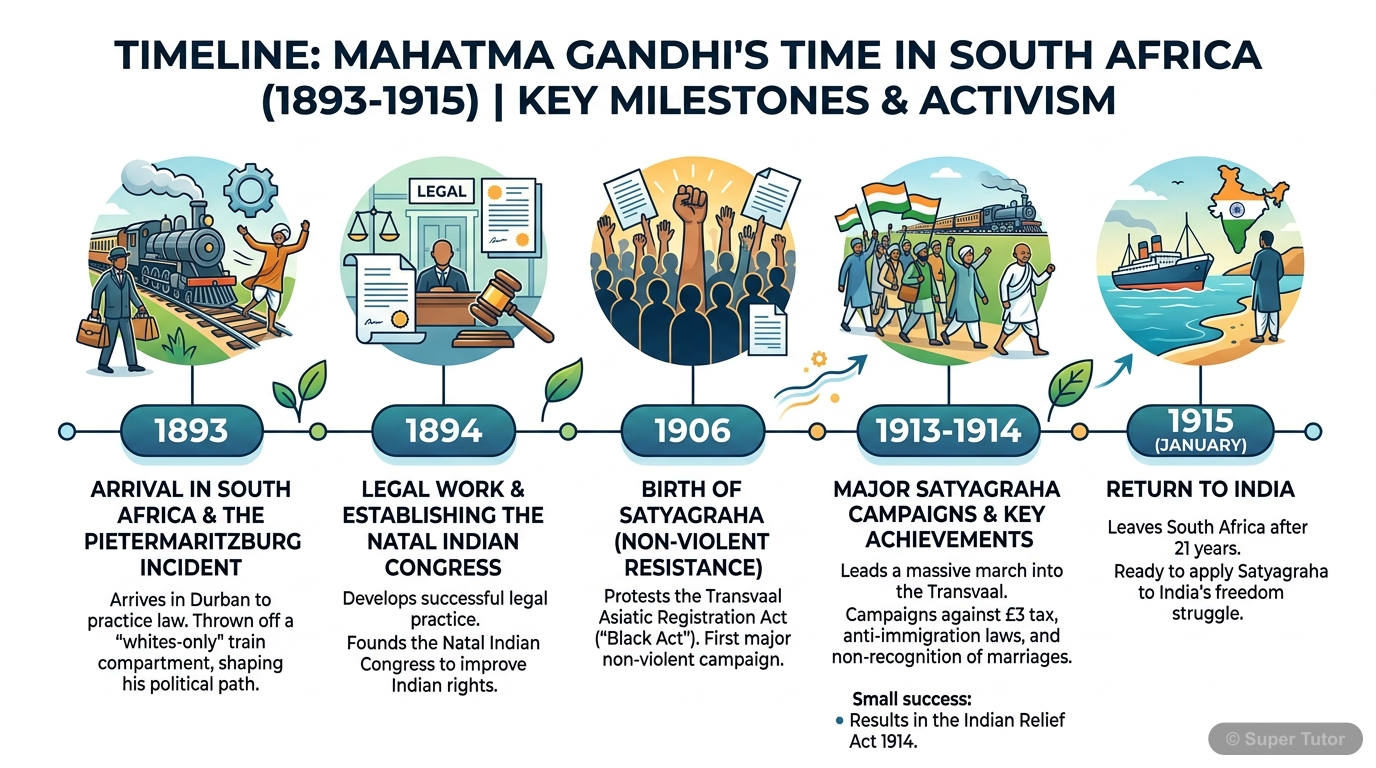
One of 11 illustrations for Mahatma Gandhi and the Nationalist Movement: Civil Disobedience and Beyond in Super Tutor — alongside flashcards, concept maps and practice questions.
Important Questions from Mahatma Gandhi and the Nationalist Movement: Civil Disobedience and Beyond
Which of the following were Gandhi's early movements in India? (Select all correct answers)
Show answer
Champaran Satyagraha (1917), Kheda Satyagraha (1918), Ahmedabad Mill Strike (1918)
Gandhi's early movements included Champaran (1917) for indigo farmers, Kheda (1918) for peasant tax relief, and Ahmedabad (1918) for textile workers. The Salt March and Quit India were later movements.
What was the Khilafat Movement concerned with?
Show answer
Restoration of the Caliphate
The Khilafat Movement (1919-1920) was led by Indian Muslims to restore the Caliphate and protect Turkish Sultan's control over Muslim sacred places. Gandhi supported it to unite Hindus and Muslims in the freedom struggle.
Why did Gandhi call off the Non-Cooperation Movement in 1922?
Show answer
Chauri Chaura violence
Gandhi called off the Non-Cooperation Movement in February 1922 after the Chauri Chaura incident, where protesters burned a police station and killed several constables. Gandhi believed this violence went against his principle of non-violence.
The Salt March began from which place?
Show answer
Sabarmati Ashram
The Salt March began on March 12, 1930, from Gandhi's Sabarmati Ashram near Ahmedabad. He walked 240 miles to the coastal village of Dandi, where he made salt by evaporating seawater, breaking the British salt monopoly.
+44 more questions on Mahatma Gandhi and the Nationalist Movement: Civil Disobedience and Beyond (Madhya Pradesh Board Class 12 History)
Practise AllFrequently Asked Questions
What are the important topics in Mahatma Gandhi and the Nationalist Movement: Civil Disobedience and Beyond for Madhya Pradesh Board Class 12 History?
How many important questions are there in Mahatma Gandhi and the Nationalist Movement: Civil Disobedience and Beyond?
Sources & Official References
Content is aligned to the official syllabus. Refer to the board website for the latest curriculum.
More resources for Mahatma Gandhi and the Nationalist Movement: Civil Disobedience and Beyond
Practice Quiz
Test yourself with a quick quiz
Revision Notes
Key points for last-minute revision
Chapter Summary
Understand the chapter at a glance
Concept Maps
See how topics connect
Study Plan
Step-by-step plan for this chapter
Flashcards
Quick-fire cards for active recall
Syllabus
What topics to cover
NCERT Solutions
Every textbook question solved step by step
For serious students
Get the full Mahatma Gandhi and the Nationalist Movement: Civil Disobedience and Beyond chapter — start free.
Quizzes, flashcards, an AI doubt solver and a study plan for Madhya Pradesh Board Class 12 History. Free to start, no card needed.