Peasants, Zamindars and the State: Agrarian Society and the Mughal Empire — Important Questions
Madhya Pradesh Board · Class 12 · History
49 important questions from Peasants, Zamindars and the State: Agrarian Society and the Mughal Empire for Madhya Pradesh Board Class 12 History.
Interactive on Super Tutor
Studying Peasants, Zamindars and the State: Agrarian Society and the Mughal Empire? Get the full interactive chapter.
Quizzes, flashcards, AI doubt-solver and a step-by-step study plan — built for important questions and more.
Free trial, no card needed.
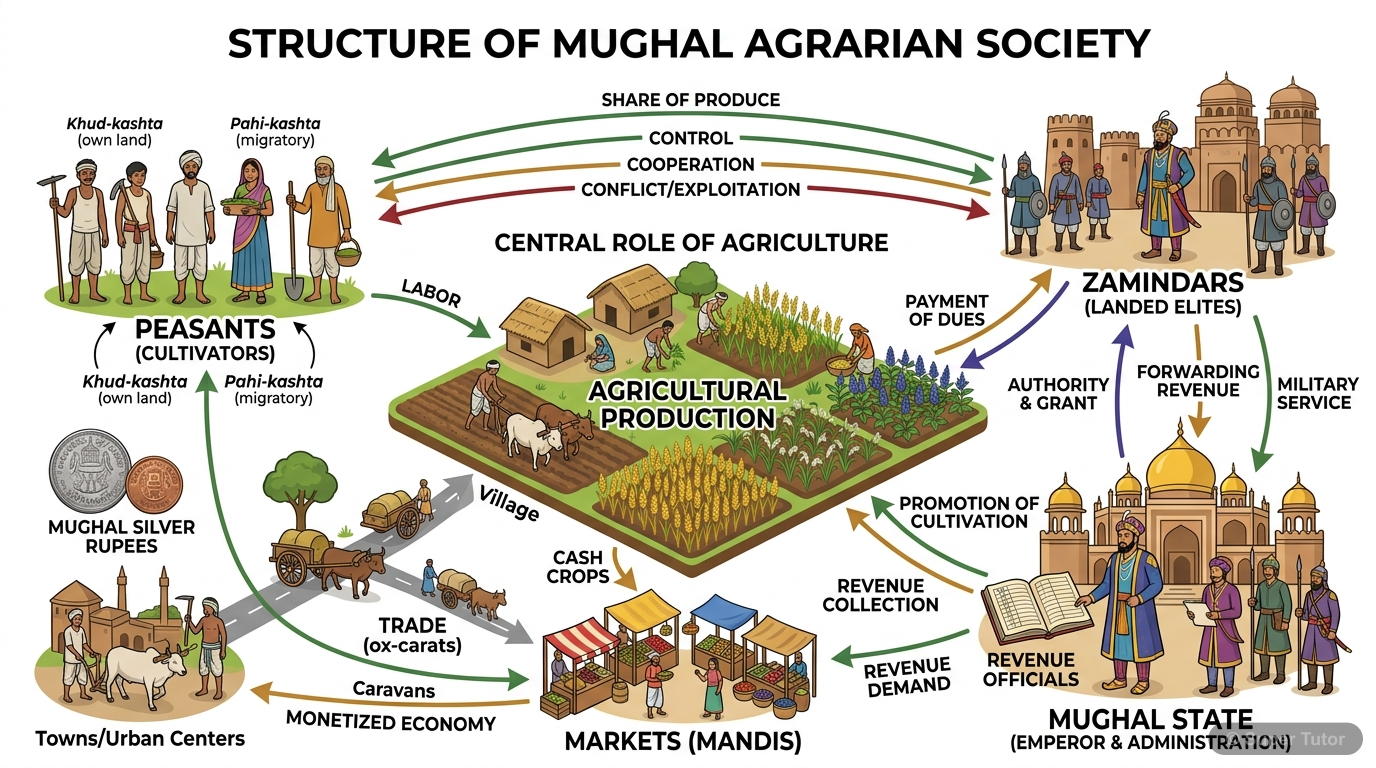
One of 11 illustrations for Peasants, Zamindars and the State: Agrarian Society and the Mughal Empire in Super Tutor — alongside flashcards, concept maps and practice questions.
Important Questions from Peasants, Zamindars and the State: Agrarian Society and the Mughal Empire
Which terms were used to denote peasants in Indo-Persian sources? (Select all correct answers)
Show answer
Raiyat, Muzarian, Kisan, Asami
Indo-Persian sources used multiple terms for peasants: raiyat (most frequent), muzarian, kisan, and asami. Zamindar referred to landed proprietors, not peasants.
Khud-kashta peasants were resident cultivators of the village.
Show answer
True
Khud-kashta were residents of the village in which they held their lands, as opposed to pahi-kashta who were non-resident cultivators from other villages.
Which crops were considered 'jins-i kamil' (perfect crops)? (Select all correct answers)
Show answer
Cotton, Sugarcane, Mustard
Jins-i kamil referred to cash crops that brought more revenue. Cotton and sugarcane were prime examples, along with oilseeds like mustard. Rice and wheat were basic staples, not cash crops.
Arrange the following land classifications in order from most to least productive:
Show answer
Polaj
Polaj was annually cultivated land (most productive), Parauti was temporarily fallow, Chachar was fallow for 3-4 years, and Banjar was uncultivated for 5+ years (least productive).
+45 more questions on Peasants, Zamindars and the State: Agrarian Society and the Mughal Empire (Madhya Pradesh Board Class 12 History)
Practise AllFrequently Asked Questions
What are the important topics in Peasants, Zamindars and the State: Agrarian Society and the Mughal Empire for Madhya Pradesh Board Class 12 History?
How many important questions are there in Peasants, Zamindars and the State: Agrarian Society and the Mughal Empire?
Sources & Official References
Content is aligned to the official syllabus. Refer to the board website for the latest curriculum.
More resources for Peasants, Zamindars and the State: Agrarian Society and the Mughal Empire
Practice Quiz
Test yourself with a quick quiz
Revision Notes
Key points for last-minute revision
Formula Sheet
The chapter's formulas in one place
Chapter Summary
Understand the chapter at a glance
Concept Maps
See how topics connect
Study Plan
Step-by-step plan for this chapter
Flashcards
Quick-fire cards for active recall
Syllabus
What topics to cover
NCERT Solutions
Every textbook question solved step by step
For serious students
Get the full Peasants, Zamindars and the State: Agrarian Society and the Mughal Empire chapter — start free.
Quizzes, flashcards, an AI doubt solver and a study plan for Madhya Pradesh Board Class 12 History. Free to start, no card needed.