Mahatma Gandhi and the Nationalist Movement: Civil Disobedience and Beyond — Syllabus
Madhya Pradesh Board · Class 12 · History
What Mahatma Gandhi and the Nationalist Movement: Civil Disobedience and Beyond covers in Madhya Pradesh Board Class 12 History: 4 topics, for the 2026-27.
Interactive on Super Tutor
Studying Mahatma Gandhi and the Nationalist Movement: Civil Disobedience and Beyond? Get the full interactive chapter.
Quizzes, flashcards, AI doubt-solver and a step-by-step study plan — built for syllabus and more.
Free trial, no card needed.
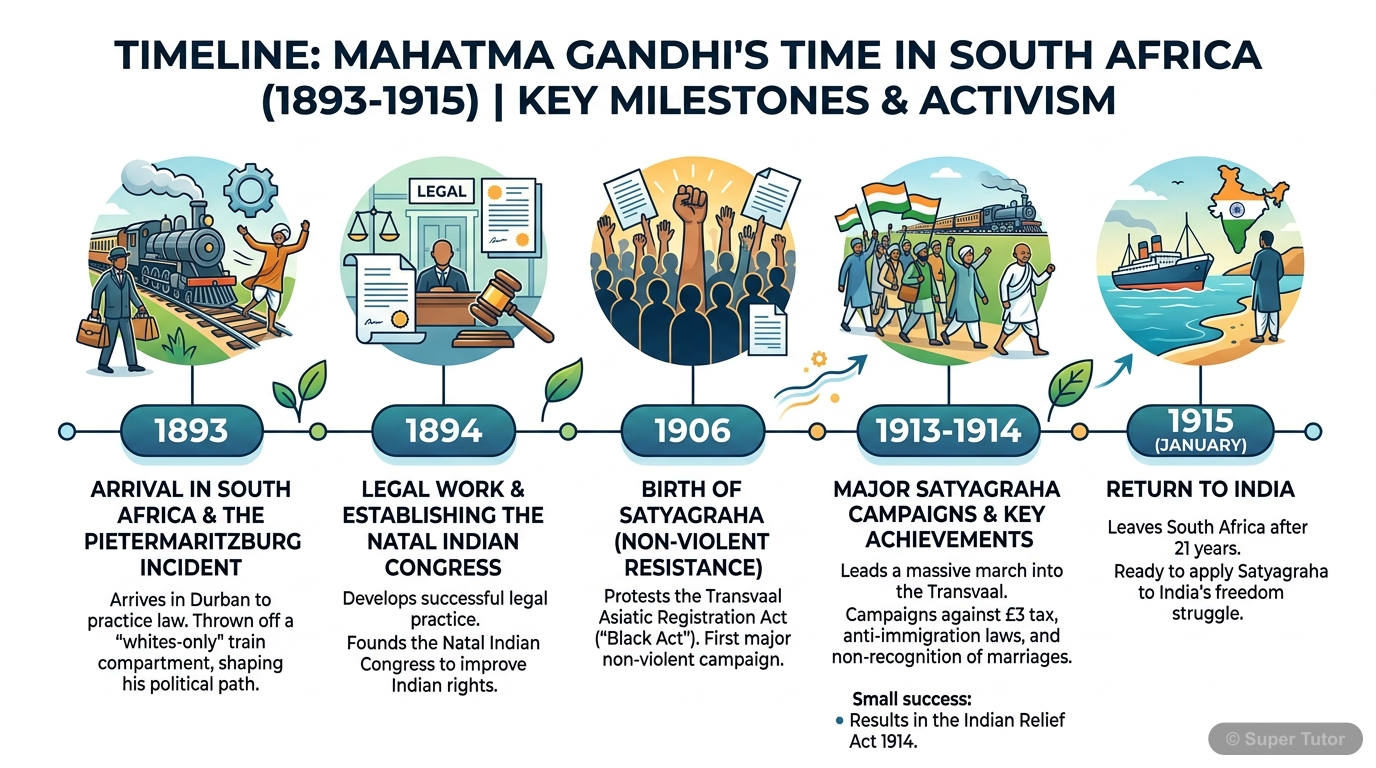
One of 11 illustrations for Mahatma Gandhi and the Nationalist Movement: Civil Disobedience and Beyond in Super Tutor — alongside flashcards, concept maps and practice questions.
Topics in Mahatma Gandhi and the Nationalist Movement: Civil Disobedience and Beyond
1. Gandhi’s Entry into Indian Politics
- Gandhi returned to India in January 1915 after two decades abroad, mostly in South Africa.
- South Africa shaped him as a leader of non-violent protest, religion harmony, and opposition to caste discrimination.
- Gopal Krishna Gokhale became his acknowledged political mentor.
2. Early Peasant and Labour Struggles
- Gandhi spent much of 1917 in Champaran seeking security of tenure and freedom to choose crops for peasants.
- In 1918 he intervened in the Ahmedabad textile mill workers’ dispute.
- In 1918 he also joined the Kheda peasants’ tax remission campaign.
3. Rowlatt Satyagraha and Non-Cooperation
- During the First World War, the British had instituted censorship of the press and detention without trial.
- The Rowlatt Act continued these wartime measures.
- The Rowlatt Satyagraha made Gandhi a truly national leader.
4. Gandhi as a People’s Leader
- By 1922 Gandhi had transformed Indian nationalism into a mass movement.
- Poor peasants, workers, and artisans saw him as a Mahatma.
- People admired that he dressed simply, lived simply, and spoke in a language close to theirs.
Key Concepts
Central concept: Mahatma Gandhi and the transformation of Indian nationalism into a mass movement through non-violent protest, social reform, and political negotiation
Work through every topic in Mahatma Gandhi and the Nationalist Movement: Civil Disobedience and Beyond with notes and quizzes
Start This ChapterFrequently Asked Questions
What are the important topics in Mahatma Gandhi and the Nationalist Movement: Civil Disobedience and Beyond for Madhya Pradesh Board Class 12 History?
How should I revise Mahatma Gandhi and the Nationalist Movement: Civil Disobedience and Beyond for the Madhya Pradesh Board Class 12 board exam?
Sources & Official References
Content is aligned to the official syllabus. Refer to the board website for the latest curriculum.
More resources for Mahatma Gandhi and the Nationalist Movement: Civil Disobedience and Beyond
Practice Quiz
Test yourself with a quick quiz
Important Questions
Exam-style questions with answers
Revision Notes
Key points for last-minute revision
Chapter Summary
Understand the chapter at a glance
Concept Maps
See how topics connect
Study Plan
Step-by-step plan for this chapter
Flashcards
Quick-fire cards for active recall
NCERT Solutions
Every textbook question solved step by step
For serious students
Get the full Mahatma Gandhi and the Nationalist Movement: Civil Disobedience and Beyond chapter — start free.
Quizzes, flashcards, an AI doubt solver and a study plan for Madhya Pradesh Board Class 12 History. Free to start, no card needed.