Mahatma Gandhi and the Nationalist Movement: Civil Disobedience and Beyond — NCERT Solutions
Madhya Pradesh Board · Class 12 · History
NCERT Solutions for Mahatma Gandhi and the Nationalist Movement: Civil Disobedience and Beyond, Madhya Pradesh Board Class 12 History: 12 textbook.
Interactive on Super Tutor
Studying Mahatma Gandhi and the Nationalist Movement: Civil Disobedience and Beyond? Get the full interactive chapter.
Quizzes, flashcards, AI doubt-solver and a step-by-step study plan — built for NCERT solutions and more.
Free trial, no card needed.
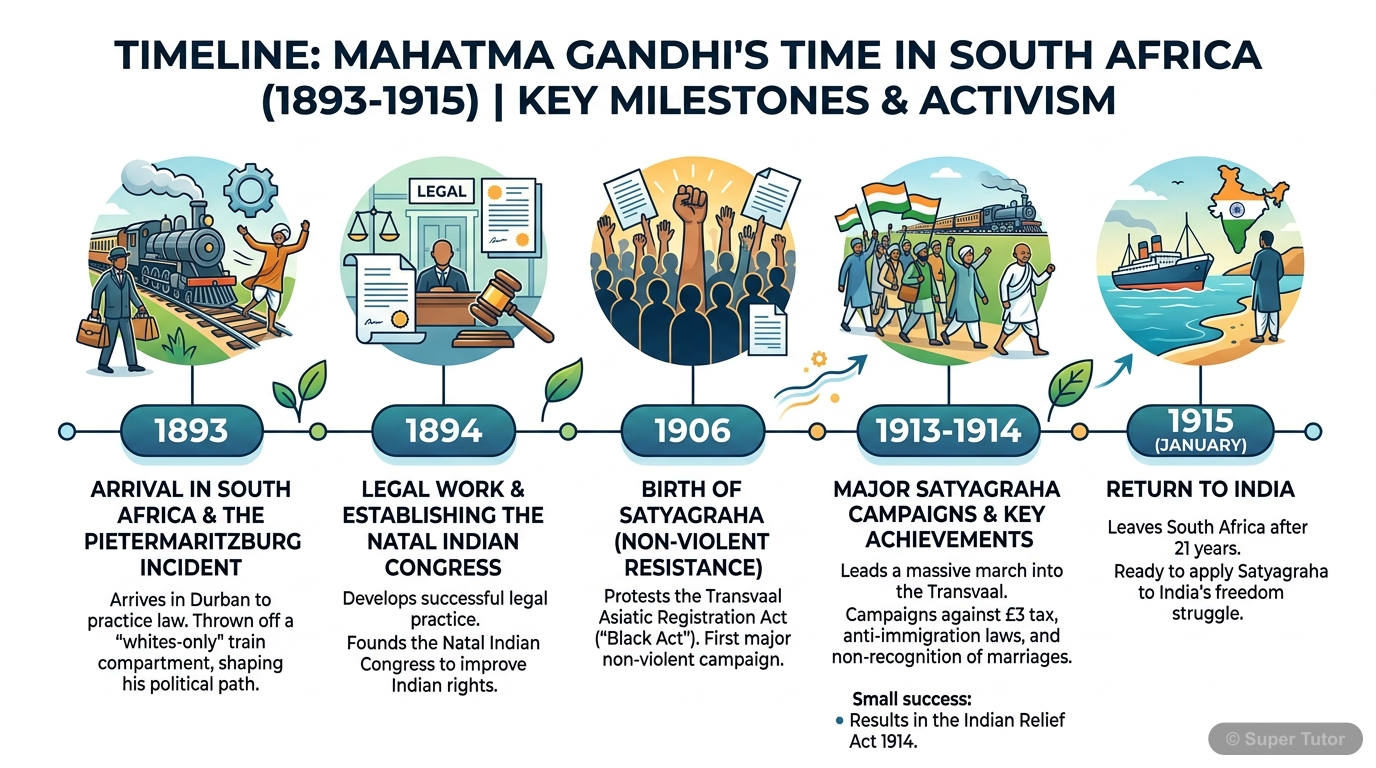
One of 11 illustrations for Mahatma Gandhi and the Nationalist Movement: Civil Disobedience and Beyond in Super Tutor — alongside flashcards, concept maps and practice questions.
The first 6 solutions are open to read. The other 6 are free with a Super Tutor account.
Answer in 100-150 Words
1How did Mahatma Gandhi seek to identify with the common people?Show solution
Given/Context: Mahatma Gandhi returned to India from South Africa in 1915 and sought to connect with the masses of India.
Answer:
Mahatma Gandhi identified with the common people in several significant ways:
- Appearance and dress: He gave up Western clothes and adopted the dhoti and shawl — the dress of the ordinary Indian peasant. This made him visually indistinguishable from the poor.
- Language: He encouraged communication of the nationalist message in the mother tongue rather than in English, making politics accessible to ordinary people.
- Travel: He travelled across India in third-class railway compartments, experiencing the hardships faced by common people.
- Championing their causes: He took up the struggles of peasants (Champaran, Kheda), mill workers (Ahmedabad), and the poor, showing genuine sympathy for their problems.
- Promotion of khadi: By spinning the charkha and wearing khadi, he symbolically aligned himself with the self-reliant village economy.
Thus, unlike other politicians who talked down to the masses, Gandhi appeared to understand and relate to their lives, making him a truly people's leader.
2How was Mahatma Gandhi perceived by the peasants?Show solution
Given/Context: Mahatma Gandhi's mass appeal among peasants was a distinctive feature of the nationalist movement.
Answer:
The peasants perceived Mahatma Gandhi in an almost reverential, even supernatural light — as a Mahatma (great soul) rather than merely a political leader. Several aspects of this perception are notable:
- Messianic figure: Peasants believed Gandhi had come to liberate them from British oppression and from the exploitation of landlords. They saw him as a saviour sent by the king to help them.
- Miraculous powers: Rumours circulated among peasants that Gandhi possessed divine powers. For example, it was believed that those who opposed him met with misfortune — a man's house caught fire, another's goat was bitten by his own dogs.
- Moral authority: Gandhi was seen as a moral force who could stop evil — people believed that uttering his name could stop brickbats from flying.
- Identification with the poor: Unlike other leaders, Gandhi dressed like them, travelled like them, and fought for their causes (Champaran, Kheda), which made him appear as one of their own.
This perception transformed Gandhi into a symbol of hope and resistance for millions of Indian peasants.
3Why did the salt laws become an important issue of struggle?Show solution
Given/Context: In 1930, Mahatma Gandhi launched the Civil Disobedience Movement by breaking the salt laws through the famous Dandi March.
Answer:
Salt became an important symbol of protest for the following reasons:
- Universal necessity: Salt is an essential item consumed by every Indian — rich or poor, Hindu or Muslim, from every region. A tax on salt therefore affected the entire population.
- Oppressive taxation: The colonial government imposed a heavy tax on salt — sometimes as much as fourteen times its actual value. This was a direct burden on the poorest sections of society.
- State monopoly: The British government held a monopoly over salt production and sale. It prevented Indians from manufacturing salt freely and even destroyed naturally occurring salt that people could have used without cost.
- Symbol of colonial exploitation: As Gandhi argued, the salt tax was a "fourfold curse" — it deprived people of a village industry, involved destruction of natural property, caused national expenditure, and imposed an enormous tax on a starving people.
- Unifying potential: Because salt was used by all Indians regardless of class, caste, or religion, the salt tax could unite the entire nation in protest.
Thus, the salt laws were both practically oppressive and symbolically powerful, making them an ideal focus for mass civil disobedience.
4Why are newspapers an important source for the study of the national movement?Show solution
Given/Context: Historians use a variety of sources to reconstruct the history of the national movement, and newspapers are among the most important.
Answer:
Newspapers are an important source for the study of the national movement for the following reasons:
- Contemporary record: Newspapers published at the time tracked Mahatma Gandhi's movements, reported on his activities, and recorded events as they happened, providing a day-to-day account of the movement.
- Diverse perspectives: Newspapers published in English as well as in various Indian languages represented different viewpoints — nationalist, loyalist, regional — giving historians a multi-dimensional picture of events.
- Public opinion: They reflected what ordinary Indians thought about Gandhi and the movement, capturing popular sentiment that official records often ignored.
- Spread of nationalism: Newspapers helped spread nationalist ideas to different parts of the country, and studying them reveals how the message of the movement was communicated.
Caution: However, newspapers must be read critically. They were not unbiased — they were published by people with their own political opinions. A London newspaper's account would differ greatly from an Indian nationalist paper's account of the same event. Therefore, historians must cross-check newspaper reports with other sources before drawing conclusions.
5Why was the charkha chosen as a symbol of nationalism?Show solution
Given/Context: Mahatma Gandhi promoted the spinning wheel (charkha) as a central symbol of the nationalist movement and of his constructive programme.
Answer:
The charkha was chosen as a symbol of nationalism for several important reasons:
- Economic self-reliance: The charkha represented the idea of swadeshi — the use of Indian-made goods. By spinning their own cloth (khadi), Indians could reduce dependence on British mill-made cloth, thereby weakening the colonial economy.
- Dignity of labour: Gandhi believed that manual labour was dignified. The charkha symbolised the idea that every Indian — whether rich or poor, educated or uneducated — could contribute to the freedom struggle through productive work.
- Unity across classes: Spinning was an activity that could be performed by all Indians regardless of caste, class, religion, or region. It was therefore a unifying symbol.
- Connection with the poor: The charkha was associated with the village economy and the life of the poor peasant. By adopting it, Gandhi signalled his identification with the masses.
- Resistance to colonialism: Producing khadi was a direct act of defiance against British economic policies that had destroyed India's traditional textile industry.
Thus, the charkha was not merely an economic tool but a powerful political and cultural symbol of Indian self-sufficiency and resistance to colonial rule.
Write a Short Essay (250-300 Words)
6How was non-cooperation a form of protest?Show solution
Introduction:
Non-cooperation was a unique and powerful form of protest launched by Mahatma Gandhi in 1920-22. It was based on the idea that colonial rule survived because Indians cooperated with it — and that if Indians withdrew their cooperation, the British could not govern.
Withdrawal of cooperation:
The Non-cooperation Movement called upon Indians to boycott British institutions and symbols of colonial authority. Students were asked to leave government-run schools and colleges. Lawyers were urged to boycott British courts. Voters were asked not to participate in elections to legislative councils. People were encouraged to return honours and titles given by the British government.
Economic dimension:
On the economic front, Indians were asked to boycott foreign cloth and use only khadi. Import of British goods was to be stopped. This struck directly at the economic interests of the colonial power.
Constructive programme:
Non-cooperation was not merely negative. Gandhi paired it with a constructive programme: promotion of khadi, establishment of national schools and colleges, and efforts towards Hindu-Muslim unity and the removal of untouchability.
Mass participation:
The movement drew in diverse social groups — peasants, workers, students, women, and merchants — each participating in ways relevant to their own lives and grievances. Peasants refused to pay taxes; workers went on strike; women picketed shops selling foreign cloth.
Significance as protest:
Non-cooperation was a form of protest because it challenged the legitimacy of British rule without resorting to violence. It demonstrated that Indians could collectively refuse to sustain a system they considered unjust. It was, in Gandhi's words, a way of making the rulers feel the moral weight of the governed.
Conclusion:
Non-cooperation thus transformed passive subjects into active resisters, making it one of the most innovative forms of political protest in modern history.
Free with a Super Tutor account
Free with a Super Tutor account
Free with a Super Tutor account
Map Work
Free with a Super Tutor account
Project
Free with a Super Tutor account
Free with a Super Tutor account
6 more solved questions in Mahatma Gandhi and the Nationalist Movement: Civil Disobedience and Beyond
They are free with a Super Tutor account, along with practice quizzes and flashcards for this chapter. Free to start, no card needed.
Frequently Asked Questions
What are the important topics in Mahatma Gandhi and the Nationalist Movement: Civil Disobedience and Beyond for Madhya Pradesh Board Class 12 History?
Are these NCERT Solutions for Mahatma Gandhi and the Nationalist Movement: Civil Disobedience and Beyond free?
How should I revise Mahatma Gandhi and the Nationalist Movement: Civil Disobedience and Beyond for the Madhya Pradesh Board Class 12 board exam?
Sources & Official References
Content is aligned to the official syllabus. Refer to the board website for the latest curriculum.
More resources for Mahatma Gandhi and the Nationalist Movement: Civil Disobedience and Beyond
Practice Quiz
Test yourself with a quick quiz
Important Questions
Exam-style questions with answers
Revision Notes
Key points for last-minute revision
Chapter Summary
Understand the chapter at a glance
Concept Maps
See how topics connect
Study Plan
Step-by-step plan for this chapter
Flashcards
Quick-fire cards for active recall
Syllabus
What topics to cover
For serious students
Get the full Mahatma Gandhi and the Nationalist Movement: Civil Disobedience and Beyond chapter — start free.
Quizzes, flashcards, an AI doubt solver and a study plan for Madhya Pradesh Board Class 12 History. Free to start, no card needed.