Mahatma Gandhi and the Nationalist Movement: Civil Disobedience and Beyond — Study Plan
Madhya Pradesh Board · Class 12 · History
A step-by-step study plan for Mahatma Gandhi and the Nationalist Movement: Civil Disobedience and Beyond, Madhya Pradesh Board Class 12 History: what.
Interactive on Super Tutor
Studying Mahatma Gandhi and the Nationalist Movement: Civil Disobedience and Beyond? Get the full interactive chapter.
Quizzes, flashcards, AI doubt-solver and a step-by-step study plan — built for study plan and more.
Free trial, no card needed.
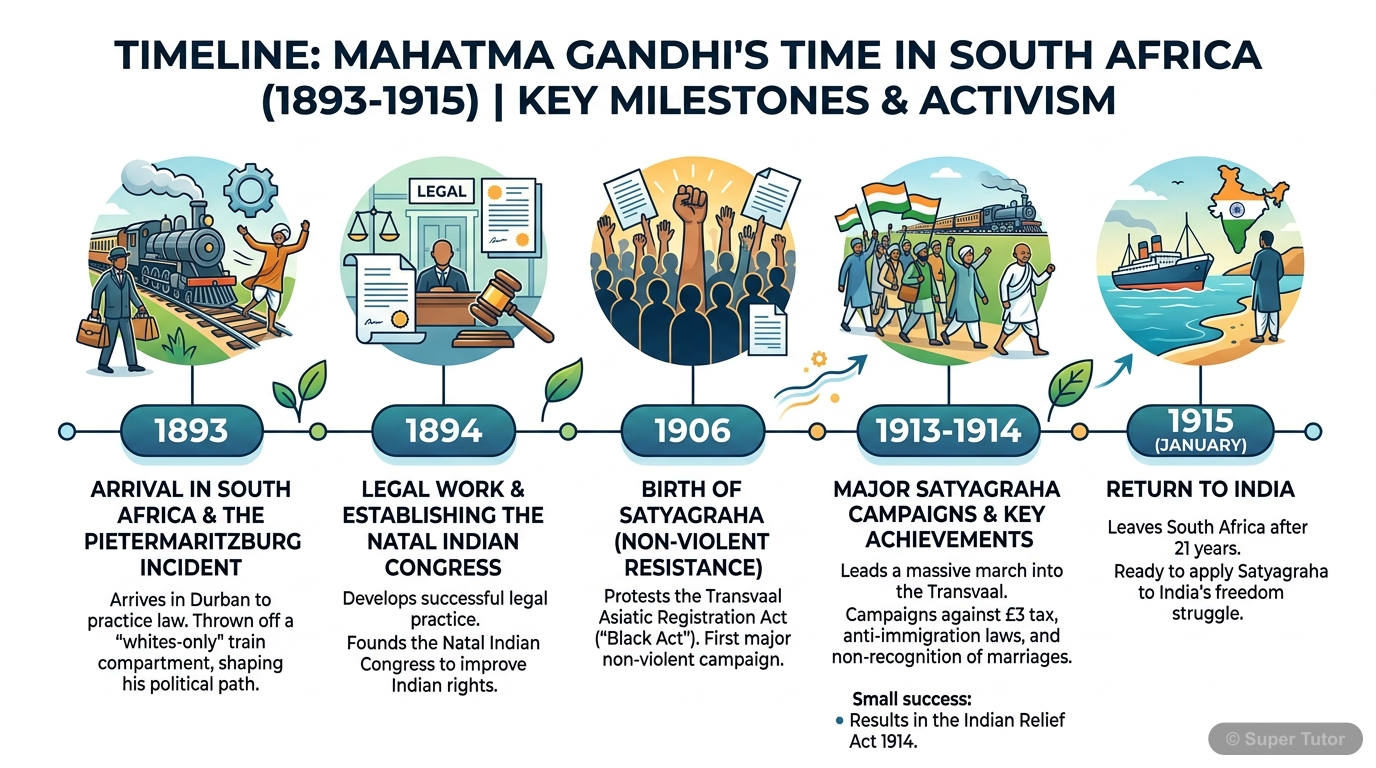
One of 11 illustrations for Mahatma Gandhi and the Nationalist Movement: Civil Disobedience and Beyond in Super Tutor — alongside flashcards, concept maps and practice questions.
Study Plan
Learn the Theory
Read the textbook chapter carefully. Note down definitions, formulas and key ideas. Focus on: 1. Gandhi’s Entry into Indian Politics, 2. Early Peasant and Labour Struggles, 3. Rowlatt Satyagraha and Non-Cooperation.
Practise
Solve the textbook exercises and extra practice questions. There are 48 questions available for this chapter.
Revise & Test
Revise key points without looking at your notes. Take a practice quiz and mark weak areas for another pass.
Spaced Revision
Come back to Mahatma Gandhi and the Nationalist Movement: Civil Disobedience and Beyond after a week. Use flashcards for quick recall and try past exam questions on this chapter.
What to Focus On
- Gandhi returned to India in January 1915.
- South Africa shaped his politics and methods of protest.
- His first major public appearance in India was at BHU in February 1916.
- The Champaran peasant approached Gandhi at Lucknow in December 1916.
- Champaran work in 1917 focused on security of tenure and crop choice.
- Ahmedabad involved a workers’ dispute in 1918.
- The Rowlatt Act continued wartime censorship and detention without trial.
- The committee was chaired by Sir Sidney Rowlatt.
- The protests spread widely across North and West India.
Common Mistakes to Avoid
Gandhi became a national leader only after the Jallianwala Bagh massacre.
Non-cooperation and Khilafat were the same movement led by Gandhi.
Gandhi called off Non-cooperation because of Jallianwala Bagh.
Memory Tips
Gandhi returned to India in January 1915 after two decades abroad, mostly in South Africa
South Africa shaped Gandhi's politics
Lal, Bal and Pal were militant nationalist leaders
Gokhale was Gandhi's political mentor among the Moderates
Want a personalised study plan?
Super Tutor builds a day-by-day plan for Madhya Pradesh Board Class 12 History that fits your exam date and pace.
Create My Study PlanFrequently Asked Questions
What are the important topics in Mahatma Gandhi and the Nationalist Movement: Civil Disobedience and Beyond for Madhya Pradesh Board Class 12 History?
How should I revise Mahatma Gandhi and the Nationalist Movement: Civil Disobedience and Beyond for the Madhya Pradesh Board Class 12 board exam?
Sources & Official References
Content is aligned to the official syllabus. Refer to the board website for the latest curriculum.
More resources for Mahatma Gandhi and the Nationalist Movement: Civil Disobedience and Beyond
Practice Quiz
Test yourself with a quick quiz
Important Questions
Exam-style questions with answers
Revision Notes
Key points for last-minute revision
Chapter Summary
Understand the chapter at a glance
Concept Maps
See how topics connect
Flashcards
Quick-fire cards for active recall
Syllabus
What topics to cover
NCERT Solutions
Every textbook question solved step by step
For serious students
Get the full Mahatma Gandhi and the Nationalist Movement: Civil Disobedience and Beyond chapter — start free.
Quizzes, flashcards, an AI doubt solver and a study plan for Madhya Pradesh Board Class 12 History. Free to start, no card needed.