Peasants, Zamindars and the State: Agrarian Society and the Mughal Empire — Flashcards
Madhya Pradesh Board · Class 12 · History
88 flashcards for Peasants, Zamindars and the State: Agrarian Society and the Mughal Empire (Madhya Pradesh Board Class 12 History) to test yourself.
Interactive on Super Tutor
Studying Peasants, Zamindars and the State: Agrarian Society and the Mughal Empire? Get the full interactive chapter.
Quizzes, flashcards, AI doubt-solver and a step-by-step study plan — built for flashcards and more.
Free trial, no card needed.
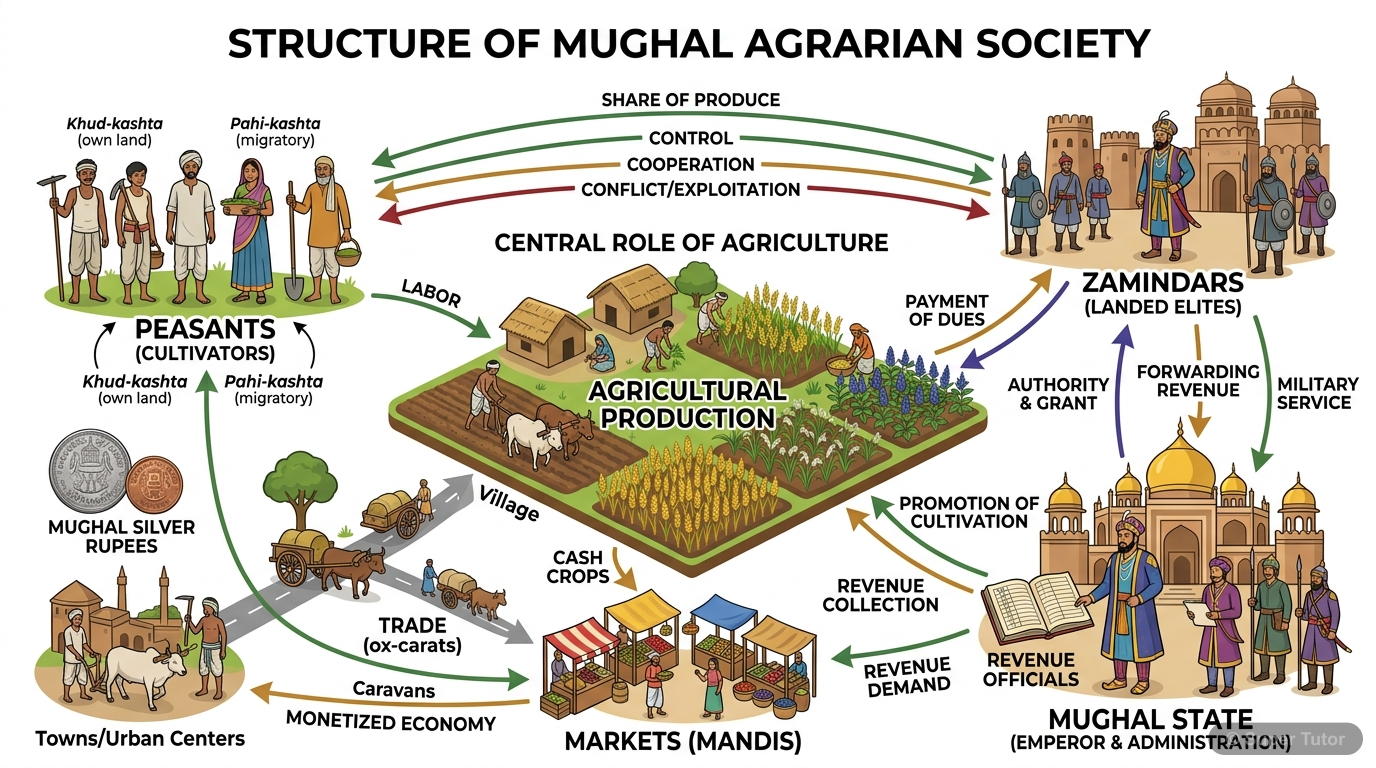
One of 11 illustrations for Peasants, Zamindars and the State: Agrarian Society and the Mughal Empire in Super Tutor — alongside flashcards, concept maps and practice questions.
Why was agrarian society the economic base of the Mughal Empire?
Answer
Agriculture was the main source of income for the Mughal state. Most people lived in villages and produced the crops from which revenue was collected. The state depended on agricultural production, so…
कृषि प्रधान समाज मुगल साम्राज्य का आर्थिक आधार क्यों था?
Answer
कृषि मुगल राज्य के लिए आय का मुख्य स्रोत था। अधिकांश लोग गाँवों में रहते थे और उन फसलों का उत्पादन करते थे जिनसे राजस्व एकत्र किया जाता था। राज्य कृषि उत्पादन पर निर्भर था, इसलिए किसानों, भूमि और करों…
मुगल काल के स्रोतों में रैयत शब्द का क्या अर्थ है?
Answer
रायत मुगल काल के स्रोतों में किसान के लिए इस्तेमाल किया जाने वाला एक सामान्य शब्द था। यह उस कृषक को संदर्भित करता था जो भूमि पर काम करता था और ग्रामीण उत्पादन की मूल इकाई का निर्माण करता था।…
What does the term raiyat mean in Mughal-period sources?
Answer
Raiyat was a common term used for a peasant in Mughal-period sources. It referred to the cultivator who worked the land and formed the basic unit of rural production.
What is the difference between khud-kashta and pahi-kashta?
Answer
Khud-kashta were resident cultivators who lived in the village where they held land. Pahi-kashta were non-resident cultivators who came from another village and cultivated land elsewhere on a contract…
खुद-कश्ता और पाही-कश्ता में क्या अंतर है?
Answer
खुद-कश्त निवासी कृषक थे जो उस गाँव में रहते थे जहाँ उनकी जमीन थी। पाही-कश्त गैर-निवासी कृषक थे जो किसी दूसरे गाँव से आकर कहीं और जमीन पर अनुबंध के आधार पर खेती करते थे। अंतर निवास का है, धन का नहीं।…
कुछ किसान पाही-कश्ता क्यों हो गए?
Answer
कुछ किसान अपनी पसंद से पाही-काश्त बन गए जब दूसरे गाँव में राजस्व की शर्तें अधिक अनुकूल थीं। अन्य लोग मजबूरी में पाही-काश्त बन गए, विशेष रूप से जब अकाल या आर्थिक संकट ने उन्हें स्थानांतरित होने के लिए …
Why did some peasants become pahi-kashta?
Answer
Some peasants became pahi-kashta by choice when revenue terms in another village were more favourable. Others became pahi-kashta because of compulsion, especially when famine or economic distress forc…
+80 more flashcards
Practise AllFrequently Asked Questions
What are the important topics in Peasants, Zamindars and the State: Agrarian Society and the Mughal Empire for Madhya Pradesh Board Class 12 History?
How many flashcards are available for Peasants, Zamindars and the State: Agrarian Society and the Mughal Empire?
How should I revise Peasants, Zamindars and the State: Agrarian Society and the Mughal Empire for the Madhya Pradesh Board Class 12 board exam?
Sources & Official References
Content is aligned to the official syllabus. Refer to the board website for the latest curriculum.
More resources for Peasants, Zamindars and the State: Agrarian Society and the Mughal Empire
Practice Quiz
Test yourself with a quick quiz
Important Questions
Exam-style questions with answers
Revision Notes
Key points for last-minute revision
Formula Sheet
The chapter's formulas in one place
Chapter Summary
Understand the chapter at a glance
Concept Maps
See how topics connect
Study Plan
Step-by-step plan for this chapter
Syllabus
What topics to cover
NCERT Solutions
Every textbook question solved step by step
For serious students
Get the full Peasants, Zamindars and the State: Agrarian Society and the Mughal Empire chapter — start free.
Quizzes, flashcards, an AI doubt solver and a study plan for Madhya Pradesh Board Class 12 History. Free to start, no card needed.