Peasants, Zamindars and the State: Agrarian Society and the Mughal Empire — Study Plan
Madhya Pradesh Board · Class 12 · History
A step-by-step study plan for Peasants, Zamindars and the State: Agrarian Society and the Mughal Empire, Madhya Pradesh Board Class 12 History: what.
Interactive on Super Tutor
Studying Peasants, Zamindars and the State: Agrarian Society and the Mughal Empire? Get the full interactive chapter.
Quizzes, flashcards, AI doubt-solver and a step-by-step study plan — built for study plan and more.
Free trial, no card needed.
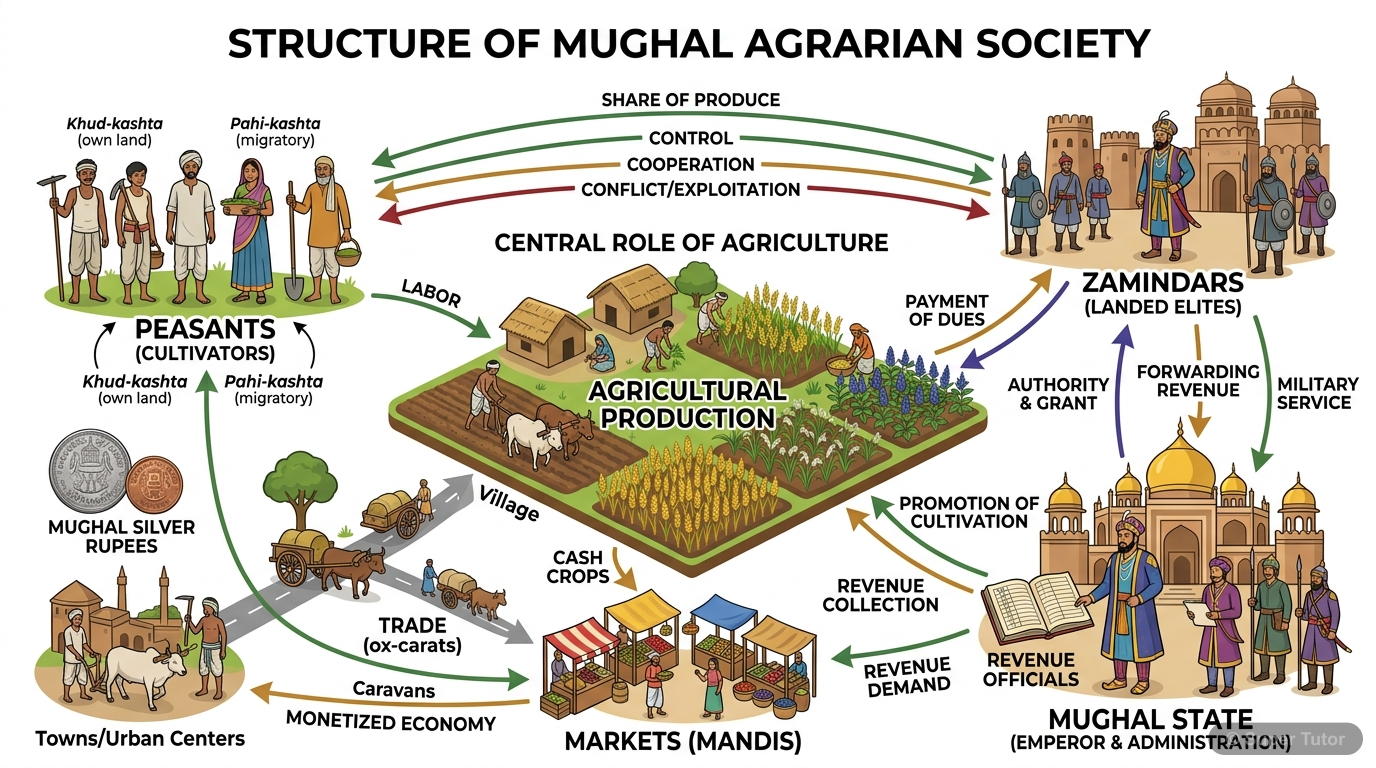
One of 11 illustrations for Peasants, Zamindars and the State: Agrarian Society and the Mughal Empire in Super Tutor — alongside flashcards, concept maps and practice questions.
Study Plan
Learn the Theory
Read the textbook chapter carefully. Note down definitions, formulas and key ideas. Focus on: 1. Peasants and Agricultural Production, 2. Irrigation, Technology, and Crop Diversity, 3. Village Community, Panchayat, and Caste.
Practise
Solve the textbook exercises and extra practice questions. There are 49 questions available for this chapter.
Revise & Test
Revise key points without looking at your notes. Take a practice quiz and mark weak areas for another pass.
Spaced Revision
Come back to Peasants, Zamindars and the State: Agrarian Society and the Mughal Empire after a week. Use flashcards for quick recall and try past exam questions on this chapter.
What to Focus On
- About 85% of India's population lived in villages during the 16th and 17th centuries.
- The village was the basic unit of agrarian society.
- Agrarian life included peasants, artisans, zamindars, forest dwellers, and state agents.
- Khud-kashta means resident cultivator.
- Pahi-kashta means non-resident or migrant cultivator.
- Peasant land was individually owned and transferable.
- Areas receiving 40 inches or more rainfall annually were generally rice-producing zones.
- Monsoon rainfall remained the backbone of agriculture.
- Babur described both wheel and bucket irrigation systems.
Common Mistakes to Avoid
All cultivators in Mughal villages were the same kind of peasant.
Village panchayat and jati panchayat were the same institution.
Zamindars were just ordinary peasants with more land.
Memory Tips
Peasants on the move in Hindustan
Resident and non-resident cultivators
Irrigation devices observed by Babur
Babur's observation about forests as refuge
Want a personalised study plan?
Super Tutor builds a day-by-day plan for Madhya Pradesh Board Class 12 History that fits your exam date and pace.
Create My Study PlanFrequently Asked Questions
What are the important topics in Peasants, Zamindars and the State: Agrarian Society and the Mughal Empire for Madhya Pradesh Board Class 12 History?
How should I revise Peasants, Zamindars and the State: Agrarian Society and the Mughal Empire for the Madhya Pradesh Board Class 12 board exam?
Sources & Official References
Content is aligned to the official syllabus. Refer to the board website for the latest curriculum.
More resources for Peasants, Zamindars and the State: Agrarian Society and the Mughal Empire
Practice Quiz
Test yourself with a quick quiz
Important Questions
Exam-style questions with answers
Revision Notes
Key points for last-minute revision
Formula Sheet
The chapter's formulas in one place
Chapter Summary
Understand the chapter at a glance
Concept Maps
See how topics connect
Flashcards
Quick-fire cards for active recall
Syllabus
What topics to cover
NCERT Solutions
Every textbook question solved step by step
For serious students
Get the full Peasants, Zamindars and the State: Agrarian Society and the Mughal Empire chapter — start free.
Quizzes, flashcards, an AI doubt solver and a study plan for Madhya Pradesh Board Class 12 History. Free to start, no card needed.