Peasants, Zamindars and the State: Agrarian Society and the Mughal Empire — NCERT Solutions
Madhya Pradesh Board · Class 12 · History
NCERT Solutions for Peasants, Zamindars and the State: Agrarian Society and the Mughal Empire, Madhya Pradesh Board Class 12 History: 19 textbook.
Interactive on Super Tutor
Studying Peasants, Zamindars and the State: Agrarian Society and the Mughal Empire? Get the full interactive chapter.
Quizzes, flashcards, AI doubt-solver and a step-by-step study plan — built for NCERT solutions and more.
Free trial, no card needed.
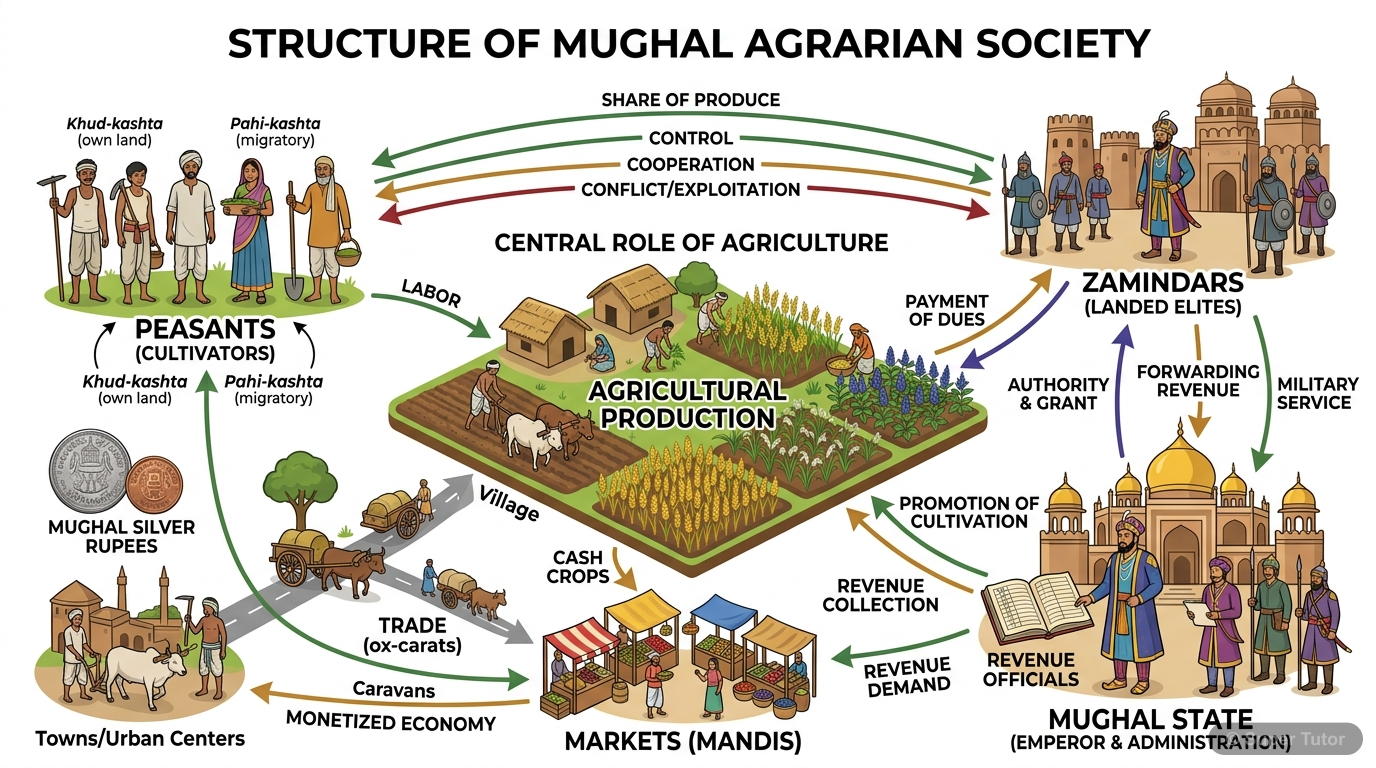
One of 11 illustrations for Peasants, Zamindars and the State: Agrarian Society and the Mughal Empire in Super Tutor — alongside flashcards, concept maps and practice questions.
The first 10 solutions are open to read. The other 9 are free with a Super Tutor account.
Source-Based Questions (In-text)
S1Describe the aspects of agricultural life that struck Babur as particular to regions in northern India. (Source 1 – Peasants on the move, Babur Nama)Show solution
Given: An excerpt from the Babur Nama describing Babur's observations of agrarian life in northern India.
Answer:
Babur was struck by the following aspects of agricultural life in northern India:
- Mobility of peasants: Babur was amazed at how quickly entire villages could be abandoned. If the people of a large, long-inhabited town decided to flee, they could do so within a day and a half, leaving no trace behind.
- Ease of re-settlement: Equally remarkable to Babur was how rapidly a new settlement could be established. Since crops were rain-grown (dependent on monsoons), there was no need to dig elaborate water channels. The abundant population of Hindustan meant that settlers 'swarmed in' quickly.
- Rain-fed agriculture: Babur noted that autumn crops grew entirely due to rainfall, and even spring crops grew without rain in many areas. This meant agriculture was largely dependent on the monsoon rather than on artificial irrigation.
- Abundance of natural resources: Khas-grass and wood were plentiful, making it easy to construct huts rapidly. A tank or well could be dug without great effort, and a village or town could spring up almost overnight.
- Large and unlimited population: Babur was struck by the sheer density of population in Hindustan, which facilitated rapid colonisation of new areas.
In short, the combination of a mobile peasantry, rain-fed agriculture, abundant natural resources, and a large population made the agrarian landscape of northern India distinctly different from what Babur had seen in Central Asia.
S2Compare the irrigation devices observed by Babur with what you have learnt about irrigation in Vijayanagara (Chapter 7). What kind of resources would each of these systems require? Which systems could ensure the participation of peasants in improving agricultural technology? (Source 2 – Irrigating trees and fields)Show solution
Given: Babur's description of irrigation devices (the Persian wheel/rahat in Lahore/Dipalpur, and the bucket/charsa in Agra/Bayana) and knowledge of Vijayanagara irrigation.
Comparison:
| Feature | Babur's Northern India | Vijayanagara | |
|---|---|---|---|
| Main system | Persian wheel (rahat) and bucket (charsa) | Large tanks (reservoirs), canals, embankments | |
| Scale | Small-scale, individual well-based | Large-scale, state-sponsored | |
| Water source | Wells | Rivers, rainwater stored in tanks | |
| Technology | Mechanical (bullock-driven wheel with pitchers) | Engineering works (dams, sluices, channels) |
Resources required:
- Persian wheel: Required a well, wooden wheels, rope, clay pitchers, and a bullock. This was within the means of a moderately prosperous peasant family.
- Bucket system (charsa): Required a well, a wooden fork/roller, rope, a large bucket, and a bullock plus two labourers. Even simpler and cheaper.
- Vijayanagara tanks and canals: Required massive state investment — engineering expertise, large labour forces, stone masonry, and royal patronage. Individual peasants could not build these on their own.
Peasant participation:
The Persian wheel and bucket systems were small-scale technologies that individual peasant families or small groups could operate and maintain. These systems therefore ensured direct peasant participation in improving agricultural technology. The large tank-and-canal systems of Vijayanagara, while more efficient for large areas, required state initiative and were beyond the capacity of ordinary peasants to construct or maintain independently.
S3What forms of intrusion into the forest does the text evoke? Compare its message with that of the miniature painting in Fig. 8.9. Who are the people identified as 'foreigners' from the perspective of the forest dwellers? (Source 3 – Clearance of forests for agricultural settlements, Chandimangala)Show solution
Given: An excerpt from the sixteenth-century Bengali poem Chandimangala by Mukundaram Chakrabarti, describing the clearing of forests by Kalaketu to set up a kingdom.
Forms of intrusion into the forest:
- Armed clearing: Kalaketu distributed heavy knives, axes, battle-axes, and pikes to outsiders who came from various lands to clear the forest. This represents a violent, organised intrusion.
- Migration of diverse groups: People came from the north (Das people), south (harvesters), and west (Zafar Mian with thousands of men). This shows large-scale human migration into forested areas.
- Establishment of markets: After clearing the forest, markets were established, signifying the transformation of forest land into agricultural and commercial zones.
- Displacement of wildlife: The sound of axes drove tigers away, symbolising the destruction of the natural habitat of forest creatures.
Comparison with Fig. 8.9 (Shah Jahan hunting nilgais):
The painting depicts the Mughal emperor hunting in the forest — a royal intrusion into forest space. While the poem shows intrusion through agricultural colonisation (clearing for settlement and trade), the painting shows intrusion through the hunt, which was a symbol of royal power and control over nature and subjects. Both represent the encroachment of 'civilised' or state power into forest zones.
Who are the 'foreigners'?
From the perspective of the original forest dwellers (the jangli or tribal communities), all the outsiders who came to clear the forest — the Das people from the north, the harvesters from the south, and Zafar Mian's men from the west — were 'foreigners.' These were agricultural settlers and migrants who did not belong to the forest community and whose arrival threatened the way of life of the indigenous forest inhabitants.
S4What principles did the Mughal state follow while classifying lands in its territories? How was revenue assessed? (Source 5 – Classification of lands under Akbar, the Ain)Show solution
Given: An excerpt from the Ain-i-Akbari describing Akbar's classification of agricultural lands.
Principles of land classification:
The Mughal state classified land on the basis of the frequency and regularity of cultivation:
- Polaj: Land that was cultivated annually for each crop in succession and was never allowed to lie fallow. This was the most productive category.
- Parauti: Land left out of cultivation temporarily so that it could recover its fertility. It was fallow for a short period.
- Chachar: Land that had lain fallow for three or four years.
- Banjar: Land that had been uncultivated for five years or more. This was the least productive category.
The underlying principle was the productivity and regularity of cultivation — the more regularly a land was cultivated, the higher its revenue assessment.
How revenue was assessed:
- For Polaj and Parauti lands, three classes were recognised: good, middling, and bad.
- The produce of each class was added together, and one-third of this total represented the medium produce.
- One-third of the medium produce was then fixed as the royal dues (land revenue).
- Thus the state's share was effectively one-ninth of the total produce of all three classes combined, or one-third of the average produce of a given quality of land.
S5What difference would each of the systems of assessment and collection of revenue have made to the cultivator? (Source 6 – Cash or kind?, the Ain)Show solution
Given: An excerpt from the Ain-i-Akbari describing four methods of revenue collection.
Analysis of each system and its impact on the cultivator:
- Kankut (crop estimation): Revenue was assessed by estimating the standing crop. The crop was cut and estimated in three lots — good, middling, and inferior.
- Impact on cultivator: This was relatively fair as it accounted for variations in crop quality. However, it depended on the honesty of the estimator; a corrupt official could over-estimate and burden the peasant.
- Batai/Bhaoli (division of harvested crop): The crops were reaped, stacked, and then divided between the state and the cultivator in the presence of both parties.
- Impact on cultivator: This was transparent since the division happened in front of the peasant. However, it required multiple intelligent inspectors, and dishonest officials could still manipulate the division. It also meant the peasant had to wait for the division before taking his share home.
- Khet-batai (division of fields after sowing): The fields were divided after sowing, before harvest.
- Impact on cultivator: This was done early in the agricultural cycle, giving the peasant certainty about his share. However, if the crop failed, the peasant still owed the state its share of the field, making this risky for the cultivator.
- Lang batai (division of grain in heaps): After cutting, the grain was formed into heaps and divided, with each party taking their share home.
- Impact on cultivator: Similar to batai, this was done after harvest and was relatively straightforward. The peasant could take his share immediately.
Overall: Payment in kind was generally more favourable to the peasant in bad years (as the state's share would automatically be less if the harvest was poor), while cash payment was more predictable but required the peasant to sell produce at market prices, which could be unfavourable.
S6Why do you think the emperor insisted on a detailed survey? (Source 7 – The jama, Aurangzeb's order, 1665)Show solution
Given: An excerpt from Aurangzeb's order to his revenue official in 1665, instructing amins to survey cultivation village by village and peasant by peasant before assessing the jama.
Reasons for insisting on a detailed survey:
- Accurate revenue assessment: A village-by-village, peasant-by-peasant (asamiwar) survey would give the state precise information about the actual state of cultivation (maujudat). This prevented under-reporting by local officials or zamindars who might collude with peasants to reduce the assessed revenue.
- Maximising state revenue: The order explicitly mentions keeping in view the 'financial interests (kifayat) of the government.' A detailed survey ensured that no cultivated land escaped taxation and that the jama (assessed revenue) was as high as possible.
- Welfare of the peasantry: The order also mentions the 'welfare of the peasantry.' A detailed survey would prevent over-assessment of poor or drought-affected villages, ensuring that revenue demands did not exceed the peasants' capacity to pay.
- Preventing corruption: Local revenue officials (amins) and zamindars could manipulate records to their own advantage. A detailed, systematic survey made such manipulation more difficult.
- Maintaining the empire's administrative efficiency: The Mughal Empire's strength depended on a steady flow of revenue. Accurate records were essential for planning military campaigns, maintaining the mansabdari system, and funding the imperial court.
In short, the detailed survey was a tool for both maximising revenue and ensuring administrative accountability.
S9List all the sources that Abu'l Fazl used to compile his work. Which of these sources would have been most useful for arriving at an understanding of agrarian relations? To what extent do you think his work would have been influenced by his relationship with Akbar? (Source 9 – 'Moistening the rose garden of fortune', Abu'l Fazl)Show solution
Given: An excerpt from Abu'l Fazl's account of how he compiled the Akbar Nama.
Sources used by Abu'l Fazl:
- Interrogation of servants of the state and old members of the imperial family.
- Testimonies of 'prudent, truth-speaking old men' and 'active-minded, right-actioned young ones.'
- Notes and memoranda sent from the provinces by those who remembered past events.
- The chronicle of events from the Record Office (established in the 19th year of the Divine Era/Akbar's reign).
- Copies of orders issued to the provinces from Akbar's accession onwards.
- Reports submitted by ministers and high officials about the affairs of the empire and foreign countries.
- Rough notes and memoranda of 'sagacious and well-informed men.'
Most useful sources for agrarian relations:
The provincial records, orders issued to revenue officials, and reports of ministers and high officials would have been most useful for understanding agrarian relations. These would have contained data on land measurement, revenue assessment, crop production, and the condition of peasants. The Ain-i-Akbari itself, which is a part of the Akbar Nama, contains detailed statistical data on land revenue, crop yields, and administrative arrangements — all derived from official records.
Influence of his relationship with Akbar:
Abu'l Fazl was Akbar's court historian and a close confidant of the emperor. This relationship would have significantly influenced his work in the following ways:
- He would have been inclined to present Akbar's reign in a favourable light, glorifying the emperor's policies and achievements.
- He may have downplayed or omitted instances of peasant distress, agrarian unrest, or failures of revenue administration.
- The very mandate he received was to 'write with the pen of sincerity the account of the glorious events and of our dominion-conquering victories' — a directive that inherently biased the account towards celebration rather than critical analysis.
- Despite these limitations, the Ain contains valuable quantitative data that, when cross-referenced with other sources, remains an important tool for historians of Mughal agrarian history.
Answer in 100-150 Words
1What are the problems in using the Ain as a source for reconstructing agrarian history? How do historians deal with this situation?Show solution
Given: The question asks about the limitations of the Ain-i-Akbari as a historical source and the methods historians use to overcome them.
Problems in using the Ain:
- Official bias: The Ain was compiled by Abu'l Fazl, Akbar's court historian and a close associate of the emperor. It was written to glorify Akbar's reign, so it tends to present an idealised picture of Mughal administration rather than a realistic one.
- Aggregated data: The Ain provides aggregate figures for revenue, crop production, and land measurement at the provincial level. These averages conceal enormous local variations in agricultural conditions, making it difficult to reconstruct the actual experience of individual peasants or villages.
- Incomplete coverage: Not all regions of the empire were surveyed with equal thoroughness. Forested areas, tribal regions, and areas of frequent unrest were often not measured or recorded accurately.
- Numerical inconsistencies: Historians like Irfan Habib have noted that the revenue figures in the Ain contain numerous errors and inconsistencies, possibly due to mistakes in compilation or deliberate manipulation by local officials.
- Limited perspective: The Ain focuses on the administrative and fiscal aspects of agrarian life. It tells us little about the social relations between peasants, zamindars, and the state from the perspective of the peasants themselves.
How historians deal with this:
- Historians cross-check the data in the Ain with other contemporary sources such as the Babur Nama, Humayun Nama, and accounts of foreign travellers like Bernier, Tavernier, and Pelsaert.
- They use regional records — such as Marathi documents, Rajasthani archives, and early British revenue surveys — to supplement and correct the Ain's data.
- Statistical methods are used to identify and correct numerical errors in the Ain's revenue figures.
- Historians like Irfan Habib have used the Ain as a starting point and then built a more nuanced picture by comparing it with a wide range of other sources.
2To what extent is it possible to characterise agricultural production in the sixteenth-seventeenth centuries as subsistence agriculture? Give reasons for your answer.Show solution
Given: The question asks whether Mughal-era agriculture was purely subsistence-based or had commercial dimensions.
Answer:
Agricultural production in the sixteenth and seventeenth centuries cannot be characterised as purely subsistence agriculture. While subsistence farming was certainly a major component, there was a significant and growing commercial dimension.
Evidence for subsistence agriculture:
- Basic staples — rice, wheat, and millets — were the most frequently cultivated crops, primarily to feed the population.
- The average peasant in north India possessed very little: barely a pair of bullocks and two ploughs. Most peasants had even less, suggesting production was primarily for survival.
- Monsoon-dependent, rain-fed agriculture was the norm, with little surplus for the market in bad years.
Evidence against purely subsistence agriculture (commercial elements):
- Cash crops: Crops like cotton, indigo, silk, and sugarcane were grown specifically for the market. Indigo and cotton were major items of both domestic and overseas trade.
- New crops: The introduction of crops like maize, tobacco, and chillies from the New World indicates engagement with global trade networks.
- Monetisation: The Mughal state encouraged payment of land revenue in cash (though payment in kind was also accepted). This compelled peasants to sell their produce in the market to obtain cash.
- Flow of silver: The massive inflow of silver bullion into India through overseas trade stimulated the monetisation of the economy, drawing peasants into market relations.
- Village artisans and traders: The presence of shroffs (money-changers) in virtually every village, as noted by Tavernier, indicates a monetised rural economy.
Conclusion:
Agricultural production in this period was a mixture of subsistence and commercial farming. While the majority of peasants primarily grew food for their own consumption, the growing demand for cash crops, the monetisation of revenue, and the expansion of trade networks meant that a significant portion of agricultural production was oriented towards the market. It would therefore be more accurate to describe it as a transitional economy — predominantly subsistence but with important and growing commercial elements.
3Describe the role played by women in agricultural production.Show solution
Given: The question asks about the contribution of women to agricultural production in Mughal India.
Answer:
Women played an indispensable role in agricultural production in Mughal India, contributing labour at virtually every stage of the production process.
Field work:
- While men typically tilled and ploughed the land, women performed equally essential tasks: sowing seeds, weeding, threshing, and winnowing the harvest.
- Women from peasant and artisan families also went to the houses of their employers or to markets when necessary, showing that their labour extended beyond the domestic sphere.
Artisanal and craft production:
- Women were central to artisanal tasks associated with agriculture: spinning yarn, sifting and kneading clay for pottery, embroidery, dyeing, and textile printing.
- The more commercialised the product, the greater the demand on women's labour. In the production of commercial goods like cotton textiles, silk, and indigo, women's labour was especially important.
Household economy:
- The basis of production in medieval Indian agriculture was the labour and resources of the entire household. Women's labour within the household — processing food, making tools, and managing domestic resources — was integral to the agricultural economy.
Property rights:
- Among the landed gentry (zamindars), women had the right to inherit property, including zamindaris. Women zamindars were known in eighteenth-century Bengal, and women in Punjab actively participated in the rural land market.
Constraints:
- Despite their crucial economic role, women faced significant social restrictions. Menstruating women were not allowed to touch the plough or the potter's wheel in western India, or enter betel-leaf groves in Bengal.
- Women were kept under strict control by male members of the family and community, and their names were often excluded from official records even when they petitioned the panchayat.
Conclusion:
Women were an essential and irreplaceable part of the agricultural workforce in Mughal India, contributing to both subsistence and commercial production. However, their economic importance was not matched by social recognition or legal rights.
Free with a Super Tutor account
Free with a Super Tutor account
Write a Short Essay (about 250-300 Words)
Free with a Super Tutor account
Free with a Super Tutor account
Free with a Super Tutor account
Free with a Super Tutor account
Map Work and Project
Free with a Super Tutor account
Free with a Super Tutor account
Free with a Super Tutor account
9 more solved questions in Peasants, Zamindars and the State: Agrarian Society and the Mughal Empire
They are free with a Super Tutor account, along with practice quizzes and flashcards for this chapter. Free to start, no card needed.
Frequently Asked Questions
What are the important topics in Peasants, Zamindars and the State: Agrarian Society and the Mughal Empire for Madhya Pradesh Board Class 12 History?
Are these NCERT Solutions for Peasants, Zamindars and the State: Agrarian Society and the Mughal Empire free?
How should I revise Peasants, Zamindars and the State: Agrarian Society and the Mughal Empire for the Madhya Pradesh Board Class 12 board exam?
Sources & Official References
Content is aligned to the official syllabus. Refer to the board website for the latest curriculum.
More resources for Peasants, Zamindars and the State: Agrarian Society and the Mughal Empire
Practice Quiz
Test yourself with a quick quiz
Important Questions
Exam-style questions with answers
Revision Notes
Key points for last-minute revision
Formula Sheet
The chapter's formulas in one place
Chapter Summary
Understand the chapter at a glance
Concept Maps
See how topics connect
Study Plan
Step-by-step plan for this chapter
Flashcards
Quick-fire cards for active recall
Syllabus
What topics to cover
For serious students
Get the full Peasants, Zamindars and the State: Agrarian Society and the Mughal Empire chapter — start free.
Quizzes, flashcards, an AI doubt solver and a study plan for Madhya Pradesh Board Class 12 History. Free to start, no card needed.