Inverse Trigonometric Functions — Chapter Summary
Madhya Pradesh Board · Class 12 · Mathematics
Summary of Inverse Trigonometric Functions for Madhya Pradesh Board Class 12 Mathematics. Part of the Madhya Pradesh Board Class 12 Mathematics syllabus.
Interactive on Super Tutor
Studying Inverse Trigonometric Functions? Get the full interactive chapter.
Quizzes, flashcards, AI doubt-solver and a step-by-step study plan — built for chapter summary and more.
Free trial, no card needed.
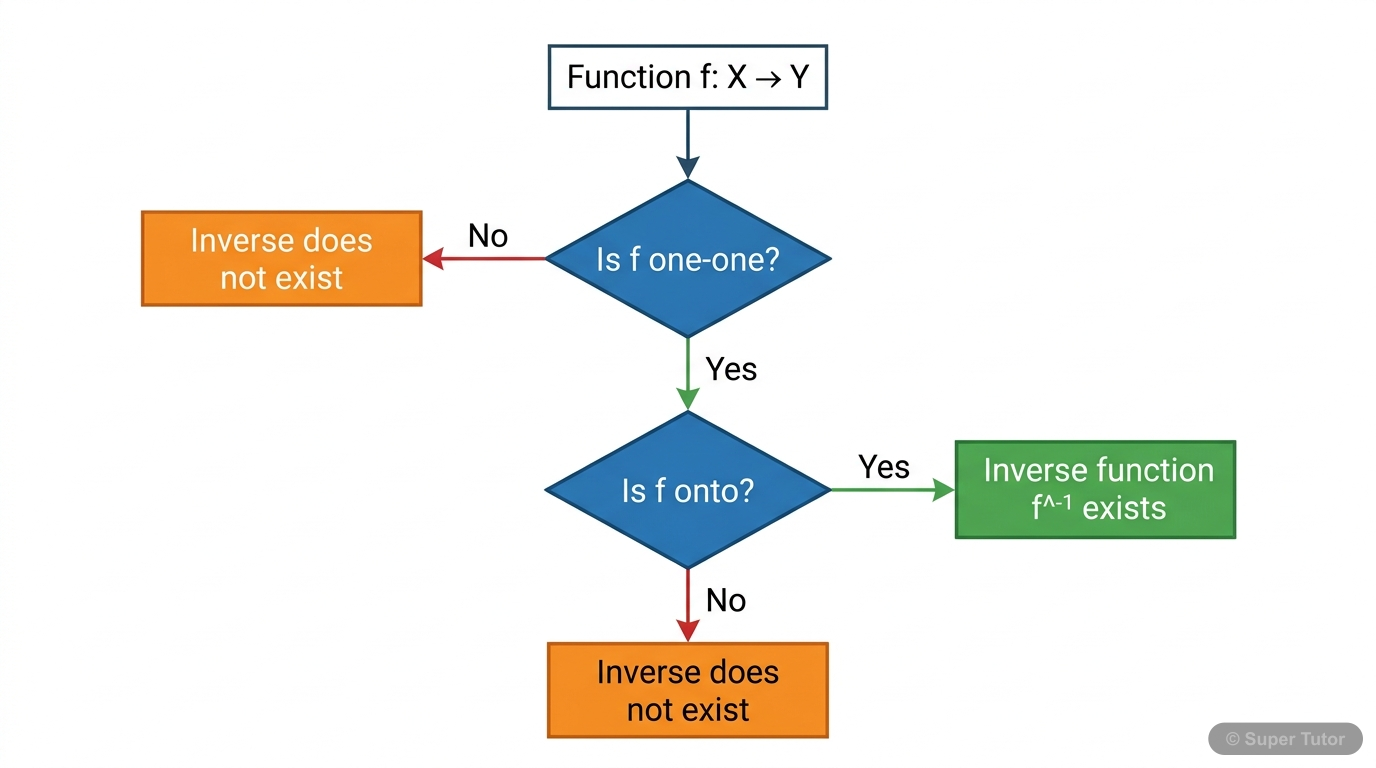
Learn better with visuals Super Tutor pairs illustrations like this with notes and quizzes for Inverse Trigonometric Functions.
Overview
Inverse trigonometric functions are defined by restricting the domains of trigonometric functions so that they become one-one and onto. This makes inverse functions possible and gives each inverse trigonometric function a principal value branch. The chapter focuses on the six inverse trigonometric f
Key Concepts
If f is one
If f is one-one and onto, then an inverse f⁻¹ exists. The compositions satisfy (f⁻¹ ∘ f)(x) = x and (f ∘ f⁻¹)(y) = y. For inverse trigonometric functi
The value of an inverse trigonometric
The value of an inverse trigonometric function that lies in the range of its principal branch is called its principal value. When no branch is mention
The sine function restricted to [
The sine function restricted to [-π/2, π/2] becomes one-one and onto with range [-1,1]. Therefore, sin⁻¹x has domain [-1,1] and principal value range
The cosine function restricted to [0
The cosine function restricted to [0, π] becomes one-one and onto with range [-1,1]. Therefore, cos⁻¹x has domain [-1,1] and principal value range [0,
cosec⁻¹x has domain R
cosec⁻¹x has domain R - (-1,1) and principal range [-π/2, π/2] - {0}. sec⁻¹x has domain R - (-1,1) and principal range [0, π] - {π/2}. These exclusion
Learning Objectives
- Understand why trigonometric functions need domain restriction to have inverses
- Learn the principal value branches of sin⁻¹, cos⁻¹, cosec⁻¹, sec⁻¹, tan⁻¹, and cot⁻¹
- Use inverse trigonometric identities correctly within their valid domains
- Interpret inverse trigonometric graphs as reflections of original graphs in the line y = x
- Find principal values of standard inverse trigonometric expressions
Frequently Asked Questions
What are the important topics in Inverse Trigonometric Functions for Madhya Pradesh Board Class 12 Mathematics?
How should I revise Inverse Trigonometric Functions for the Madhya Pradesh Board Class 12 board exam?
Sources & Official References
Content is aligned to the official syllabus. Refer to the board website for the latest curriculum.
More resources for Inverse Trigonometric Functions
Practice Quiz
Test yourself with a quick quiz
Important Questions
Exam-style questions with answers
Revision Notes
Key points for last-minute revision
Formula Sheet
The chapter's formulas in one place
Concept Maps
See how topics connect
Study Plan
Step-by-step plan for this chapter
Flashcards
Quick-fire cards for active recall
Syllabus
What topics to cover
NCERT Solutions
Every textbook question solved step by step
For serious students
Get the full Inverse Trigonometric Functions chapter — start free.
Quizzes, flashcards, an AI doubt solver and a study plan for Madhya Pradesh Board Class 12 Mathematics. Free to start, no card needed.