Chapter 3 of 15
NCERT Solutions

Inverse Trigonometric Functions — NCERT Solutions

Madhya Pradesh Board · Class 12 · Mathematics

NCERT Solutions for Inverse Trigonometric Functions, Madhya Pradesh Board Class 12 Mathematics: 43 textbook questions solved step by step.

105 questions44 flashcards6 formulas & key relations5 concepts

Interactive on Super Tutor

Studying Inverse Trigonometric Functions? Get the full interactive chapter.

Quizzes, flashcards, AI doubt-solver and a step-by-step study plan — built for NCERT solutions and more.

Free trial, no card needed.
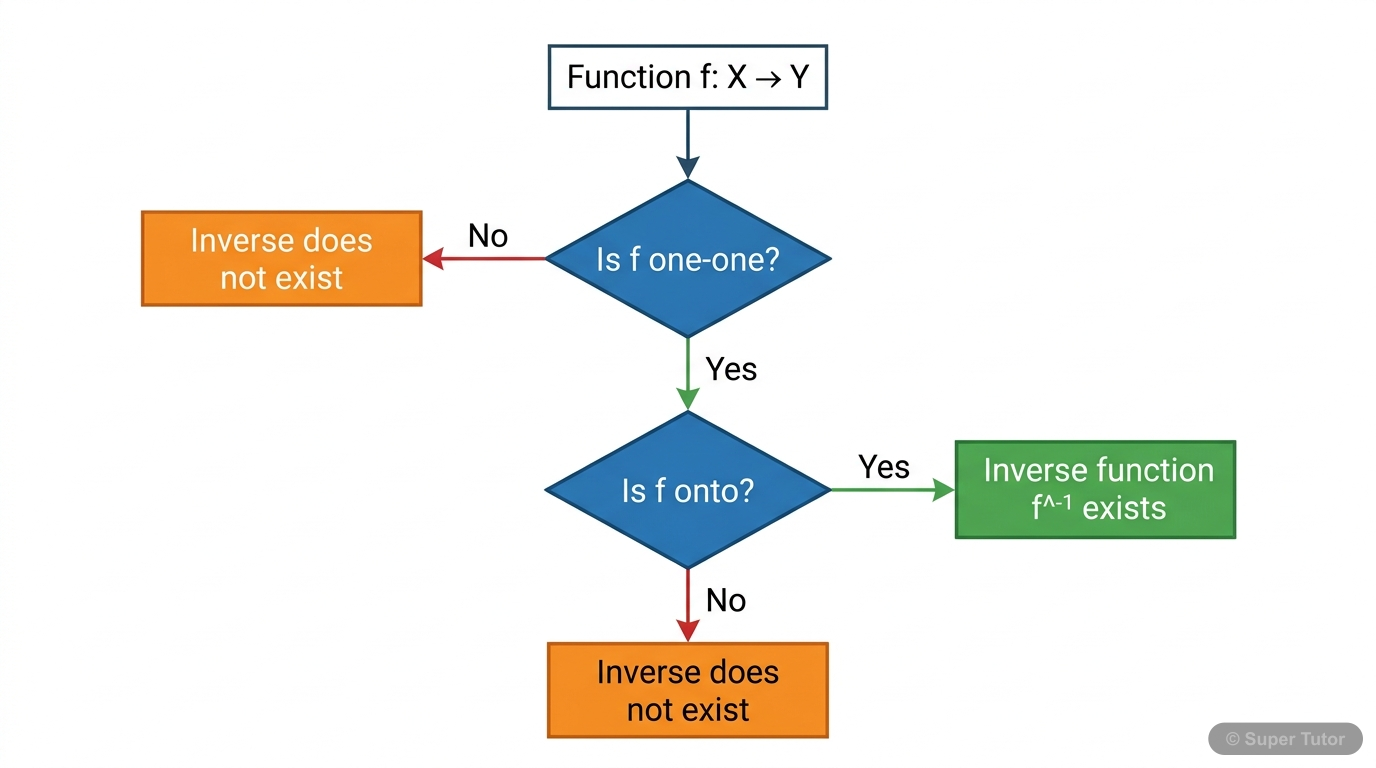
A flowchart illustrating the conditions (one-one and onto) required for a function to have an inverse, and what happens if these conditions are not met.
Super Tutor

Learn better with visuals Super Tutor pairs illustrations like this with notes and quizzes for Inverse Trigonometric Functions.

43 Questions Solved · 3 Sections

The first 22 solutions are open to read. The other 21 are free with a Super Tutor account.

Exercise 2.1

1Find the principal value of sin⁡−1(−12)\sin^{-1}\left(-\dfrac{1}{2}\right).Show solution

Given: sin⁡−1(−12)\sin^{-1}\left(-\dfrac{1}{2}\right)

Concept: The principal value branch of sin⁡−1\sin^{-1} is [−π2,π2]\left[-\dfrac{\pi}{2}, \dfrac{\pi}{2}\right].

Working:

Let sin⁡−1(−12)=y\sin^{-1}\left(-\dfrac{1}{2}\right) = y. Then sin⁡y=−12\sin y = -\dfrac{1}{2}.

We know that sin⁡(−π6)=−12\sin\left(-\dfrac{\pi}{6}\right) = -\dfrac{1}{2} and −π6∈[−π2,π2]-\dfrac{\pi}{6} \in \left[-\dfrac{\pi}{2}, \dfrac{\pi}{2}\right].

Answer: The principal value of sin⁡−1(−12)=−π6\sin^{-1}\left(-\dfrac{1}{2}\right) = \boxed{-\dfrac{\pi}{6}}.

2Find the principal value of cos⁡−1(32)\cos^{-1}\left(\dfrac{\sqrt{3}}{2}\right).Show solution

Given: cos⁡−1(32)\cos^{-1}\left(\dfrac{\sqrt{3}}{2}\right)

Concept: The principal value branch of cos⁡−1\cos^{-1} is [0,π][0, \pi].

Working:

Let cos⁡−1(32)=y\cos^{-1}\left(\dfrac{\sqrt{3}}{2}\right) = y. Then cos⁡y=32\cos y = \dfrac{\sqrt{3}}{2}.

We know that cos⁡(π6)=32\cos\left(\dfrac{\pi}{6}\right) = \dfrac{\sqrt{3}}{2} and π6∈[0,π]\dfrac{\pi}{6} \in [0, \pi].

Answer: The principal value of cos⁡−1(32)=π6\cos^{-1}\left(\dfrac{\sqrt{3}}{2}\right) = \boxed{\dfrac{\pi}{6}}.

3Find the principal value of csc⁡−1(2)\csc^{-1}(2).Show solution

Given: csc⁡−1(2)\csc^{-1}(2)

Concept: The principal value branch of csc⁡−1\csc^{-1} is [−π2,π2]−{0}\left[-\dfrac{\pi}{2}, \dfrac{\pi}{2}\right] - \{0\}.

Working:

Let csc⁡−1(2)=y\csc^{-1}(2) = y. Then csc⁡y=2\csc y = 2, i.e., sin⁡y=12\sin y = \dfrac{1}{2}.

We know that sin⁡(π6)=12\sin\left(\dfrac{\pi}{6}\right) = \dfrac{1}{2}, so csc⁡(π6)=2\csc\left(\dfrac{\pi}{6}\right) = 2 and π6∈[−π2,π2]−{0}\dfrac{\pi}{6} \in \left[-\dfrac{\pi}{2}, \dfrac{\pi}{2}\right] - \{0\}.

Answer: The principal value of csc⁡−1(2)=π6\csc^{-1}(2) = \boxed{\dfrac{\pi}{6}}.

4Find the principal value of tan⁡−1(−3)\tan^{-1}(-\sqrt{3}).Show solution

Given: tan⁡−1(−3)\tan^{-1}(-\sqrt{3})

Concept: The principal value branch of tan⁡−1\tan^{-1} is (−π2,π2)\left(-\dfrac{\pi}{2}, \dfrac{\pi}{2}\right).

Working:

Let tan⁡−1(−3)=y\tan^{-1}(-\sqrt{3}) = y. Then tan⁡y=−3\tan y = -\sqrt{3}.

We know that tan⁡(−π3)=−3\tan\left(-\dfrac{\pi}{3}\right) = -\sqrt{3} and −π3∈(−π2,π2)-\dfrac{\pi}{3} \in \left(-\dfrac{\pi}{2}, \dfrac{\pi}{2}\right).

Answer: The principal value of tan⁡−1(−3)=−π3\tan^{-1}(-\sqrt{3}) = \boxed{-\dfrac{\pi}{3}}.

5Find the principal value of cos⁡−1(−12)\cos^{-1}\left(-\dfrac{1}{2}\right).Show solution

Given: cos⁡−1(−12)\cos^{-1}\left(-\dfrac{1}{2}\right)

Concept: The principal value branch of cos⁡−1\cos^{-1} is [0,π][0, \pi].

Working:

Let cos⁡−1(−12)=y\cos^{-1}\left(-\dfrac{1}{2}\right) = y. Then cos⁡y=−12\cos y = -\dfrac{1}{2}.

We know that cos⁡(2π3)=−12\cos\left(\dfrac{2\pi}{3}\right) = -\dfrac{1}{2} and 2π3∈[0,π]\dfrac{2\pi}{3} \in [0, \pi].

Answer: The principal value of cos⁡−1(−12)=2π3\cos^{-1}\left(-\dfrac{1}{2}\right) = \boxed{\dfrac{2\pi}{3}}.

6Find the principal value of tan⁡−1(−1)\tan^{-1}(-1).Show solution

Given: tan⁡−1(−1)\tan^{-1}(-1)

Concept: The principal value branch of tan⁡−1\tan^{-1} is (−π2,π2)\left(-\dfrac{\pi}{2}, \dfrac{\pi}{2}\right).

Working:

Let tan⁡−1(−1)=y\tan^{-1}(-1) = y. Then tan⁡y=−1\tan y = -1.

We know that tan⁡(−π4)=−1\tan\left(-\dfrac{\pi}{4}\right) = -1 and −π4∈(−π2,π2)-\dfrac{\pi}{4} \in \left(-\dfrac{\pi}{2}, \dfrac{\pi}{2}\right).

Answer: The principal value of tan⁡−1(−1)=−π4\tan^{-1}(-1) = \boxed{-\dfrac{\pi}{4}}.

7Find the principal value of sec⁡−1(23)\sec^{-1}\left(\dfrac{2}{\sqrt{3}}\right).Show solution

Given: sec⁡−1(23)\sec^{-1}\left(\dfrac{2}{\sqrt{3}}\right)

Concept: The principal value branch of sec⁡−1\sec^{-1} is [0,π]−{π2}[0, \pi] - \left\{\dfrac{\pi}{2}\right\}.

Working:

Let sec⁡−1(23)=y\sec^{-1}\left(\dfrac{2}{\sqrt{3}}\right) = y. Then sec⁡y=23\sec y = \dfrac{2}{\sqrt{3}}, i.e., cos⁡y=32\cos y = \dfrac{\sqrt{3}}{2}.

We know that cos⁡(π6)=32\cos\left(\dfrac{\pi}{6}\right) = \dfrac{\sqrt{3}}{2} and π6∈[0,π]−{π2}\dfrac{\pi}{6} \in [0, \pi] - \left\{\dfrac{\pi}{2}\right\}.

Answer: The principal value of sec⁡−1(23)=π6\sec^{-1}\left(\dfrac{2}{\sqrt{3}}\right) = \boxed{\dfrac{\pi}{6}}.

8Find the principal value of cot⁡−1(3)\cot^{-1}(\sqrt{3}).Show solution

Given: cot⁡−1(3)\cot^{-1}(\sqrt{3})

Concept: The principal value branch of cot⁡−1\cot^{-1} is (0,π)(0, \pi).

Working:

Let cot⁡−1(3)=y\cot^{-1}(\sqrt{3}) = y. Then cot⁡y=3\cot y = \sqrt{3}.

We know that cot⁡(π6)=3\cot\left(\dfrac{\pi}{6}\right) = \sqrt{3} and π6∈(0,π)\dfrac{\pi}{6} \in (0, \pi).

Answer: The principal value of cot⁡−1(3)=π6\cot^{-1}(\sqrt{3}) = \boxed{\dfrac{\pi}{6}}.

9Find the principal value of cos⁡−1(−12)\cos^{-1}\left(-\dfrac{1}{\sqrt{2}}\right).Show solution

Given: cos⁡−1(−12)\cos^{-1}\left(-\dfrac{1}{\sqrt{2}}\right)

Concept: The principal value branch of cos⁡−1\cos^{-1} is [0,π][0, \pi].

Working:

Let cos⁡−1(−12)=y\cos^{-1}\left(-\dfrac{1}{\sqrt{2}}\right) = y. Then cos⁡y=−12\cos y = -\dfrac{1}{\sqrt{2}}.

We know that cos⁡(3π4)=−12\cos\left(\dfrac{3\pi}{4}\right) = -\dfrac{1}{\sqrt{2}} and 3π4∈[0,π]\dfrac{3\pi}{4} \in [0, \pi].

Answer: The principal value of cos⁡−1(−12)=3π4\cos^{-1}\left(-\dfrac{1}{\sqrt{2}}\right) = \boxed{\dfrac{3\pi}{4}}.

10Find the principal value of csc⁡−1(−2)\csc^{-1}(-\sqrt{2}).Show solution

Given: csc⁡−1(−2)\csc^{-1}(-\sqrt{2})

Concept: The principal value branch of csc⁡−1\csc^{-1} is [−π2,π2]−{0}\left[-\dfrac{\pi}{2}, \dfrac{\pi}{2}\right] - \{0\}.

Working:

Let csc⁡−1(−2)=y\csc^{-1}(-\sqrt{2}) = y. Then csc⁡y=−2\csc y = -\sqrt{2}, i.e., sin⁡y=−12\sin y = -\dfrac{1}{\sqrt{2}}.

We know that sin⁡(−π4)=−12\sin\left(-\dfrac{\pi}{4}\right) = -\dfrac{1}{\sqrt{2}} and −π4∈[−π2,π2]−{0}-\dfrac{\pi}{4} \in \left[-\dfrac{\pi}{2}, \dfrac{\pi}{2}\right] - \{0\}.

Answer: The principal value of csc⁡−1(−2)=−π4\csc^{-1}(-\sqrt{2}) = \boxed{-\dfrac{\pi}{4}}.

11Find the value of tan⁡−1(1)+cos⁡−1(−12)+sin⁡−1(−12)\tan^{-1}(1) + \cos^{-1}\left(-\dfrac{1}{2}\right) + \sin^{-1}\left(-\dfrac{1}{2}\right).Show solution

Given: tan⁡−1(1)+cos⁡−1(−12)+sin⁡−1(−12)\tan^{-1}(1) + \cos^{-1}\left(-\dfrac{1}{2}\right) + \sin^{-1}\left(-\dfrac{1}{2}\right)

Working:

Step 1: Find tan⁡−1(1)\tan^{-1}(1).
tan⁡(π4)=1⇒tan⁡−1(1)=π4\tan\left(\frac{\pi}{4}\right) = 1 \Rightarrow \tan^{-1}(1) = \frac{\pi}{4}

Step 2: Find cos⁡−1(−12)\cos^{-1}\left(-\dfrac{1}{2}\right).
cos⁡(2π3)=−12⇒cos⁡−1(−12)=2π3\cos\left(\frac{2\pi}{3}\right) = -\frac{1}{2} \Rightarrow \cos^{-1}\left(-\frac{1}{2}\right) = \frac{2\pi}{3}

Step 3: Find sin⁡−1(−12)\sin^{-1}\left(-\dfrac{1}{2}\right).
sin⁡(−π6)=−12⇒sin⁡−1(−12)=−π6\sin\left(-\frac{\pi}{6}\right) = -\frac{1}{2} \Rightarrow \sin^{-1}\left(-\frac{1}{2}\right) = -\frac{\pi}{6}

Step 4: Add all three values.
π4+2π3+(−π6)=3π12+8π12−2π12=9π12=3π4\frac{\pi}{4} + \frac{2\pi}{3} + \left(-\frac{\pi}{6}\right) = \frac{3\pi}{12} + \frac{8\pi}{12} - \frac{2\pi}{12} = \frac{9\pi}{12} = \frac{3\pi}{4}

Answer: tan⁡−1(1)+cos⁡−1(−12)+sin⁡−1(−12)=3π4\tan^{-1}(1) + \cos^{-1}\left(-\dfrac{1}{2}\right) + \sin^{-1}\left(-\dfrac{1}{2}\right) = \boxed{\dfrac{3\pi}{4}}.

12Find the value of cos⁡−112+2sin⁡−112\cos^{-1}\dfrac{1}{2} + 2\sin^{-1}\dfrac{1}{2}.Show solution

Given: cos⁡−112+2sin⁡−112\cos^{-1}\dfrac{1}{2} + 2\sin^{-1}\dfrac{1}{2}

Working:

Step 1: Find cos⁡−112\cos^{-1}\dfrac{1}{2}.
cos⁡(π3)=12⇒cos⁡−112=π3\cos\left(\frac{\pi}{3}\right) = \frac{1}{2} \Rightarrow \cos^{-1}\frac{1}{2} = \frac{\pi}{3}

Step 2: Find sin⁡−112\sin^{-1}\dfrac{1}{2}.
sin⁡(π6)=12⇒sin⁡−112=π6\sin\left(\frac{\pi}{6}\right) = \frac{1}{2} \Rightarrow \sin^{-1}\frac{1}{2} = \frac{\pi}{6}

Step 3: Compute the expression.
π3+2×π6=π3+π3=2π3\frac{\pi}{3} + 2 \times \frac{\pi}{6} = \frac{\pi}{3} + \frac{\pi}{3} = \frac{2\pi}{3}

Answer: cos⁡−112+2sin⁡−112=2π3\cos^{-1}\dfrac{1}{2} + 2\sin^{-1}\dfrac{1}{2} = \boxed{\dfrac{2\pi}{3}}.

13If sin⁡−1x=y\sin^{-1}x = y, then
(A) 0≤y≤π0 \leq y \leq \pi
(B) −π2≤y≤π2-\dfrac{\pi}{2} \leq y \leq \dfrac{\pi}{2}
(C) 0<y<π0 < y < \pi
(D) −π2<y<π2-\dfrac{\pi}{2} < y < \dfrac{\pi}{2}
Show solution

Correct Option: (B) −π2≤y≤π2-\dfrac{\pi}{2} \leq y \leq \dfrac{\pi}{2}

Justification: The principal value branch of sin⁡−1\sin^{-1} is defined as [−π2,π2]\left[-\dfrac{\pi}{2}, \dfrac{\pi}{2}\right], which is a closed interval. Therefore, if sin⁡−1x=y\sin^{-1}x = y, then y∈[−π2,π2]y \in \left[-\dfrac{\pi}{2}, \dfrac{\pi}{2}\right], i.e., −π2≤y≤π2-\dfrac{\pi}{2} \leq y \leq \dfrac{\pi}{2}.

14tan⁡−13−sec⁡−1(−2)\tan^{-1}\sqrt{3} - \sec^{-1}(-2) is equal to
(A) π\pi
(B) −π3-\dfrac{\pi}{3}
(C) π3\dfrac{\pi}{3}
(D) 2π3\dfrac{2\pi}{3}
Show solution

Correct Option: (B) −π3-\dfrac{\pi}{3}

Working:

Step 1: Find tan⁡−13\tan^{-1}\sqrt{3}.
tan⁡(π3)=3⇒tan⁡−13=π3\tan\left(\frac{\pi}{3}\right) = \sqrt{3} \Rightarrow \tan^{-1}\sqrt{3} = \frac{\pi}{3}

Step 2: Find sec⁡−1(−2)\sec^{-1}(-2).
sec⁡y=−2⇒cos⁡y=−12⇒y=2π3∈[0,π]−{π2}\sec y = -2 \Rightarrow \cos y = -\frac{1}{2} \Rightarrow y = \frac{2\pi}{3} \in [0,\pi]-\left\{\frac{\pi}{2}\right\}
∴sec⁡−1(−2)=2π3\therefore \sec^{-1}(-2) = \frac{2\pi}{3}

Step 3: Compute.
tan⁡−13−sec⁡−1(−2)=π3−2π3=−π3\tan^{-1}\sqrt{3} - \sec^{-1}(-2) = \frac{\pi}{3} - \frac{2\pi}{3} = -\frac{\pi}{3}

Answer: Option (B) −π3-\dfrac{\pi}{3}.

Exercise 2.2

1Prove that 3sin⁡−1x=sin⁡−1(3x−4x3)3\sin^{-1}x = \sin^{-1}(3x - 4x^3), x∈[−12,12]x \in \left[-\dfrac{1}{2}, \dfrac{1}{2}\right].Show solution

To Prove: 3sin⁡−1x=sin⁡−1(3x−4x3)3\sin^{-1}x = \sin^{-1}(3x - 4x^3)

Proof:

Let sin⁡−1x=θ\sin^{-1}x = \theta, so x=sin⁡θx = \sin\theta.

Since x∈[−12,12]x \in \left[-\dfrac{1}{2}, \dfrac{1}{2}\right], we have θ∈[−π6,π6]\theta \in \left[-\dfrac{\pi}{6}, \dfrac{\pi}{6}\right], which means 3θ∈[−π2,π2]3\theta \in \left[-\dfrac{\pi}{2}, \dfrac{\pi}{2}\right].

Now, using the triple angle formula:
sin⁡3θ=3sin⁡θ−4sin⁡3θ=3x−4x3\sin 3\theta = 3\sin\theta - 4\sin^3\theta = 3x - 4x^3

Since 3θ∈[−π2,π2]3\theta \in \left[-\dfrac{\pi}{2}, \dfrac{\pi}{2}\right], we can apply sin⁡−1\sin^{-1} to both sides:
3θ=sin⁡−1(3x−4x3)3\theta = \sin^{-1}(3x - 4x^3)

Substituting back θ=sin⁡−1x\theta = \sin^{-1}x:
3sin⁡−1x=sin⁡−1(3x−4x3)Hence Proved.3\sin^{-1}x = \sin^{-1}(3x - 4x^3) \qquad \textbf{Hence Proved.}

2Prove that 3cos⁡−1x=cos⁡−1(4x3−3x)3\cos^{-1}x = \cos^{-1}(4x^3 - 3x), x∈[12,1]x \in \left[\dfrac{1}{2}, 1\right].Show solution

To Prove: 3cos⁡−1x=cos⁡−1(4x3−3x)3\cos^{-1}x = \cos^{-1}(4x^3 - 3x)

Proof:

Let cos⁡−1x=θ\cos^{-1}x = \theta, so x=cos⁡θx = \cos\theta.

Since x∈[12,1]x \in \left[\dfrac{1}{2}, 1\right], we have θ∈[0,π3]\theta \in \left[0, \dfrac{\pi}{3}\right], which means 3θ∈[0,π]3\theta \in [0, \pi].

Using the triple angle formula:
cos⁡3θ=4cos⁡3θ−3cos⁡θ=4x3−3x\cos 3\theta = 4\cos^3\theta - 3\cos\theta = 4x^3 - 3x

Since 3θ∈[0,π]3\theta \in [0, \pi], we can apply cos⁡−1\cos^{-1} to both sides:
3θ=cos⁡−1(4x3−3x)3\theta = \cos^{-1}(4x^3 - 3x)

Substituting back θ=cos⁡−1x\theta = \cos^{-1}x:
3cos⁡−1x=cos⁡−1(4x3−3x)Hence Proved.3\cos^{-1}x = \cos^{-1}(4x^3 - 3x) \qquad \textbf{Hence Proved.}

3Write tan⁡−11+x2−1x\tan^{-1}\dfrac{\sqrt{1+x^2}-1}{x}, x≠0x \neq 0 in the simplest form.Show solution

Given: tan⁡−11+x2−1x\tan^{-1}\dfrac{\sqrt{1+x^2}-1}{x}

Working:

Let x=tan⁡θx = \tan\theta, so θ=tan⁡−1x\theta = \tan^{-1}x, where θ∈(−π2,π2)\theta \in \left(-\dfrac{\pi}{2}, \dfrac{\pi}{2}\right).

Then:
1+x2=1+tan⁡2θ=sec⁡θ\sqrt{1+x^2} = \sqrt{1+\tan^2\theta} = \sec\theta

Substituting:
tan⁡−1sec⁡θ−1tan⁡θ=tan⁡−11−cos⁡θsin⁡θ\tan^{-1}\frac{\sec\theta - 1}{\tan\theta} = \tan^{-1}\frac{1 - \cos\theta}{\sin\theta}

Using half-angle identities: 1−cos⁡θ=2sin⁡2θ21 - \cos\theta = 2\sin^2\dfrac{\theta}{2} and sin⁡θ=2sin⁡θ2cos⁡θ2\sin\theta = 2\sin\dfrac{\theta}{2}\cos\dfrac{\theta}{2}:
=tan⁡−12sin⁡2θ22sin⁡θ2cos⁡θ2=tan⁡−1(tan⁡θ2)=θ2= \tan^{-1}\frac{2\sin^2\frac{\theta}{2}}{2\sin\frac{\theta}{2}\cos\frac{\theta}{2}} = \tan^{-1}\left(\tan\frac{\theta}{2}\right) = \frac{\theta}{2}

Substituting back θ=tan⁡−1x\theta = \tan^{-1}x:
=12tan⁡−1x= \frac{1}{2}\tan^{-1}x

Answer: tan⁡−11+x2−1x=12tan⁡−1x\tan^{-1}\dfrac{\sqrt{1+x^2}-1}{x} = \dfrac{1}{2}\tan^{-1}x.

4Write tan⁡−1(1−cos⁡x1+cos⁡x)\tan^{-1}\left(\sqrt{\dfrac{1-\cos x}{1+\cos x}}\right), 0<x<π0 < x < \pi in the simplest form.Show solution

Given: tan⁡−1(1−cos⁡x1+cos⁡x)\tan^{-1}\left(\sqrt{\dfrac{1-\cos x}{1+\cos x}}\right), 0<x<π0 < x < \pi

Working:

Using half-angle identities:
1−cos⁡x=2sin⁡2x2,1+cos⁡x=2cos⁡2x21 - \cos x = 2\sin^2\frac{x}{2}, \quad 1 + \cos x = 2\cos^2\frac{x}{2}

So:
1−cos⁡x1+cos⁡x=2sin⁡2x22cos⁡2x2=∣tan⁡x2∣\sqrt{\frac{1-\cos x}{1+\cos x}} = \sqrt{\frac{2\sin^2\frac{x}{2}}{2\cos^2\frac{x}{2}}} = \left|\tan\frac{x}{2}\right|

Since 0<x<π0 < x < \pi, we have 0<x2<π20 < \dfrac{x}{2} < \dfrac{\pi}{2}, so tan⁡x2>0\tan\dfrac{x}{2} > 0.

Therefore:
tan⁡−1(tan⁡x2)=x2\tan^{-1}\left(\tan\frac{x}{2}\right) = \frac{x}{2}

Answer: tan⁡−1(1−cos⁡x1+cos⁡x)=x2\tan^{-1}\left(\sqrt{\dfrac{1-\cos x}{1+\cos x}}\right) = \dfrac{x}{2}.

5Write tan⁡−1(cos⁡x−sin⁡xcos⁡x+sin⁡x)\tan^{-1}\left(\dfrac{\cos x - \sin x}{\cos x + \sin x}\right), −π4<x<3π4-\dfrac{\pi}{4} < x < \dfrac{3\pi}{4} in the simplest form.Show solution

Given: tan⁡−1(cos⁡x−sin⁡xcos⁡x+sin⁡x)\tan^{-1}\left(\dfrac{\cos x - \sin x}{\cos x + \sin x}\right)

Working:

Divide numerator and denominator by cos⁡x\cos x:
tan⁡−1(1−tan⁡x1+tan⁡x)\tan^{-1}\left(\frac{1 - \tan x}{1 + \tan x}\right)

Using the identity tan⁡(A−B)=tan⁡A−tan⁡B1+tan⁡Atan⁡B\tan(A - B) = \dfrac{\tan A - \tan B}{1 + \tan A \tan B} with A=π4A = \dfrac{\pi}{4} and B=xB = x:
=tan⁡−1(tan⁡(π4−x))= \tan^{-1}\left(\tan\left(\frac{\pi}{4} - x\right)\right)

Since −π4<x<3π4-\dfrac{\pi}{4} < x < \dfrac{3\pi}{4}, we have −π<π4−x<π2-\pi < \dfrac{\pi}{4} - x < \dfrac{\pi}{2}, but more precisely π4−x∈(−π2,π2)\dfrac{\pi}{4} - x \in \left(-\dfrac{\pi}{2}, \dfrac{\pi}{2}\right) for the given range.

Therefore:
=π4−x= \frac{\pi}{4} - x

Answer: tan⁡−1(cos⁡x−sin⁡xcos⁡x+sin⁡x)=π4−x\tan^{-1}\left(\dfrac{\cos x - \sin x}{\cos x + \sin x}\right) = \dfrac{\pi}{4} - x.

6Write tan⁡−1xa2−x2\tan^{-1}\dfrac{x}{\sqrt{a^2-x^2}}, ∣x∣<a|x| < a in the simplest form.Show solution

Given: tan⁡−1xa2−x2\tan^{-1}\dfrac{x}{\sqrt{a^2-x^2}}, ∣x∣<a|x| < a

Working:

Let x=asin⁡θx = a\sin\theta, so θ=sin⁡−1xa\theta = \sin^{-1}\dfrac{x}{a}, where θ∈(−π2,π2)\theta \in \left(-\dfrac{\pi}{2}, \dfrac{\pi}{2}\right).

Then:
a2−x2=a2−a2sin⁡2θ=acos⁡θ\sqrt{a^2 - x^2} = \sqrt{a^2 - a^2\sin^2\theta} = a\cos\theta

Substituting:
tan⁡−1asin⁡θacos⁡θ=tan⁡−1(tan⁡θ)=θ=sin⁡−1xa\tan^{-1}\frac{a\sin\theta}{a\cos\theta} = \tan^{-1}(\tan\theta) = \theta = \sin^{-1}\frac{x}{a}

Answer: tan⁡−1xa2−x2=sin⁡−1xa\tan^{-1}\dfrac{x}{\sqrt{a^2-x^2}} = \sin^{-1}\dfrac{x}{a}.

7Write tan⁡−1(3a2x−x3a3−3ax2)\tan^{-1}\left(\dfrac{3a^2x - x^3}{a^3 - 3ax^2}\right), a>0a > 0; −a3<x<a3-\dfrac{a}{\sqrt{3}} < x < \dfrac{a}{\sqrt{3}} in the simplest form.Show solution

Given: tan⁡−1(3a2x−x3a3−3ax2)\tan^{-1}\left(\dfrac{3a^2x - x^3}{a^3 - 3ax^2}\right)

Working:

Let x=atan⁡θx = a\tan\theta, so θ=tan⁡−1xa\theta = \tan^{-1}\dfrac{x}{a}.

Since −a3<x<a3-\dfrac{a}{\sqrt{3}} < x < \dfrac{a}{\sqrt{3}}, we have −13<tan⁡θ<13-\dfrac{1}{\sqrt{3}} < \tan\theta < \dfrac{1}{\sqrt{3}}, so θ∈(−π6,π6)\theta \in \left(-\dfrac{\pi}{6}, \dfrac{\pi}{6}\right) and 3θ∈(−π2,π2)3\theta \in \left(-\dfrac{\pi}{2}, \dfrac{\pi}{2}\right).

Substituting x=atan⁡θx = a\tan\theta:
3a2(atan⁡θ)−(atan⁡θ)3a3−3a(atan⁡θ)2=3a3tan⁡θ−a3tan⁡3θa3−3a3tan⁡2θ=3tan⁡θ−tan⁡3θ1−3tan⁡2θ=tan⁡3θ\frac{3a^2(a\tan\theta) - (a\tan\theta)^3}{a^3 - 3a(a\tan\theta)^2} = \frac{3a^3\tan\theta - a^3\tan^3\theta}{a^3 - 3a^3\tan^2\theta} = \frac{3\tan\theta - \tan^3\theta}{1 - 3\tan^2\theta} = \tan 3\theta

Therefore:
tan⁡−1(tan⁡3θ)=3θ=3tan⁡−1xa\tan^{-1}(\tan 3\theta) = 3\theta = 3\tan^{-1}\frac{x}{a}

Answer: tan⁡−1(3a2x−x3a3−3ax2)=3tan⁡−1xa\tan^{-1}\left(\dfrac{3a^2x - x^3}{a^3 - 3ax^2}\right) = 3\tan^{-1}\dfrac{x}{a}.

8Find the value of tan⁡−1[2cos⁡(2sin⁡−112)]\tan^{-1}\left[2\cos\left(2\sin^{-1}\dfrac{1}{2}\right)\right].Show solution

Given: tan⁡−1[2cos⁡(2sin⁡−112)]\tan^{-1}\left[2\cos\left(2\sin^{-1}\dfrac{1}{2}\right)\right]

Working:

Step 1: Find sin⁡−112\sin^{-1}\dfrac{1}{2}.
sin⁡−112=π6\sin^{-1}\frac{1}{2} = \frac{\pi}{6}

Step 2: Find 2sin⁡−1122\sin^{-1}\dfrac{1}{2}.
2×π6=π32 \times \frac{\pi}{6} = \frac{\pi}{3}

Step 3: Find cos⁡(π3)\cos\left(\dfrac{\pi}{3}\right).
cos⁡π3=12\cos\frac{\pi}{3} = \frac{1}{2}

Step 4: Compute the full expression.
tan⁡−1[2×12]=tan⁡−1(1)=π4\tan^{-1}\left[2 \times \frac{1}{2}\right] = \tan^{-1}(1) = \frac{\pi}{4}

Answer: tan⁡−1[2cos⁡(2sin⁡−112)]=π4\tan^{-1}\left[2\cos\left(2\sin^{-1}\dfrac{1}{2}\right)\right] = \boxed{\dfrac{\pi}{4}}.

9Find the value of tan⁡12[sin⁡−12x1+x2+cos⁡−11−y21+y2]\tan\dfrac{1}{2}\left[\sin^{-1}\dfrac{2x}{1+x^2} + \cos^{-1}\dfrac{1-y^2}{1+y^2}\right], ∣x∣<1|x| < 1, y>0y > 0 and xy<1xy < 1.

Free with a Super Tutor account

10Find the value of sin⁡−1(sin⁡2π3)\sin^{-1}\left(\sin\dfrac{2\pi}{3}\right).

Free with a Super Tutor account

11Find the value of tan⁡−1(tan⁡3π4)\tan^{-1}\left(\tan\dfrac{3\pi}{4}\right).

Free with a Super Tutor account

12Find the value of tan⁡(sin⁡−135+cot⁡−132)\tan\left(\sin^{-1}\dfrac{3}{5} + \cot^{-1}\dfrac{3}{2}\right).

Free with a Super Tutor account

13cos⁡−1(cos⁡7π6)\cos^{-1}\left(\cos\dfrac{7\pi}{6}\right) is equal to
(A) 7π6\dfrac{7\pi}{6}
(B) 5π6\dfrac{5\pi}{6}
(C) π3\dfrac{\pi}{3}
(D) π6\dfrac{\pi}{6}

Free with a Super Tutor account

14sin⁡(π3−sin⁡−1(−12))\sin\left(\dfrac{\pi}{3} - \sin^{-1}\left(-\dfrac{1}{2}\right)\right) is equal to
(A) 12\dfrac{1}{2}
(B) 13\dfrac{1}{3}
(C) 14\dfrac{1}{4}
(D) 11

Free with a Super Tutor account

15tan⁡−13−cot⁡−1(−3)\tan^{-1}\sqrt{3} - \cot^{-1}(-\sqrt{3}) is equal to
(A) π\pi
(B) −π2-\dfrac{\pi}{2}
(C) 00
(D) 232\sqrt{3}

Free with a Super Tutor account

Miscellaneous Exercise on Chapter 2

1Find the value of cos⁡−1(cos⁡13π6)\cos^{-1}\left(\cos\dfrac{13\pi}{6}\right).

Free with a Super Tutor account

2Find the value of tan⁡−1(tan⁡7π6)\tan^{-1}\left(\tan\dfrac{7\pi}{6}\right).

Free with a Super Tutor account

3Prove that 2sin⁡−135=tan⁡−12472\sin^{-1}\dfrac{3}{5} = \tan^{-1}\dfrac{24}{7}.

Free with a Super Tutor account

4Prove that sin⁡−1817+sin⁡−135=tan⁡−17736\sin^{-1}\dfrac{8}{17} + \sin^{-1}\dfrac{3}{5} = \tan^{-1}\dfrac{77}{36}.

Free with a Super Tutor account

5Prove that cos⁡−145+cos⁡−11213=cos⁡−13365\cos^{-1}\dfrac{4}{5} + \cos^{-1}\dfrac{12}{13} = \cos^{-1}\dfrac{33}{65}.

Free with a Super Tutor account

6Prove that cos⁡−11213+sin⁡−135=sin⁡−15665\cos^{-1}\dfrac{12}{13} + \sin^{-1}\dfrac{3}{5} = \sin^{-1}\dfrac{56}{65}.

Free with a Super Tutor account

7Prove that tan⁡−16316=sin⁡−1513+cos⁡−135\tan^{-1}\dfrac{63}{16} = \sin^{-1}\dfrac{5}{13} + \cos^{-1}\dfrac{3}{5}.

Free with a Super Tutor account

8Prove that tan⁡−1x=12cos⁡−11−x1+x\tan^{-1}\sqrt{x} = \dfrac{1}{2}\cos^{-1}\dfrac{1-x}{1+x}, x∈[0,1]x \in [0,1].

Free with a Super Tutor account

9Prove that cot⁡−1(1+sin⁡x+1−sin⁡x1+sin⁡x−1−sin⁡x)=x2\cot^{-1}\left(\dfrac{\sqrt{1+\sin x}+\sqrt{1-\sin x}}{\sqrt{1+\sin x}-\sqrt{1-\sin x}}\right) = \dfrac{x}{2}, x∈(0,π4)x \in \left(0, \dfrac{\pi}{4}\right).

Free with a Super Tutor account

10Prove that tan⁡−1(1+x−1−x1+x+1−x)=π4−12cos⁡−1x\tan^{-1}\left(\dfrac{\sqrt{1+x}-\sqrt{1-x}}{\sqrt{1+x}+\sqrt{1-x}}\right) = \dfrac{\pi}{4} - \dfrac{1}{2}\cos^{-1}x, −12≤x≤1-\dfrac{1}{\sqrt{2}} \leq x \leq 1. [Hint: Put x=cos⁡2θx = \cos 2\theta]

Free with a Super Tutor account

11Solve: 2tan⁡−1(cos⁡x)=tan⁡−1(2cosec⁡x)2\tan^{-1}(\cos x) = \tan^{-1}(2\operatorname{cosec}x).

Free with a Super Tutor account

12Solve: tan⁡−11−x1+x=12tan⁡−1x\tan^{-1}\dfrac{1-x}{1+x} = \dfrac{1}{2}\tan^{-1}x, (x>0)(x > 0).

Free with a Super Tutor account

13sin⁡(tan⁡−1x)\sin(\tan^{-1}x), ∣x∣<1|x| < 1 is equal to
(A) x1−x2\dfrac{x}{\sqrt{1-x^2}}
(B) 11−x2\dfrac{1}{\sqrt{1-x^2}}
(C) 11+x2\dfrac{1}{\sqrt{1+x^2}}
(D) x1+x2\dfrac{x}{\sqrt{1+x^2}}

Free with a Super Tutor account

14sin⁡−1(1−x)−2sin⁡−1x=π2\sin^{-1}(1-x) - 2\sin^{-1}x = \dfrac{\pi}{2}, then xx is equal to
(A) 0,120, \dfrac{1}{2}
(B) 1,121, \dfrac{1}{2}
(C) 00
(D) 12\dfrac{1}{2}

Free with a Super Tutor account

21 more solved questions in Inverse Trigonometric Functions

They are free with a Super Tutor account, along with practice quizzes and flashcards for this chapter. Free to start, no card needed.

Frequently Asked Questions

What are the important topics in Inverse Trigonometric Functions for Madhya Pradesh Board Class 12 Mathematics?
Key topics in Inverse Trigonometric Functions include Basic ideas and principal value branches, Domains and principal value ranges, Standard principal values and worked examples, Important identities and simplification patterns. Study these first, then practise questions on each for the Madhya Pradesh Board Class 12 board exam.
Are these NCERT Solutions for Inverse Trigonometric Functions free?
The first 22 of the 43 solutions on this page are open to read. The other 21 are free with a Super Tutor account — signing up is free and needs no card.
How should I revise Inverse Trigonometric Functions for the Madhya Pradesh Board Class 12 board exam?
Learn the core ideas first, then work through the 105 practice questions on Inverse Trigonometric Functions. Revise definitions regularly and use flashcards for quick recall before the exam.

Sources & Official References

Content is aligned to the official syllabus. Refer to the board website for the latest curriculum.

For serious students

Get the full Inverse Trigonometric Functions chapter — start free.

Quizzes, flashcards, an AI doubt solver and a study plan for Madhya Pradesh Board Class 12 Mathematics. Free to start, no card needed.