Chapter 6 of 15
NCERT Solutions

Differential Equations — NCERT Solutions

Madhya Pradesh Board · Class 12 · Mathematics

NCERT Solutions for Differential Equations, Madhya Pradesh Board Class 12 Mathematics: 98 textbook questions solved step by step.

94 questions50 flashcards17 formulas & key relations5 concepts

Interactive on Super Tutor

Studying Differential Equations? Get the full interactive chapter.

Quizzes, flashcards, AI doubt-solver and a step-by-step study plan — built for NCERT solutions and more.

Free trial, no card needed.
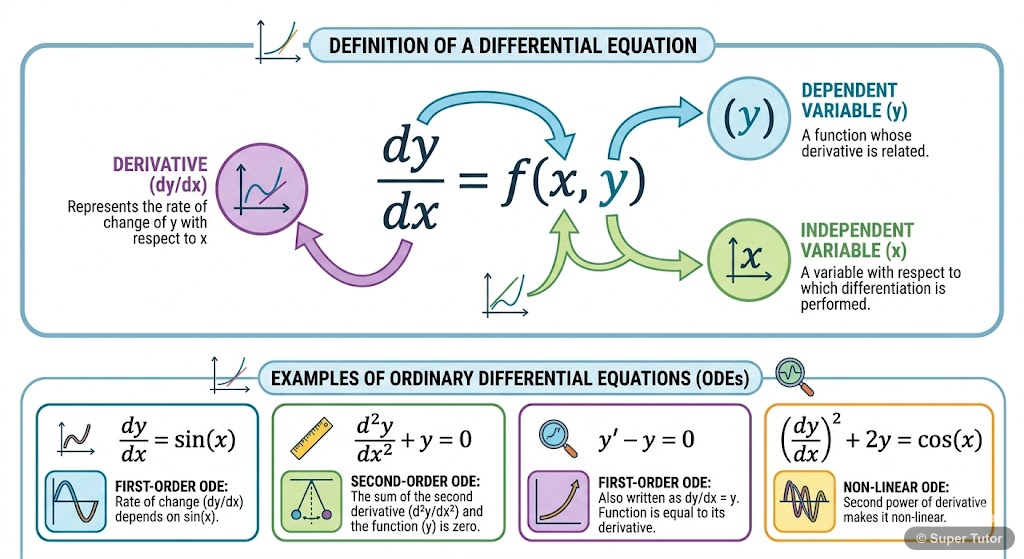
A diagram illustrating the components of a differential equation, showing independent variable, dependent variable, and derivatives. Examples of Ordinary Differential Equations (ODEs) are included.
Super Tutor

Learn better with visuals Super Tutor pairs illustrations like this with notes and quizzes for Differential Equations.

98 Questions Solved · 6 Sections

The first 49 solutions are open to read. The other 49 are free with a Super Tutor account.

Exercise 9.1

1Determine order and degree (if defined) of the differential equation: d4ydx4+sin⁡(y′′′)=0\frac{d^4y}{dx^4} + \sin(y''') = 0Show solution

Given: d4ydx4+sin⁡(y′′′)=0\dfrac{d^4y}{dx^4} + \sin(y''') = 0

Order: The highest order derivative present is d4ydx4\dfrac{d^4y}{dx^4} (i.e., the 4th derivative), so the order is 4.

Degree: The equation contains sin⁡(y′′′)\sin(y'''), which is a transcendental (non-polynomial) function of the derivative y′′′y'''. Therefore, the equation is not a polynomial in its derivatives.

Degree is not defined.

2Determine order and degree (if defined) of the differential equation: y′+5y=0y' + 5y = 0Show solution

Given: y′+5y=0y' + 5y = 0

Order: The highest order derivative present is y′=dydxy' = \dfrac{dy}{dx}, so the order is 1.

Degree: The equation is a polynomial in y′y' and the highest power of y′y' is 1.

Degree is 1.

3Determine order and degree (if defined) of the differential equation: (dsdt)4+3sd2sdt2=0\left(\frac{ds}{dt}\right)^4 + 3s\frac{d^2s}{dt^2} = 0Show solution

Given: (dsdt)4+3sd2sdt2=0\left(\dfrac{ds}{dt}\right)^4 + 3s\dfrac{d^2s}{dt^2} = 0

Order: The highest order derivative present is d2sdt2\dfrac{d^2s}{dt^2}, so the order is 2.

Degree: The equation is a polynomial in d2sdt2\dfrac{d^2s}{dt^2} and dsdt\dfrac{ds}{dt}. The highest power of the highest order derivative d2sdt2\dfrac{d^2s}{dt^2} is 1.

Degree is 1.

4Determine order and degree (if defined) of the differential equation: (d2ydx2)2+cos⁡(dydx)=0\left(\frac{d^2y}{dx^2}\right)^2 + \cos\left(\frac{dy}{dx}\right) = 0Show solution

Given: (d2ydx2)2+cos⁡(dydx)=0\left(\dfrac{d^2y}{dx^2}\right)^2 + \cos\left(\dfrac{dy}{dx}\right) = 0

Order: The highest order derivative present is d2ydx2\dfrac{d^2y}{dx^2}, so the order is 2.

Degree: The equation contains cos⁡(dydx)\cos\left(\dfrac{dy}{dx}\right), which is a transcendental function of the derivative dydx\dfrac{dy}{dx}. Therefore, the equation is not a polynomial in its derivatives.

Degree is not defined.

5Determine order and degree (if defined) of the differential equation: d2ydx2=cos⁡3x+sin⁡3x\frac{d^2y}{dx^2} = \cos 3x + \sin 3xShow solution

Given: d2ydx2=cos⁡3x+sin⁡3x\dfrac{d^2y}{dx^2} = \cos 3x + \sin 3x

Order: The highest order derivative present is d2ydx2\dfrac{d^2y}{dx^2}, so the order is 2.

Degree: The equation is a polynomial in d2ydx2\dfrac{d^2y}{dx^2} and the highest power of d2ydx2\dfrac{d^2y}{dx^2} is 1.

Degree is 1.

6Determine order and degree (if defined) of the differential equation: (y′′′)2+(y′′)3+(y′)4+y5=0(y''')^2 + (y'')^3 + (y')^4 + y^5 = 0Show solution

Given: (y′′′)2+(y′′)3+(y′)4+y5=0(y''')^2 + (y'')^3 + (y')^4 + y^5 = 0

Order: The highest order derivative present is y′′′y''' (3rd derivative), so the order is 3.

Degree: The equation is a polynomial in y′′′y''', y′′y'', y′y'. The highest power of the highest order derivative y′′′y''' is 2.

Degree is 2.

7Determine order and degree (if defined) of the differential equation: y′′′+2y′′+y′=0y''' + 2y'' + y' = 0Show solution

Given: y′′′+2y′′+y′=0y''' + 2y'' + y' = 0

Order: The highest order derivative present is y′′′y''' (3rd derivative), so the order is 3.

Degree: The equation is a polynomial in y′′′y''', y′′y'', y′y' and the highest power of y′′′y''' is 1.

Degree is 1.

8Determine order and degree (if defined) of the differential equation: y′+y=exy' + y = e^xShow solution

Given: y′+y=exy' + y = e^x

Order: The highest order derivative present is y′=dydxy' = \dfrac{dy}{dx}, so the order is 1.

Degree: The equation is a polynomial in y′y' and the highest power of y′y' is 1.

Degree is 1.

9Determine order and degree (if defined) of the differential equation: y′′+(y′)2+2y=0y'' + (y')^2 + 2y = 0Show solution

Given: y′′+(y′)2+2y=0y'' + (y')^2 + 2y = 0

Order: The highest order derivative present is y′′y'' (2nd derivative), so the order is 2.

Degree: The equation is a polynomial in y′′y'' and y′y'. The highest power of the highest order derivative y′′y'' is 1.

Degree is 1.

10Determine order and degree (if defined) of the differential equation: y′′+2y′+sin⁡y=0y'' + 2y' + \sin y = 0Show solution

Given: y′′+2y′+sin⁡y=0y'' + 2y' + \sin y = 0

Order: The highest order derivative present is y′′y'' (2nd derivative), so the order is 2.

Degree: The equation is a polynomial in y′′y'' and y′y'. The term sin⁡y\sin y involves yy (the dependent variable), not a derivative, so it does not affect the polynomial nature in derivatives. The highest power of y′′y'' is 1.

Degree is 1.

11The degree of the differential equation (d2ydx2)3+(dydx)2+sin⁡(dydx)+1=0\left(\frac{d^2y}{dx^2}\right)^3 + \left(\frac{dy}{dx}\right)^2 + \sin\left(\frac{dy}{dx}\right) + 1 = 0 is: (A) 3, (B) 2, (C) 1, (D) not definedShow solution

Correct Option: (D) not defined

Justification: The equation contains the term sin⁡(dydx)\sin\left(\dfrac{dy}{dx}\right), which is a transcendental (non-polynomial) function of the derivative dydx\dfrac{dy}{dx}. Since the equation is not a polynomial in its derivatives, the degree is not defined.

12The order of the differential equation 2x2d2ydx2−3dydx+y=02x^2\frac{d^2y}{dx^2} - 3\frac{dy}{dx} + y = 0 is: (A) 2, (B) 1, (C) 0, (D) not definedShow solution

Correct Option: (A) 2

Justification: The highest order derivative present in the equation is d2ydx2\dfrac{d^2y}{dx^2} (2nd order derivative). Therefore, the order of the differential equation is 2.

Exercise 9.2

1Verify that y=ex+1y = e^x + 1 is a solution of the differential equation y′′−y′=0y'' - y' = 0.Show solution

Given: y=ex+1y = e^x + 1

Differentiating once: y′=exy' = e^x

Differentiating again: y′′=exy'' = e^x

Substituting in the differential equation:
y′′−y′=ex−ex=0=R.H.S.y'' - y' = e^x - e^x = 0 = \text{R.H.S.}

Hence, y=ex+1y = e^x + 1 is a solution of y′′−y′=0y'' - y' = 0. ✓

2Verify that y=x2+2x+Cy = x^2 + 2x + C is a solution of the differential equation y′−2x−2=0y' - 2x - 2 = 0.Show solution

Given: y=x2+2x+Cy = x^2 + 2x + C

Differentiating: y′=2x+2y' = 2x + 2

Substituting in the differential equation:
y′−2x−2=(2x+2)−2x−2=0=R.H.S.y' - 2x - 2 = (2x + 2) - 2x - 2 = 0 = \text{R.H.S.}

Hence, y=x2+2x+Cy = x^2 + 2x + C is a solution of y′−2x−2=0y' - 2x - 2 = 0. ✓

3Verify that y=cos⁡x+Cy = \cos x + C is a solution of the differential equation y′+sin⁡x=0y' + \sin x = 0.Show solution

Given: y=cos⁡x+Cy = \cos x + C

Differentiating: y′=−sin⁡xy' = -\sin x

Substituting in the differential equation:
y′+sin⁡x=−sin⁡x+sin⁡x=0=R.H.S.y' + \sin x = -\sin x + \sin x = 0 = \text{R.H.S.}

Hence, y=cos⁡x+Cy = \cos x + C is a solution of y′+sin⁡x=0y' + \sin x = 0. ✓

4Verify that y=1+x2y = \sqrt{1+x^2} is a solution of the differential equation y′=xy1+x2y' = \frac{xy}{1+x^2}.Show solution

Given: y=1+x2=(1+x2)1/2y = \sqrt{1+x^2} = (1+x^2)^{1/2}

Differentiating:
y′=12(1+x2)−1/2⋅2x=x1+x2y' = \frac{1}{2}(1+x^2)^{-1/2} \cdot 2x = \frac{x}{\sqrt{1+x^2}}

R.H.S.:
xy1+x2=x⋅1+x21+x2=x1+x2\frac{xy}{1+x^2} = \frac{x \cdot \sqrt{1+x^2}}{1+x^2} = \frac{x}{\sqrt{1+x^2}}

Since L.H.S. == R.H.S., y=1+x2y = \sqrt{1+x^2} is a solution. ✓

5Verify that y=Axy = Ax is a solution of the differential equation xy′=yxy' = y (x≠0)(x \neq 0).Show solution

Given: y=Axy = Ax

Differentiating: y′=Ay' = A

Substituting in the differential equation:
xy′=x⋅A=Ax=y=R.H.S.xy' = x \cdot A = Ax = y = \text{R.H.S.}

Hence, y=Axy = Ax is a solution of xy′=yxy' = y. ✓

6Verify that y=xsin⁡xy = x\sin x is a solution of the differential equation xy′=y+xx2−y2xy' = y + x\sqrt{x^2 - y^2} (x≠0(x \neq 0 and x>yx > y or x<−y)x < -y).Show solution

Given: y=xsin⁡xy = x\sin x

Differentiating: y′=sin⁡x+xcos⁡xy' = \sin x + x\cos x

L.H.S.: xy′=x(sin⁡x+xcos⁡x)=xsin⁡x+x2cos⁡xxy' = x(\sin x + x\cos x) = x\sin x + x^2\cos x

R.H.S.: y+xx2−y2y + x\sqrt{x^2 - y^2}

Now, y2=x2sin⁡2xy^2 = x^2\sin^2 x, so:
x2−y2=x2−x2sin⁡2x=x2(1−sin⁡2x)=x2cos⁡2xx^2 - y^2 = x^2 - x^2\sin^2 x = x^2(1 - \sin^2 x) = x^2\cos^2 x
x2−y2=∣xcos⁡x∣=xcos⁡x(assuming xcos⁡x>0)\sqrt{x^2 - y^2} = |x\cos x| = x\cos x \quad (\text{assuming } x\cos x > 0)

Therefore:
y+xx2−y2=xsin⁡x+x⋅xcos⁡x=xsin⁡x+x2cos⁡xy + x\sqrt{x^2 - y^2} = x\sin x + x \cdot x\cos x = x\sin x + x^2\cos x

L.H.S. == R.H.S. ✓

7Verify that xy=log⁡y+Cxy = \log y + C is a solution of the differential equation y′=y21−xyy' = \frac{y^2}{1-xy} (xy≠1)(xy \neq 1).Show solution

Given: xy=log⁡y+Cxy = \log y + C

Differentiating both sides with respect to xx:
y+xdydx=1ydydxy + x\frac{dy}{dx} = \frac{1}{y}\frac{dy}{dx}

y=dydx(1y−x)=dydx⋅1−xyyy = \frac{dy}{dx}\left(\frac{1}{y} - x\right) = \frac{dy}{dx}\cdot\frac{1-xy}{y}

dydx=y21−xy\frac{dy}{dx} = \frac{y^2}{1-xy}

This is exactly the given differential equation. Hence verified. ✓

8Verify that y−cos⁡y=xy - \cos y = x is a solution of the differential equation (ysin⁡y+cos⁡y+x)y′=y(y\sin y + \cos y + x)y' = y.Show solution

Given: y−cos⁡y=xy - \cos y = x

Differentiating both sides with respect to xx:
dydx+sin⁡y⋅dydx=1\frac{dy}{dx} + \sin y \cdot \frac{dy}{dx} = 1
dydx(1+sin⁡y)=1\frac{dy}{dx}(1 + \sin y) = 1
dydx=11+sin⁡y\frac{dy}{dx} = \frac{1}{1 + \sin y}

Now check L.H.S. of the differential equation:
(ysin⁡y+cos⁡y+x)y′(y\sin y + \cos y + x)y'

Since x=y−cos⁡yx = y - \cos y:
ysin⁡y+cos⁡y+x=ysin⁡y+cos⁡y+y−cos⁡y=ysin⁡y+y=y(1+sin⁡y)y\sin y + \cos y + x = y\sin y + \cos y + y - \cos y = y\sin y + y = y(1 + \sin y)

Therefore:
(ysin⁡y+cos⁡y+x)y′=y(1+sin⁡y)⋅11+sin⁡y=y=R.H.S.(y\sin y + \cos y + x)y' = y(1+\sin y) \cdot \frac{1}{1+\sin y} = y = \text{R.H.S.}

Hence verified. ✓

9Verify that x+y=tan⁡−1yx + y = \tan^{-1}y is a solution of the differential equation y2y′+y2+1=0y^2y' + y^2 + 1 = 0.Show solution

Given: x+y=tan⁡−1yx + y = \tan^{-1}y

Differentiating both sides with respect to xx:
1+dydx=11+y2⋅dydx1 + \frac{dy}{dx} = \frac{1}{1+y^2}\cdot\frac{dy}{dx}

1=dydx(11+y2−1)=dydx⋅1−(1+y2)1+y2=dydx⋅−y21+y21 = \frac{dy}{dx}\left(\frac{1}{1+y^2} - 1\right) = \frac{dy}{dx}\cdot\frac{1 - (1+y^2)}{1+y^2} = \frac{dy}{dx}\cdot\frac{-y^2}{1+y^2}

dydx=−(1+y2)y2\frac{dy}{dx} = \frac{-(1+y^2)}{y^2}

Substituting in the differential equation y2y′+y2+1=0y^2y' + y^2 + 1 = 0:
y2⋅−(1+y2)y2+y2+1=−(1+y2)+y2+1=−1−y2+y2+1=0=R.H.S.y^2 \cdot \frac{-(1+y^2)}{y^2} + y^2 + 1 = -(1+y^2) + y^2 + 1 = -1 - y^2 + y^2 + 1 = 0 = \text{R.H.S.}

Hence verified. ✓

10Verify that y=a2−x2, x∈(−a,a)y = \sqrt{a^2 - x^2},\ x \in (-a,a) is a solution of the differential equation x+ydydx=0x + y\frac{dy}{dx} = 0 (y≠0)(y \neq 0).Show solution

Given: y=a2−x2y = \sqrt{a^2 - x^2}

Differentiating:
dydx=−2x2a2−x2=−xa2−x2=−xy\frac{dy}{dx} = \frac{-2x}{2\sqrt{a^2-x^2}} = \frac{-x}{\sqrt{a^2-x^2}} = \frac{-x}{y}

Substituting in the differential equation:
x+ydydx=x+y⋅−xy=x−x=0=R.H.S.x + y\frac{dy}{dx} = x + y \cdot \frac{-x}{y} = x - x = 0 = \text{R.H.S.}

Hence verified. ✓

11The number of arbitrary constants in the general solution of a differential equation of fourth order are: (A) 0, (B) 2, (C) 3, (D) 4Show solution

Correct Option: (D) 4

Justification: The general solution of a differential equation of order nn contains exactly nn arbitrary constants. For a fourth order differential equation, the general solution contains 4 arbitrary constants.

12The number of arbitrary constants in the particular solution of a differential equation of third order are: (A) 3, (B) 2, (C) 1, (D) 0Show solution

Correct Option: (D) 0

Justification: A particular solution is obtained from the general solution by assigning specific values to all arbitrary constants. Therefore, a particular solution contains no arbitrary constants, regardless of the order of the differential equation.

Exercise 9.3

1Find the general solution of the differential equation dydx=1−cos⁡x1+cos⁡x\frac{dy}{dx} = \frac{1-\cos x}{1+\cos x}.Show solution

Given: dydx=1−cos⁡x1+cos⁡x\dfrac{dy}{dx} = \dfrac{1-\cos x}{1+\cos x}

Using identities: 1−cos⁡x=2sin⁡2x21 - \cos x = 2\sin^2\dfrac{x}{2} and 1+cos⁡x=2cos⁡2x21 + \cos x = 2\cos^2\dfrac{x}{2}

dydx=2sin⁡2x22cos⁡2x2=tan⁡2x2=sec⁡2x2−1\frac{dy}{dx} = \frac{2\sin^2\frac{x}{2}}{2\cos^2\frac{x}{2}} = \tan^2\frac{x}{2} = \sec^2\frac{x}{2} - 1

Separating variables and integrating:
dy=(sec⁡2x2−1)dxdy = \left(\sec^2\frac{x}{2} - 1\right)dx

∫dy=∫(sec⁡2x2−1)dx\int dy = \int\left(\sec^2\frac{x}{2} - 1\right)dx

y=tan⁡x212−x+Cy = \frac{\tan\frac{x}{2}}{\frac{1}{2}} - x + C

y=2tan⁡x2−x+C\boxed{y = 2\tan\frac{x}{2} - x + C}

2Find the general solution of the differential equation dydx=4−y2\frac{dy}{dx} = \sqrt{4-y^2} (−2<y<2)(-2 < y < 2).Show solution

Given: dydx=4−y2\dfrac{dy}{dx} = \sqrt{4-y^2}

Separating variables:
dy4−y2=dx\frac{dy}{\sqrt{4-y^2}} = dx

Integrating both sides:
∫dy4−y2=∫dx\int\frac{dy}{\sqrt{4-y^2}} = \int dx

sin⁡−1y2=x+C\sin^{-1}\frac{y}{2} = x + C

sin⁡−1y2=x+Cory=2sin⁡(x+C)\boxed{\sin^{-1}\frac{y}{2} = x + C} \quad \text{or} \quad y = 2\sin(x+C)

3Find the general solution of the differential equation dydx+y=1\frac{dy}{dx} + y = 1 (y≠1)(y \neq 1).Show solution

Given: dydx+y=1\dfrac{dy}{dx} + y = 1, i.e., dydx=1−y\dfrac{dy}{dx} = 1 - y

Separating variables:
dy1−y=dx\frac{dy}{1-y} = dx

Integrating both sides:
∫dy1−y=∫dx\int\frac{dy}{1-y} = \int dx

−log⁡∣1−y∣=x+C1-\log|1-y| = x + C_1

log⁡∣1−y∣=−x−C1\log|1-y| = -x - C_1

∣1−y∣=e−x−C1=e−C1⋅e−x|1-y| = e^{-x-C_1} = e^{-C_1}\cdot e^{-x}

1−y=±e−C1⋅e−x=Ae−x(where A=±e−C1)1 - y = \pm e^{-C_1}\cdot e^{-x} = Ae^{-x} \quad (\text{where } A = \pm e^{-C_1})

y=1−Ae−x\boxed{y = 1 - Ae^{-x}}

or equivalently y=1+Ce−xy = 1 + Ce^{-x} where CC is an arbitrary constant.

4Find the general solution of the differential equation sec⁡2xtan⁡y dx+sec⁡2ytan⁡x dy=0\sec^2 x \tan y\, dx + \sec^2 y \tan x\, dy = 0.Show solution

Given: sec⁡2xtan⁡y dx+sec⁡2ytan⁡x dy=0\sec^2 x \tan y\, dx + \sec^2 y \tan x\, dy = 0

Separating variables (dividing by tan⁡xtan⁡y\tan x \tan y):
sec⁡2xtan⁡xdx+sec⁡2ytan⁡ydy=0\frac{\sec^2 x}{\tan x}dx + \frac{\sec^2 y}{\tan y}dy = 0

Integrating both sides:
∫sec⁡2xtan⁡xdx+∫sec⁡2ytan⁡ydy=0\int\frac{\sec^2 x}{\tan x}dx + \int\frac{\sec^2 y}{\tan y}dy = 0

Let tan⁡x=u⇒sec⁡2x dx=du\tan x = u \Rightarrow \sec^2 x\, dx = du for the first integral, and similarly for the second:
log⁡∣tan⁡x∣+log⁡∣tan⁡y∣=log⁡C\log|\tan x| + \log|\tan y| = \log C

log⁡∣tan⁡x⋅tan⁡y∣=log⁡C\log|\tan x \cdot \tan y| = \log C

tan⁡x⋅tan⁡y=C\boxed{\tan x \cdot \tan y = C}

5Find the general solution of the differential equation (ex+e−x)dy−(ex−e−x)dx=0(e^x + e^{-x})dy - (e^x - e^{-x})dx = 0.Show solution

Given: (ex+e−x)dy=(ex−e−x)dx(e^x + e^{-x})dy = (e^x - e^{-x})dx

Separating variables:
dy=ex−e−xex+e−xdxdy = \frac{e^x - e^{-x}}{e^x + e^{-x}}dx

Integrating both sides:
∫dy=∫ex−e−xex+e−xdx\int dy = \int\frac{e^x - e^{-x}}{e^x + e^{-x}}dx

Note that the numerator is the derivative of the denominator:
y=log⁡∣ex+e−x∣+Cy = \log|e^x + e^{-x}| + C

y=log⁡(ex+e−x)+C\boxed{y = \log(e^x + e^{-x}) + C}

(Since ex+e−x>0e^x + e^{-x} > 0, absolute value is not needed.)

6Find the general solution of the differential equation dydx=(1+x2)(1+y2)\frac{dy}{dx} = (1+x^2)(1+y^2).Show solution

Given: dydx=(1+x2)(1+y2)\dfrac{dy}{dx} = (1+x^2)(1+y^2)

Separating variables:
dy1+y2=(1+x2)dx\frac{dy}{1+y^2} = (1+x^2)dx

Integrating both sides:
∫dy1+y2=∫(1+x2)dx\int\frac{dy}{1+y^2} = \int(1+x^2)dx

tan⁡−1y=x+x33+C\tan^{-1}y = x + \frac{x^3}{3} + C

tan⁡−1y=x+x33+C\boxed{\tan^{-1}y = x + \frac{x^3}{3} + C}

7Find the general solution of the differential equation ylog⁡y dx−x dy=0y\log y\, dx - x\, dy = 0.Show solution

Given: ylog⁡y dx=x dyy\log y\, dx = x\, dy

Separating variables:
dxx=dyylog⁡y\frac{dx}{x} = \frac{dy}{y\log y}

Integrating both sides:
∫dxx=∫dyylog⁡y\int\frac{dx}{x} = \int\frac{dy}{y\log y}

For the right side, let log⁡y=t⇒1ydy=dt\log y = t \Rightarrow \dfrac{1}{y}dy = dt:
log⁡∣x∣=∫dtt=log⁡∣t∣=log⁡∣log⁡y∣\log|x| = \int\frac{dt}{t} = \log|t| = \log|\log y|

log⁡∣x∣=log⁡∣log⁡y∣+log⁡C\log|x| = \log|\log y| + \log C

log⁡∣x∣=log⁡∣Clog⁡y∣\log|x| = \log|C\log y|

x=Clog⁡y\boxed{x = C\log y}

8Find the general solution of the differential equation x5dydx=−y5x^5\frac{dy}{dx} = -y^5.Show solution

Given: x5dydx=−y5x^5\dfrac{dy}{dx} = -y^5

Separating variables:
dyy5=−dxx5\frac{dy}{y^5} = -\frac{dx}{x^5}

y−5dy=−x−5dxy^{-5}dy = -x^{-5}dx

Integrating both sides:
∫y−5dy=−∫x−5dx\int y^{-5}dy = -\int x^{-5}dx

y−4−4=−x−4−4+C1\frac{y^{-4}}{-4} = -\frac{x^{-4}}{-4} + C_1

−14y4=14x4+C1-\frac{1}{4y^4} = \frac{1}{4x^4} + C_1

Multiplying by −4-4:
1y4=−1x4+C(C=−4C1)\frac{1}{y^4} = -\frac{1}{x^4} + C \quad (C = -4C_1)

x−4+y−4=C\boxed{x^{-4} + y^{-4} = C}

9Find the general solution of the differential equation dydx=sin⁡−1x\frac{dy}{dx} = \sin^{-1}x.Show solution

Given: dydx=sin⁡−1x\dfrac{dy}{dx} = \sin^{-1}x

Separating variables:
dy=sin⁡−1x dxdy = \sin^{-1}x\, dx

Integrating both sides:
y=∫sin⁡−1x dxy = \int \sin^{-1}x\, dx

Using integration by parts: u=sin⁡−1xu = \sin^{-1}x, dv=dxdv = dx
dudx=11−x2,v=x\frac{du}{dx} = \frac{1}{\sqrt{1-x^2}}, \quad v = x

y=xsin⁡−1x−∫x1−x2dxy = x\sin^{-1}x - \int\frac{x}{\sqrt{1-x^2}}dx

For ∫x1−x2dx\displaystyle\int\frac{x}{\sqrt{1-x^2}}dx: let 1−x2=t⇒−2x dx=dt1-x^2 = t \Rightarrow -2x\,dx = dt
∫x1−x2dx=−12∫t−1/2dt=−t=−1−x2\int\frac{x}{\sqrt{1-x^2}}dx = -\frac{1}{2}\int t^{-1/2}dt = -\sqrt{t} = -\sqrt{1-x^2}

Therefore:
y=xsin⁡−1x−(−1−x2)+Cy = x\sin^{-1}x - (-\sqrt{1-x^2}) + C

y=xsin⁡−1x+1−x2+C\boxed{y = x\sin^{-1}x + \sqrt{1-x^2} + C}

10Find the general solution of the differential equation extan⁡y dx+(1−ex)sec⁡2y dy=0e^x\tan y\, dx + (1-e^x)\sec^2 y\, dy = 0.Show solution

Given: extan⁡y dx+(1−ex)sec⁡2y dy=0e^x\tan y\, dx + (1-e^x)\sec^2 y\, dy = 0

Separating variables (dividing by tan⁡y(1−ex)\tan y(1-e^x)):
ex1−exdx+sec⁡2ytan⁡ydy=0\frac{e^x}{1-e^x}dx + \frac{\sec^2 y}{\tan y}dy = 0

Integrating both sides:
∫ex1−exdx+∫sec⁡2ytan⁡ydy=0\int\frac{e^x}{1-e^x}dx + \int\frac{\sec^2 y}{\tan y}dy = 0

For the first integral, let 1−ex=t⇒−exdx=dt1-e^x = t \Rightarrow -e^x dx = dt:
∫ex1−exdx=−∫dtt=−log⁡∣t∣=−log⁡∣1−ex∣\int\frac{e^x}{1-e^x}dx = -\int\frac{dt}{t} = -\log|t| = -\log|1-e^x|

For the second integral, let tan⁡y=u⇒sec⁡2y dy=du\tan y = u \Rightarrow \sec^2 y\, dy = du:
∫sec⁡2ytan⁡ydy=log⁡∣tan⁡y∣\int\frac{\sec^2 y}{\tan y}dy = \log|\tan y|

Therefore:
−log⁡∣1−ex∣+log⁡∣tan⁡y∣=log⁡C-\log|1-e^x| + \log|\tan y| = \log C

log⁡∣tan⁡y1−ex∣=log⁡C\log\left|\frac{\tan y}{1-e^x}\right| = \log C

tan⁡y=C(1−ex)\boxed{\tan y = C(1-e^x)}

11Find the particular solution of (x3+x2+x+1)dydx=2x2+x(x^3+x^2+x+1)\frac{dy}{dx} = 2x^2+x; y=1y=1 when x=0x=0.Show solution

Given: (x3+x2+x+1)dydx=2x2+x(x^3+x^2+x+1)\dfrac{dy}{dx} = 2x^2+x

Separating variables:
dy=2x2+xx3+x2+x+1dxdy = \frac{2x^2+x}{x^3+x^2+x+1}dx

Factoring the denominator:
x3+x2+x+1=x2(x+1)+(x+1)=(x2+1)(x+1)x^3+x^2+x+1 = x^2(x+1)+(x+1) = (x^2+1)(x+1)

Partial fractions:
2x2+x(x2+1)(x+1)=Ax+1+Bx+Dx2+1\frac{2x^2+x}{(x^2+1)(x+1)} = \frac{A}{x+1} + \frac{Bx+D}{x^2+1}

2x2+x=A(x2+1)+(Bx+D)(x+1)2x^2+x = A(x^2+1) + (Bx+D)(x+1)

Setting x=−1x = -1: 2−1=A(2)⇒A=122-1 = A(2) \Rightarrow A = \dfrac{1}{2}

Expanding: 2x2+x=Ax2+A+Bx2+Bx+Dx+D2x^2+x = Ax^2+A+Bx^2+Bx+Dx+D

Comparing x2x^2: 2=A+B⇒B=2−12=322 = A+B \Rightarrow B = 2 - \dfrac{1}{2} = \dfrac{3}{2}

Comparing constant: 0=A+D⇒D=−120 = A+D \Rightarrow D = -\dfrac{1}{2}

Comparing xx: 1=B+D=32−12=11 = B+D = \dfrac{3}{2} - \dfrac{1}{2} = 1 ✓

Integrating:
y=∫[1/2x+1+32x−12x2+1]dxy = \int\left[\frac{1/2}{x+1} + \frac{\frac{3}{2}x - \frac{1}{2}}{x^2+1}\right]dx

y=12log⁡∣x+1∣+34log⁡(x2+1)−12tan⁡−1x+Cy = \frac{1}{2}\log|x+1| + \frac{3}{4}\log(x^2+1) - \frac{1}{2}\tan^{-1}x + C

Applying condition y=1y=1 when x=0x=0:
1=12log⁡1+34log⁡1−12⋅0+C⇒C=11 = \frac{1}{2}\log 1 + \frac{3}{4}\log 1 - \frac{1}{2}\cdot 0 + C \Rightarrow C = 1

Particular solution:
y=12log⁡∣x+1∣+34log⁡(x2+1)−12tan⁡−1x+1\boxed{y = \frac{1}{2}\log|x+1| + \frac{3}{4}\log(x^2+1) - \frac{1}{2}\tan^{-1}x + 1}

12Find the particular solution of x(x2−1)dydx=1x(x^2-1)\frac{dy}{dx} = 1; y=0y=0 when x=2x=2.Show solution

Given: x(x2−1)dydx=1x(x^2-1)\dfrac{dy}{dx} = 1

Separating variables:
dy=dxx(x2−1)=dxx(x−1)(x+1)dy = \frac{dx}{x(x^2-1)} = \frac{dx}{x(x-1)(x+1)}

Partial fractions:
1x(x−1)(x+1)=Ax+Bx−1+Cx+1\frac{1}{x(x-1)(x+1)} = \frac{A}{x} + \frac{B}{x-1} + \frac{C}{x+1}

x=0x=0: 1=A(−1)(1)⇒A=−11 = A(-1)(1) \Rightarrow A = -1

x=1x=1: 1=B(1)(2)⇒B=121 = B(1)(2) \Rightarrow B = \dfrac{1}{2}

x=−1x=-1: 1=C(−1)(−2)⇒C=121 = C(-1)(-2) \Rightarrow C = \dfrac{1}{2}

Integrating:
y=−log⁡∣x∣+12log⁡∣x−1∣+12log⁡∣x+1∣+Ky = -\log|x| + \frac{1}{2}\log|x-1| + \frac{1}{2}\log|x+1| + K

y=12log⁡∣(x−1)(x+1)∣−log⁡∣x∣+K=12log⁡∣x2−1x2∣+Ky = \frac{1}{2}\log|(x-1)(x+1)| - \log|x| + K = \frac{1}{2}\log\left|\frac{x^2-1}{x^2}\right| + K

Applying condition y=0y=0 when x=2x=2:
0=12log⁡∣34∣+K⇒K=−12log⁡34=12log⁡430 = \frac{1}{2}\log\left|\frac{3}{4}\right| + K \Rightarrow K = -\frac{1}{2}\log\frac{3}{4} = \frac{1}{2}\log\frac{4}{3}

Particular solution:
y=12log⁡∣x2−1x2∣+12log⁡43y = \frac{1}{2}\log\left|\frac{x^2-1}{x^2}\right| + \frac{1}{2}\log\frac{4}{3}

y=12log⁡∣4(x2−1)3x2∣\boxed{y = \frac{1}{2}\log\left|\frac{4(x^2-1)}{3x^2}\right|}

13Find the particular solution of cos⁡(dydx)=a\cos\left(\frac{dy}{dx}\right) = a (a∈R)(a \in \mathbf{R}); y=1y=1 when x=0x=0.Show solution

Given: cos⁡(dydx)=a\cos\left(\dfrac{dy}{dx}\right) = a

dydx=cos⁡−1a\frac{dy}{dx} = \cos^{-1}a

Since aa is a constant, cos⁡−1a\cos^{-1}a is also a constant. Let cos⁡−1a=k\cos^{-1}a = k.

Separating variables:
dy=k dxdy = k\, dx

Integrating:
y=kx+C=xcos⁡−1a+Cy = kx + C = x\cos^{-1}a + C

Applying condition y=1y=1 when x=0x=0:
1=0+C⇒C=11 = 0 + C \Rightarrow C = 1

Particular solution:
y=xcos⁡−1a+1\boxed{y = x\cos^{-1}a + 1}

14Find the particular solution of dydx=ytan⁡x\frac{dy}{dx} = y\tan x; y=1y=1 when x=0x=0.Show solution

Given: dydx=ytan⁡x\dfrac{dy}{dx} = y\tan x

Separating variables:
dyy=tan⁡x dx\frac{dy}{y} = \tan x\, dx

Integrating both sides:
log⁡∣y∣=log⁡∣sec⁡x∣+log⁡C\log|y| = \log|\sec x| + \log C

∣y∣=C∣sec⁡x∣|y| = C|\sec x|

y=Csec⁡xy = C\sec x

Applying condition y=1y=1 when x=0x=0:
1=Csec⁡0=C⋅1⇒C=11 = C\sec 0 = C \cdot 1 \Rightarrow C = 1

Particular solution:
y=sec⁡x\boxed{y = \sec x}

15Find the equation of a curve passing through the point (0,0)(0,0) and whose differential equation is y′=exsin⁡xy' = e^x\sin x.Show solution

Given: dydx=exsin⁡x\dfrac{dy}{dx} = e^x\sin x, passing through (0,0)(0,0).

Integrating:
y=∫exsin⁡x dxy = \int e^x\sin x\, dx

Using integration by parts twice:
I=∫exsin⁡x dxI = \int e^x\sin x\, dx
I=exsin⁡x−∫excos⁡x dxI = e^x\sin x - \int e^x\cos x\, dx
I=exsin⁡x−[excos⁡x+∫exsin⁡x dx]I = e^x\sin x - \left[e^x\cos x + \int e^x\sin x\, dx\right]
I=exsin⁡x−excos⁡x−II = e^x\sin x - e^x\cos x - I
2I=ex(sin⁡x−cos⁡x)2I = e^x(\sin x - \cos x)
I=ex(sin⁡x−cos⁡x)2I = \frac{e^x(\sin x - \cos x)}{2}

So: y=ex(sin⁡x−cos⁡x)2+Cy = \dfrac{e^x(\sin x - \cos x)}{2} + C

Applying condition y=0y=0 when x=0x=0:
0=e0(0−1)2+C=−12+C⇒C=120 = \frac{e^0(0-1)}{2} + C = -\frac{1}{2} + C \Rightarrow C = \frac{1}{2}

Equation of the curve:
y=ex(sin⁡x−cos⁡x)2+12=ex(sin⁡x−cos⁡x)+12\boxed{y = \frac{e^x(\sin x - \cos x)}{2} + \frac{1}{2} = \frac{e^x(\sin x - \cos x) + 1}{2}}

16For the differential equation xydydx=(x+2)(y+2)xy\frac{dy}{dx} = (x+2)(y+2), find the solution curve passing through the point (1,−1)(1,-1).Show solution

Given: xydydx=(x+2)(y+2)xy\dfrac{dy}{dx} = (x+2)(y+2)

Separating variables:
yy+2dy=x+2xdx\frac{y}{y+2}dy = \frac{x+2}{x}dx

(1−2y+2)dy=(1+2x)dx\left(1 - \frac{2}{y+2}\right)dy = \left(1 + \frac{2}{x}\right)dx

Integrating both sides:
y−2log⁡∣y+2∣=x+2log⁡∣x∣+Cy - 2\log|y+2| = x + 2\log|x| + C

Applying condition (1,−1)(1,-1):
−1−2log⁡∣1∣=1+2log⁡∣1∣+C-1 - 2\log|1| = 1 + 2\log|1| + C
−1−0=1+0+C⇒C=−2-1 - 0 = 1 + 0 + C \Rightarrow C = -2

Equation of the curve:
y−2log⁡∣y+2∣=x+2log⁡∣x∣−2y - 2\log|y+2| = x + 2\log|x| - 2

y−x+2=2log⁡∣x(y+2)∣\boxed{y - x + 2 = 2\log|x(y+2)|}

17Find the equation of a curve passing through the point (0,−2)(0,-2) given that at any point (x,y)(x,y) on the curve, the product of the slope of its tangent and yy coordinate of the point is equal to the xx coordinate of the point.Show solution

Given condition: ydydx=xy\dfrac{dy}{dx} = x, passing through (0,−2)(0,-2).

Separating variables:
y dy=x dxy\, dy = x\, dx

Integrating both sides:
y22=x22+C\frac{y^2}{2} = \frac{x^2}{2} + C

y2=x2+2Cy^2 = x^2 + 2C

Applying condition (0,−2)(0,-2):
(−2)2=0+2C⇒4=2C⇒C=2(-2)^2 = 0 + 2C \Rightarrow 4 = 2C \Rightarrow C = 2

Equation of the curve:
y2=x2+4\boxed{y^2 = x^2 + 4}

18At any point (x,y)(x,y) of a curve, the slope of the tangent is twice the slope of the line segment joining the point of contact to the point (−4,−3)(-4,-3). Find the equation of the curve given that it passes through (−2,1)(-2,1).Show solution

Given: Slope of tangent =2×= 2 \times slope of line joining (x,y)(x,y) to (−4,−3)(-4,-3)

dydx=2⋅y−(−3)x−(−4)=2(y+3)x+4\frac{dy}{dx} = 2\cdot\frac{y-(-3)}{x-(-4)} = \frac{2(y+3)}{x+4}

Separating variables:
dyy+3=2 dxx+4\frac{dy}{y+3} = \frac{2\, dx}{x+4}

Integrating both sides:
log⁡∣y+3∣=2log⁡∣x+4∣+log⁡C\log|y+3| = 2\log|x+4| + \log C

∣y+3∣=C(x+4)2|y+3| = C(x+4)^2

y+3=C(x+4)2y+3 = C(x+4)^2

Applying condition (−2,1)(-2,1):
1+3=C(−2+4)2=C⋅4⇒C=11+3 = C(-2+4)^2 = C\cdot 4 \Rightarrow C = 1

Equation of the curve:
y+3=(x+4)2\boxed{y+3 = (x+4)^2}

19The volume of a spherical balloon being inflated changes at a constant rate. If initially its radius is 3 units and after 3 seconds it is 6 units. Find the radius of balloon after tt seconds.Show solution

Let VV be the volume of the spherical balloon at time tt. Given: dVdt=k\dfrac{dV}{dt} = k (constant).

Volume of sphere: V=43πr3V = \dfrac{4}{3}\pi r^3

dVdt=4πr2drdt=k\frac{dV}{dt} = 4\pi r^2 \frac{dr}{dt} = k

Integrating dVdt=k\dfrac{dV}{dt} = k:
V=kt+CV = kt + C
43πr3=kt+C(1)\frac{4}{3}\pi r^3 = kt + C \tag{1}

At t=0t=0, r=3r=3:
43π(27)=C⇒C=36π\frac{4}{3}\pi(27) = C \Rightarrow C = 36\pi

At t=3t=3, r=6r=6:
43π(216)=3k+36π\frac{4}{3}\pi(216) = 3k + 36\pi
288π=3k+36π288\pi = 3k + 36\pi
3k=252π⇒k=84π3k = 252\pi \Rightarrow k = 84\pi

Substituting in (1):
43πr3=84πt+36π\frac{4}{3}\pi r^3 = 84\pi t + 36\pi
43r3=84t+36\frac{4}{3}r^3 = 84t + 36
r3=34(84t+36)=63t+27r^3 = \frac{3}{4}(84t+36) = 63t + 27

r=(63t+27)1/3 units\boxed{r = (63t+27)^{1/3} \text{ units}}

20In a bank, principal increases continuously at the rate of r%r\% per year. Find the value of rr if Rs 100 double itself in 10 years (log⁡e2=0.6931\log_e 2 = 0.6931).Show solution

Given: dPdt=r100P\dfrac{dP}{dt} = \dfrac{r}{100}P

Separating variables and integrating:
dPP=r100dt\frac{dP}{P} = \frac{r}{100}dt
log⁡P=r100t+C1\log P = \frac{r}{100}t + C_1
P=Cert/100P = Ce^{rt/100}

At t=0t=0, P=100P=100: C=100C = 100

So P=100 ert/100P = 100\, e^{rt/100}

At t=10t=10, P=200P=200:
200=100 e10r/100200 = 100\, e^{10r/100}
2=er/102 = e^{r/10}
log⁡e2=r10\log_e 2 = \frac{r}{10}
r=10log⁡e2=10×0.6931=6.931r = 10\log_e 2 = 10 \times 0.6931 = 6.931

r≈6.931%\boxed{r \approx 6.931\%}

21In a bank, principal increases continuously at the rate of 5%5\% per year. An amount of Rs 1000 is deposited with this bank, how much will it worth after 10 years (e0.5=1.648e^{0.5} = 1.648).Show solution

Given: Rate =5%= 5\%, P0=1000P_0 = 1000, t=10t = 10 years.

From the standard result: P=P0 ert/100P = P_0\, e^{rt/100}

P=1000×e(5×10)/100=1000×e0.5P = 1000 \times e^{(5 \times 10)/100} = 1000 \times e^{0.5}

P=1000×1.648=1648P = 1000 \times 1.648 = 1648

P=Rs 1648\boxed{P = \text{Rs }1648}

22In a culture, the bacteria count is 1,00,000. The number is increased by 10%10\% in 2 hours. In how many hours will the count reach 2,00,000, if the rate of growth of bacteria is proportional to the number present?Show solution

Let NN be the bacteria count at time tt (in hours).

Given: dNdt=kN\dfrac{dN}{dt} = kN

Solution: N=N0ektN = N_0 e^{kt}

At t=0t=0: N0=1,00,000N_0 = 1{,}00{,}000

At t=2t=2: N=1,10,000N = 1{,}10{,}000 (increased by 10%)
1,10,000=1,00,000 e2k1{,}10{,}000 = 1{,}00{,}000\, e^{2k}
e2k=1110e^{2k} = \frac{11}{10}
2k=log⁡e11102k = \log_e\frac{11}{10}
k=12log⁡e1110k = \frac{1}{2}\log_e\frac{11}{10}

When N=2,00,000N = 2{,}00{,}000:
2,00,000=1,00,000 ekt2{,}00{,}000 = 1{,}00{,}000\, e^{kt}
ekt=2e^{kt} = 2
kt=log⁡e2kt = \log_e 2
t=log⁡e2k=log⁡e212log⁡e1110=2log⁡e2log⁡e1110t = \frac{\log_e 2}{k} = \frac{\log_e 2}{\frac{1}{2}\log_e\frac{11}{10}} = \frac{2\log_e 2}{\log_e\frac{11}{10}}

t=2log⁡e2log⁡e(1110) hours\boxed{t = \frac{2\log_e 2}{\log_e\left(\frac{11}{10}\right)} \text{ hours}}

23The general solution of the differential equation dydx=ex+y\frac{dy}{dx} = e^{x+y} is: (A) ex+e−y=Ce^x + e^{-y} = C, (B) ex+ey=Ce^x + e^y = C, (C) e−x+ey=Ce^{-x} + e^y = C, (D) e−x+e−y=Ce^{-x} + e^{-y} = CShow solution

Correct Option: (A) ex+e−y=Ce^x + e^{-y} = C

Working:
dydx=ex⋅ey\frac{dy}{dx} = e^x \cdot e^y

Separating variables:
e−ydy=exdxe^{-y}dy = e^x dx

Integrating:
−e−y=ex+C1-e^{-y} = e^x + C_1

ex+e−y=C(C=−C1)e^x + e^{-y} = C \quad (C = -C_1)

Hence option (A) is correct.

Exercise 9.4

1Show that the differential equation (x2+xy)dy=(x2+y2)dx(x^2+xy)dy = (x^2+y^2)dx is homogeneous and solve it.Show solution

Step 1: Show homogeneity.

Rewrite as dydx=x2+y2x2+xy\dfrac{dy}{dx} = \dfrac{x^2+y^2}{x^2+xy}.

Let F(x,y)=x2+y2x2+xyF(x,y) = \dfrac{x^2+y^2}{x^2+xy}.

F(λx,λy)=λ2x2+λ2y2λ2x2+λx⋅λy=λ2(x2+y2)λ2(x2+xy)=F(x,y)=λ0F(x,y)F(\lambda x, \lambda y) = \dfrac{\lambda^2 x^2 + \lambda^2 y^2}{\lambda^2 x^2 + \lambda x \cdot \lambda y} = \dfrac{\lambda^2(x^2+y^2)}{\lambda^2(x^2+xy)} = F(x,y) = \lambda^0 F(x,y)

So the equation is homogeneous of degree 0.

Step 2: Substitute y=vxy = vx, so dydx=v+xdvdx\dfrac{dy}{dx} = v + x\dfrac{dv}{dx}.

v+xdvdx=x2+v2x2x2+x⋅vx=1+v21+vv + x\frac{dv}{dx} = \frac{x^2 + v^2x^2}{x^2 + x\cdot vx} = \frac{1+v^2}{1+v}

xdvdx=1+v21+v−v=1+v2−v(1+v)1+v=1+v2−v−v21+v=1−v1+vx\frac{dv}{dx} = \frac{1+v^2}{1+v} - v = \frac{1+v^2 - v(1+v)}{1+v} = \frac{1+v^2-v-v^2}{1+v} = \frac{1-v}{1+v}

Step 3: Separate variables.
1+v1−vdv=dxx\frac{1+v}{1-v}dv = \frac{dx}{x}

−(1+v)v−1dv=dxx\frac{-(1+v)}{v-1}dv = \frac{dx}{x}

Write 1+v1−v=−(v−1)+2v−1=−1+2v−1\dfrac{1+v}{1-v} = \dfrac{-(v-1)+2}{v-1} = -1 + \dfrac{2}{v-1}...

Alternatively: 1+v1−v=−1+21−v\dfrac{1+v}{1-v} = -1 + \dfrac{2}{1-v}

Step 4: Integrate.
∫(−1+21−v)dv=∫dxx\int\left(-1 + \frac{2}{1-v}\right)dv = \int\frac{dx}{x}

−v−2log⁡∣1−v∣=log⁡∣x∣+C-v - 2\log|1-v| = \log|x| + C

Substituting v=y/xv = y/x:
−yx−2log⁡∣1−yx∣=log⁡∣x∣+C-\frac{y}{x} - 2\log\left|1-\frac{y}{x}\right| = \log|x| + C

−yx−2log⁡∣x−yx∣=log⁡∣x∣+C-\frac{y}{x} - 2\log\left|\frac{x-y}{x}\right| = \log|x| + C

−yx−2log⁡∣x−y∣+2log⁡∣x∣=log⁡∣x∣+C-\frac{y}{x} - 2\log|x-y| + 2\log|x| = \log|x| + C

−yx+log⁡∣x∣−2log⁡∣x−y∣=C-\frac{y}{x} + \log|x| - 2\log|x-y| = C

log⁡∣x∣−2log⁡∣x−y∣=yx+C\boxed{\log|x| - 2\log|x-y| = \frac{y}{x} + C}

2Show that the differential equation y′=x+yxy' = \frac{x+y}{x} is homogeneous and solve it.Show solution

Step 1: Show homogeneity.

F(x,y)=x+yxF(x,y) = \dfrac{x+y}{x}; F(λx,λy)=λx+λyλx=x+yx=λ0F(x,y)F(\lambda x, \lambda y) = \dfrac{\lambda x + \lambda y}{\lambda x} = \dfrac{x+y}{x} = \lambda^0 F(x,y). Homogeneous of degree 0.

Step 2: Substitute y=vxy = vx.
v+xdvdx=x+vxx=1+vv + x\frac{dv}{dx} = \frac{x+vx}{x} = 1+v

xdvdx=1x\frac{dv}{dx} = 1

Step 3: Separate and integrate.
dv=dxxdv = \frac{dx}{x}

v=log⁡∣x∣+Cv = \log|x| + C

yx=log⁡∣x∣+C\frac{y}{x} = \log|x| + C

y=xlog⁡∣x∣+Cx\boxed{y = x\log|x| + Cx}

3Show that the differential equation (x−y)dy−(x+y)dx=0(x-y)dy - (x+y)dx = 0 is homogeneous and solve it.

Free with a Super Tutor account

4Show that the differential equation (x2−y2)dx+2xy dy=0(x^2-y^2)dx + 2xy\,dy = 0 is homogeneous and solve it.

Free with a Super Tutor account

5Show that the differential equation x2dydx=x2−2y2+xyx^2\frac{dy}{dx} = x^2 - 2y^2 + xy is homogeneous and solve it.

Free with a Super Tutor account

6Show that the differential equation x dy−y dx=x2+y2 dxx\,dy - y\,dx = \sqrt{x^2+y^2}\,dx is homogeneous and solve it.

Free with a Super Tutor account

7Show that the differential equation {xcos⁡(yx)+ysin⁡(yx)}y dx={ysin⁡(yx)−xcos⁡(yx)}x dy\left\{x\cos\left(\frac{y}{x}\right) + y\sin\left(\frac{y}{x}\right)\right\}y\,dx = \left\{y\sin\left(\frac{y}{x}\right) - x\cos\left(\frac{y}{x}\right)\right\}x\,dy is homogeneous and solve it.

Free with a Super Tutor account

8Show that the differential equation xdydx−y+xsin⁡(yx)=0x\frac{dy}{dx} - y + x\sin\left(\frac{y}{x}\right) = 0 is homogeneous and solve it.

Free with a Super Tutor account

9Show that the differential equation y dx+xlog⁡(yx)dy−2x dy=0y\,dx + x\log\left(\frac{y}{x}\right)dy - 2x\,dy = 0 is homogeneous and solve it.

Free with a Super Tutor account

10Show that the differential equation (1+ex/y)dx+ex/y(1−xy)dy=0\left(1+e^{x/y}\right)dx + e^{x/y}\left(1-\frac{x}{y}\right)dy = 0 is homogeneous and solve it.

Free with a Super Tutor account

11Find the particular solution of (x+y)dy+(x−y)dx=0(x+y)dy + (x-y)dx = 0; y=1y=1 when x=1x=1.

Free with a Super Tutor account

12Find the particular solution of x2dy+(xy+y2)dx=0x^2dy + (xy+y^2)dx = 0; y=1y=1 when x=1x=1.

Free with a Super Tutor account

13Find the particular solution of [xsin⁡2(yx)−y]dx+x dy=0\left[x\sin^2\left(\frac{y}{x}\right) - y\right]dx + x\,dy = 0; y=π4y = \frac{\pi}{4} when x=1x=1.

Free with a Super Tutor account

14Find the particular solution of dydx−yx+cosec(yx)=0\frac{dy}{dx} - \frac{y}{x} + \text{cosec}\left(\frac{y}{x}\right) = 0; y=0y=0 when x=1x=1.

Free with a Super Tutor account

15Find the particular solution of 2xy+y2−2x2dydx=02xy + y^2 - 2x^2\frac{dy}{dx} = 0; y=2y=2 when x=1x=1.

Free with a Super Tutor account

16A homogeneous differential equation of the form dxdy=h(xy)\frac{dx}{dy} = h\left(\frac{x}{y}\right) can be solved by making the substitution: (A) y=vxy=vx, (B) v=yxv=yx, (C) x=vyx=vy, (D) x=vx=v

Free with a Super Tutor account

17Which of the following is a homogeneous differential equation? (A) (4x+6y+5)dy−(3y+2x+4)dx=0(4x+6y+5)dy-(3y+2x+4)dx=0, (B) (xy)dx−(x3+y3)dy=0(xy)dx-(x^3+y^3)dy=0, (C) (x3+2y2)dx+2xy dy=0(x^3+2y^2)dx+2xy\,dy=0, (D) y2dx+(x2−xy−y2)dy=0y^2dx+(x^2-xy-y^2)dy=0

Free with a Super Tutor account

Exercise 9.5

1Find the general solution of the differential equation dydx+2y=sin⁡x\frac{dy}{dx} + 2y = \sin x.

Free with a Super Tutor account

2Find the general solution of the differential equation dydx+3y=e−2x\frac{dy}{dx} + 3y = e^{-2x}.

Free with a Super Tutor account

3Find the general solution of the differential equation dydx+yx=x2\frac{dy}{dx} + \frac{y}{x} = x^2.

Free with a Super Tutor account

4Find the general solution of the differential equation dydx+(sec⁡x)y=tan⁡x\frac{dy}{dx} + (\sec x)y = \tan x (0≤x<π2)\left(0 \leq x < \frac{\pi}{2}\right).

Free with a Super Tutor account

5Find the general solution of the differential equation cos⁡2xdydx+y=tan⁡x\cos^2 x\frac{dy}{dx} + y = \tan x (0≤x<π2)\left(0 \leq x < \frac{\pi}{2}\right).

Free with a Super Tutor account

6Find the general solution of the differential equation xdydx+2y=x2log⁡xx\frac{dy}{dx} + 2y = x^2\log x.

Free with a Super Tutor account

7Find the general solution of the differential equation xlog⁡xdydx+y=2xlog⁡xx\log x\frac{dy}{dx} + y = \frac{2}{x}\log x.

Free with a Super Tutor account

8Find the general solution of the differential equation (1+x2)dy+2xy dx=cot⁡x dx(1+x^2)dy + 2xy\,dx = \cot x\,dx (x≠0)(x \neq 0).

Free with a Super Tutor account

9Find the general solution of the differential equation xdydx+y−x+xycot⁡x=0x\frac{dy}{dx} + y - x + xy\cot x = 0 (x≠0)(x \neq 0).

Free with a Super Tutor account

10Find the general solution of the differential equation (x+y)dydx=1(x+y)\frac{dy}{dx} = 1.

Free with a Super Tutor account

11Find the general solution of the differential equation y dx+(x−y2)dy=0y\,dx + (x-y^2)dy = 0.

Free with a Super Tutor account

12Find the general solution of the differential equation (x+3y2)dydx=y(x+3y^2)\frac{dy}{dx} = y (y>0)(y > 0).

Free with a Super Tutor account

13Find the particular solution of dydx+2ytan⁡x=sin⁡x\frac{dy}{dx} + 2y\tan x = \sin x; y=0y=0 when x=π3x = \frac{\pi}{3}.

Free with a Super Tutor account

14Find the particular solution of (1+x2)dydx+2xy=11+x2(1+x^2)\frac{dy}{dx} + 2xy = \frac{1}{1+x^2}; y=0y=0 when x=1x=1.

Free with a Super Tutor account

15Find the particular solution of dydx−3ycot⁡x=sin⁡2x\frac{dy}{dx} - 3y\cot x = \sin 2x; y=2y=2 when x=π2x=\frac{\pi}{2}.

Free with a Super Tutor account

16Find the equation of a curve passing through the origin given that the slope of the tangent to the curve at any point (x,y)(x,y) is equal to the sum of the coordinates of the point.

Free with a Super Tutor account

17Find the equation of a curve passing through the point (0,2)(0,2) given that the sum of the coordinates of any point on the curve exceeds the magnitude of the slope of the tangent to the curve at that point by 5.

Free with a Super Tutor account

18The Integrating Factor of the differential equation xdydx−y=2x2x\frac{dy}{dx} - y = 2x^2 is: (A) e−xe^{-x}, (B) e−ye^{-y}, (C) 1x\frac{1}{x}, (D) xx

Free with a Super Tutor account

19The Integrating Factor of the differential equation (1−y2)dxdy+yx=ay(1-y^2)\frac{dx}{dy} + yx = ay (−1<y<1)(-1 < y < 1) is: (A) 1y2−1\frac{1}{y^2-1}, (B) 1y2−1\frac{1}{\sqrt{y^2-1}}, (C) 11−y2\frac{1}{1-y^2}, (D) 11−y2\frac{1}{\sqrt{1-y^2}}

Free with a Super Tutor account

Miscellaneous Exercise on Chapter 9

1For each of the differential equations given below, indicate its order and degree (if defined):
(i) d2ydx2+5x(dydx)2−6y=log⁡x\frac{d^2y}{dx^2} + 5x\left(\frac{dy}{dx}\right)^2 - 6y = \log x
(ii) (dydx)3−4(dydx)2+7y=sin⁡x\left(\frac{dy}{dx}\right)^3 - 4\left(\frac{dy}{dx}\right)^2 + 7y = \sin x
(iii) d4ydx4−sin⁡(d3ydx3)=0\frac{d^4y}{dx^4} - \sin\left(\frac{d^3y}{dx^3}\right) = 0

Free with a Super Tutor account

2For each of the exercises given below, verify that the given function (implicit or explicit) is a solution of the corresponding differential equation:
(i) xy=aex+be−x+x2xy = ae^x + be^{-x} + x^2 : xd2ydx2+2dydx−xy+x2−2=0x\frac{d^2y}{dx^2} + 2\frac{dy}{dx} - xy + x^2 - 2 = 0
(ii) y=ex(acos⁡x+bsin⁡x)y = e^x(a\cos x + b\sin x) : d2ydx2−2dydx+2y=0\frac{d^2y}{dx^2} - 2\frac{dy}{dx} + 2y = 0
(iii) y=xsin⁡3xy = x\sin 3x : d2ydx2+9y−6cos⁡3x=0\frac{d^2y}{dx^2} + 9y - 6\cos 3x = 0
(iv) x2=2y2log⁡yx^2 = 2y^2\log y : (x2+y2)dydx−xy=0(x^2+y^2)\frac{dy}{dx} - xy = 0

Free with a Super Tutor account

3Prove that x2−y2=c(x2+y2)2x^2 - y^2 = c(x^2+y^2)^2 is the general solution of the differential equation (x3−3xy2)dx=(y3−3x2y)dy(x^3-3xy^2)dx = (y^3-3x^2y)dy, where cc is a parameter.

Free with a Super Tutor account

4Find the general solution of the differential equation dydx+1−y21−x2=0\frac{dy}{dx} + \sqrt{\frac{1-y^2}{1-x^2}} = 0.

Free with a Super Tutor account

5Show that the general solution of the differential equation dydx+y2+y+1x2+x+1=0\frac{dy}{dx} + \frac{y^2+y+1}{x^2+x+1} = 0 is given by (x+y+1)=A(1−x−y−2xy)(x+y+1) = A(1-x-y-2xy), where AA is a parameter.

Free with a Super Tutor account

6Find the equation of the curve passing through the point (0,π4)\left(0,\frac{\pi}{4}\right) whose differential equation is sin⁡xcos⁡y dx+cos⁡xsin⁡y dy=0\sin x\cos y\,dx + \cos x\sin y\,dy = 0.

Free with a Super Tutor account

7Find the particular solution of the differential equation (1+e2x)dy+(1+y2)ex dx=0(1+e^{2x})dy + (1+y^2)e^x\,dx = 0, given that y=1y=1 when x=0x=0.

Free with a Super Tutor account

8Solve the differential equation yex/ydx=(xex/y+y2)dyye^{x/y}dx = \left(xe^{x/y} + y^2\right)dy (y≠0)(y \neq 0).

Free with a Super Tutor account

9Find a particular solution of the differential equation (x−y)(dx+dy)=dx−dy(x-y)(dx+dy) = dx - dy, given that y=−1y=-1 when x=0x=0. (Hint: put x−y=tx-y=t)

Free with a Super Tutor account

10Solve the differential equation [e−2xx−yx]dxdy=1\left[\frac{e^{-2\sqrt{x}}}{\sqrt{x}} - \frac{y}{\sqrt{x}}\right]\frac{dx}{dy} = 1 (x≠0)(x \neq 0).

Free with a Super Tutor account

11Find a particular solution of the differential equation dydx+ycot⁡x=4xcosec⁡x\frac{dy}{dx} + y\cot x = 4x\cosec x (x≠0)(x \neq 0), given that y=0y=0 when x=π2x=\frac{\pi}{2}.

Free with a Super Tutor account

12Find a particular solution of the differential equation (x+1)dydx=2e−y−1(x+1)\frac{dy}{dx} = 2e^{-y} - 1, given that y=0y=0 when x=0x=0.

Free with a Super Tutor account

13The general solution of the differential equation y dx−x dyy=0\frac{y\,dx - x\,dy}{y} = 0 is: (A) xy=Cxy = C, (B) x=Cy2x = Cy^2, (C) y=Cxy = Cx, (D) y=Cx2y = Cx^2

Free with a Super Tutor account

14The general solution of a differential equation of the type dxdy+P1x=Q1\frac{dx}{dy} + P_1 x = Q_1 is: (A) ye∫P1dy=∫(Q1e∫P1dy)dy+Cye^{\int P_1 dy} = \int(Q_1 e^{\int P_1 dy})dy + C, (B) y⋅e∫P1dx=∫(Q1e∫P1dx)dx+Cy\cdot e^{\int P_1 dx} = \int(Q_1 e^{\int P_1 dx})dx + C, (C) xe∫P1dy=∫(Q1e∫P1dy)dy+Cxe^{\int P_1 dy} = \int(Q_1 e^{\int P_1 dy})dy + C, (D) xe∫P1dx=∫(Q1e∫P1dx)dx+Cxe^{\int P_1 dx} = \int(Q_1 e^{\int P_1 dx})dx + C

Free with a Super Tutor account

15The general solution of the differential equation ex dy+(yex+2x)dx=0e^x\,dy + (ye^x + 2x)dx = 0 is: (A) xey+x2=Cxe^y + x^2 = C, (B) xey+y2=Cxe^y + y^2 = C, (C) yex+x2=Cye^x + x^2 = C, (D) yey+x2=Cye^y + x^2 = C

Free with a Super Tutor account

49 more solved questions in Differential Equations

They are free with a Super Tutor account, along with practice quizzes and flashcards for this chapter. Free to start, no card needed.

Frequently Asked Questions

What are the important topics in Differential Equations for Madhya Pradesh Board Class 12 Mathematics?
Key topics in Differential Equations include Basic Ideas, Order, and Degree, General Solution and Particular Solution, Variable Separable Differential Equations, Homogeneous Differential Equations. Study these first, then practise questions on each for the Madhya Pradesh Board Class 12 board exam.
Are these NCERT Solutions for Differential Equations free?
The first 49 of the 98 solutions on this page are open to read. The other 49 are free with a Super Tutor account — signing up is free and needs no card.
How should I revise Differential Equations for the Madhya Pradesh Board Class 12 board exam?
Learn the core ideas first, then work through the 94 practice questions on Differential Equations. Revise definitions regularly and use flashcards for quick recall before the exam.

Sources & Official References

Content is aligned to the official syllabus. Refer to the board website for the latest curriculum.

For serious students

Get the full Differential Equations chapter — start free.

Quizzes, flashcards, an AI doubt solver and a study plan for Madhya Pradesh Board Class 12 Mathematics. Free to start, no card needed.