Probability — NCERT Solutions
Madhya Pradesh Board · Class 12 · Mathematics
NCERT Solutions for Probability, Madhya Pradesh Board Class 12 Mathematics: 62 textbook questions solved step by step.
Interactive on Super Tutor
Studying Probability? Get the full interactive chapter.
Quizzes, flashcards, AI doubt-solver and a step-by-step study plan — built for NCERT solutions and more.
Free trial, no card needed.
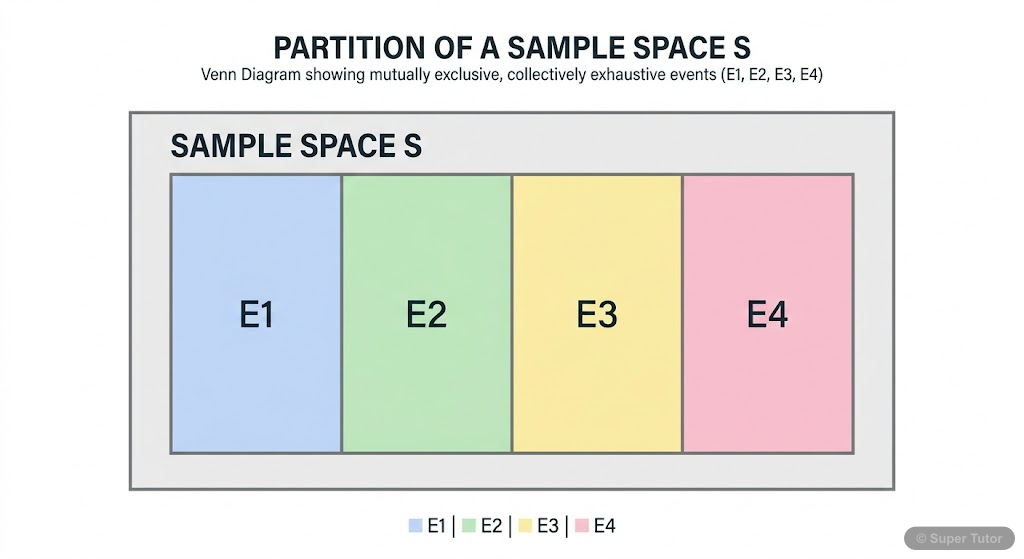
Learn better with visuals Super Tutor pairs illustrations like this with notes and quizzes for Probability.
The first 31 solutions are open to read. The other 31 are free with a Super Tutor account.
Exercise 13.1
1Given that E and F are events such that , and , find and .Show solution
Given: , ,
Formula used: and
Finding :
Finding :
Answer: and .
2Compute , if and .Show solution
Given: ,
Formula used:
Answer: .
3If , and , find (i) , (ii) , (iii) .Show solution
Given: , ,
(i) Finding :
Using :
(ii) Finding :
(iii) Finding :
Using :
Answers: (i) , (ii) , (iii) .
4Evaluate , if and .Show solution
Given: and
From the given condition:
Finding :
Finding :
Answer: .
5If , and , find (i) , (ii) , (iii) .Show solution
Given: , ,
(i) Finding :
(ii) Finding :
(iii) Finding :
Answers: (i) , (ii) , (iii) .
6A coin is tossed three times. Determine for: (i) E: head on third toss, F: heads on first two tosses; (ii) E: at least two heads, F: at most two heads; (iii) E: at most two tails, F: at least one tail.Show solution
Sample space when a coin is tossed three times has equally likely outcomes:
(i) E: head on third toss, F: heads on first two tosses
(ii) E: at least two heads, F: at most two heads
(iii) E: at most two tails, F: at least one tail
(all except TTT)
Answers: (i) , (ii) , (iii) .
7Two coins are tossed once. Determine for: (i) E: tail appears on one coin, F: one coin shows head; (ii) E: no tail appears, F: no head appears.Show solution
Sample space: , each with probability .
(i) E: tail appears on one coin, F: one coin shows head
(exactly one tail)
(exactly one head)
(ii) E: no tail appears, F: no head appears
(no tail)
(no head)
Answers: (i) , (ii) .
8A die is thrown three times. E: 4 appears on the third toss, F: 6 and 5 appears respectively on first two tosses. Determine .Show solution
Given: A die is thrown three times. Total outcomes = .
: 6 on first toss and 5 on second toss.
, so .
: 6 on first, 5 on second, 4 on third = , so .
Answer: .
9Mother, father and son line up at random for a family picture. E: son on one end, F: father in middle. Determine .Show solution
Given: Three people — Mother (M), Father (F), Son (S) — line up at random.
Total arrangements = :
(father in middle): , so .
(son on one end): ... Let me list carefully:
- Son on left end:
- Son on right end:
So .
(father in middle AND son on one end): , so .
Answer: . (When father is in the middle, son must be on one end.)
10A black and a red dice are rolled. (a) Find the conditional probability of obtaining a sum greater than 9, given that the black die resulted in a 5. (b) Find the conditional probability of obtaining the sum 8, given that the red die resulted in a number less than 4.Show solution
Sample space: Each die has 6 faces, so total outcomes = .
(a) Let A = sum > 9, B = black die shows 5.
, .
For sum > 9 with black die = 5: red die must be > 4, i.e., 5 or 6.
, .
(b) Let C = sum is 8, D = red die shows a number less than 4 (i.e., 1, 2, or 3).
Here (black, red) pairs where red < 4: .
For sum = 8 with red die < 4: pairs (black, red) with black + red = 8 and red ∈ {1,2,3}:
- red = 1: black = 7 (impossible)
- red = 2: black = 6 → ✓
- red = 3: black = 5 → ✓
, .
Answers: (a) , (b) .
11A fair die is rolled. Consider events , and . Find (i) and ; (ii) and ; (iii) and .Show solution
Given: A fair die is rolled. , each with probability .
, ,
, , , ,
(i) and :
(ii) and :
(iii) and :
, so .
, so .
Answers: (i) , ; (ii) , ; (iii) , .
12Assume that each born child is equally likely to be a boy or a girl. If a family has two children, what is the conditional probability that both are girls given that (i) the youngest is a girl, (ii) at least one is a girl?Show solution
Sample space: (first child, second child), each equally likely with probability .
Let A = both children are girls = .
(i) Given: youngest (second child) is a girl.
Let = youngest is a girl = , .
, .
(ii) Given: at least one is a girl.
Let = at least one girl = , .
, .
Answers: (i) , (ii) .
13An instructor has a question bank consisting of 300 easy True/False questions, 200 difficult True/False questions, 500 easy multiple choice questions and 400 difficult multiple choice questions. If a question is selected at random from the question bank, what is the probability that it will be an easy question given that it is a multiple choice question?Show solution
Given:
- Easy True/False: 300
- Difficult True/False: 200
- Easy Multiple Choice: 500
- Difficult Multiple Choice: 400
- Total questions:
Let E = easy question, M = multiple choice question.
Answer: The required probability is .
14Given that the two numbers appearing on throwing two dice are different. Find the probability of the event 'the sum of numbers on the dice is 4'.Show solution
Sample space: Total outcomes when two dice are thrown = 36.
Let F = numbers on the two dice are different.
Number of outcomes where both dice show the same number = 6 (i.e., (1,1),(2,2),...,(6,6)).
So , .
Let E = sum of numbers is 4.
Outcomes with sum 4: .
But we need different numbers, so exclude .
, .
Answer: .
15Consider the experiment of throwing a die, if a multiple of 3 comes up, throw the die again and if any other number comes, toss a coin. Find the conditional probability of the event 'the coin shows a tail', given that 'at least one die shows a 3'.Show solution
Sample space construction:
- If die shows 3 or 6 (multiples of 3): throw die again → outcomes: — 12 outcomes.
- If die shows 1, 2, 4, or 5: toss a coin → outcomes: — 8 outcomes.
Each face of the die has probability . For multiples of 3, the second die has probability each; for others, coin has probability each.
Each outcome in the first group has probability .
Each outcome in the second group has probability .
Let A = coin shows tail = .
Let B = at least one die shows 3.
includes outcomes where first die = 3: and where second die = 3: .
So .
(A involves coin outcomes, B involves only die outcomes — they are disjoint events).
Answer: .
16If , , then is (A) 0, (B) , (C) not defined, (D) 1.Show solution
Correct Answer: (C) not defined.
. Since , the conditional probability is not defined (division by zero is undefined).
17If A and B are events such that , then (A) but , (B) , (C) , (D) .Show solution
Correct Answer: (D) .
implies:
Provided , we can cancel from both sides to get .
Exercise 13.2
1If and , find if A and B are independent events.Show solution
Given: , , A and B are independent.
For independent events:
Answer: .
2Two cards are drawn at random and without replacement from a pack of 52 playing cards. Find the probability that both the cards are black.Show solution
Given: A pack of 52 cards has 26 black cards.
Let = first card drawn is black, = second card drawn is black.
After drawing one black card, 25 black cards remain out of 51 total:
By multiplication theorem:
Answer: The probability that both cards are black is .
3A box of oranges is inspected by examining three randomly selected oranges drawn without replacement. If all the three oranges are good, the box is approved for sale, otherwise, it is rejected. Find the probability that a box containing 15 oranges out of which 12 are good and 3 are bad ones will be approved for sale.Show solution
Given: 15 oranges total: 12 good, 3 bad. Three are drawn without replacement.
The box is approved if all three selected oranges are good.
Let be the events that the 1st, 2nd, 3rd orange drawn is good.
By multiplication theorem:
Answer: The probability that the box is approved for sale is .
4A fair coin and an unbiased die are tossed. Let A be the event 'head appears on the coin' and B be the event '3 on the die'. Check whether A and B are independent events or not.Show solution
Given: A fair coin and an unbiased die are tossed.
The event = head on coin AND 3 on die = .
Total outcomes = , so:
Since , A and B are independent events.
5A die marked 1, 2, 3 in red and 4, 5, 6 in green is tossed. Let A be the event 'the number is even,' and B be the event 'the number is red'. Are A and B independent?Show solution
Given: Die faces: 1(red), 2(red), 3(red), 4(green), 5(green), 6(green).
= even number = , .
= red number = , .
= even AND red = , .
Now, .
Since , A and B are NOT independent.
6Let E and F be events with , and . Are E and F independent?Show solution
Given: , , .
Check: .
But .
Since , i.e., , E and F are NOT independent.
7Given that the events A and B are such that , and . Find if they are (i) mutually exclusive (ii) independent.Show solution
Given: , , .
(i) Mutually exclusive: .
(ii) Independent: .
Answers: (i) , (ii) .
8Let A and B be independent events with and . Find (i) , (ii) , (iii) , (iv) .Show solution
Given: A and B are independent, , .
(i)
(ii)
(iii) Since A and B are independent:
(iv) Since A and B are independent:
Answers: (i) , (ii) , (iii) , (iv) .
9If A and B are two events such that , and , find P(not A and not B).Show solution
Given: , , .
P(not A and not B) = .
Answer: .
10Events A and B are such that , and . State whether A and B are independent.Show solution
Given: , , .
Using De Morgan's law: .
Now check: .
Since , A and B are NOT independent.
11Given two independent events A and B such that , . Find (i) P(A and B), (ii) P(A and not B), (iii) P(A or B), (iv) P(neither A nor B).Show solution
Given: A and B independent, , .
(i) P(A and B):
(ii) P(A and not B):
(iii) P(A or B):
(iv) P(neither A nor B):
Answers: (i) , (ii) , (iii) , (iv) .
12A die is tossed thrice. Find the probability of getting an odd number at least once.Show solution
Given: A die is tossed three times.
P(odd number on one toss) = .
P(no odd number in three tosses) = P(even on all three tosses) .
P(at least one odd number) .
Answer: .
13Two balls are drawn at random with replacement from a box containing 10 black and 8 red balls. Find the probability that (i) both balls are red, (ii) first ball is black and second is red, (iii) one of them is black and other is red.Show solution
Given: Box has 10 black and 8 red balls. Total = 18. Draws are with replacement.
, .
(i) Both balls are red:
(ii) First ball is black and second is red:
(iii) One black and one red (in any order):
Answers: (i) , (ii) , (iii) .
14Probability of solving specific problem independently by A and B are and respectively. If both try to solve the problem independently, find the probability that (i) the problem is solved, (ii) exactly one of them solves the problem.Show solution
Given: , . A and B work independently.
, .
(i) Problem is solved (at least one solves it):
(ii) Exactly one of them solves:
Answers: (i) , (ii) .
Free with a Super Tutor account
Free with a Super Tutor account
Free with a Super Tutor account
Free with a Super Tutor account
Exercise 13.3
Free with a Super Tutor account
Free with a Super Tutor account
Free with a Super Tutor account
Free with a Super Tutor account
Free with a Super Tutor account
Free with a Super Tutor account
Free with a Super Tutor account
Free with a Super Tutor account
Free with a Super Tutor account
Free with a Super Tutor account
Free with a Super Tutor account
Free with a Super Tutor account
Free with a Super Tutor account
Free with a Super Tutor account
Miscellaneous Exercise on Chapter 13
Free with a Super Tutor account
Free with a Super Tutor account
Free with a Super Tutor account
Free with a Super Tutor account
Free with a Super Tutor account
Free with a Super Tutor account
Free with a Super Tutor account
Free with a Super Tutor account
Free with a Super Tutor account
Free with a Super Tutor account
Free with a Super Tutor account
Free with a Super Tutor account
Free with a Super Tutor account
31 more solved questions in Probability
They are free with a Super Tutor account, along with practice quizzes and flashcards for this chapter. Free to start, no card needed.
Frequently Asked Questions
What are the important topics in Probability for Madhya Pradesh Board Class 12 Mathematics?
Are these NCERT Solutions for Probability free?
How should I revise Probability for the Madhya Pradesh Board Class 12 board exam?
Sources & Official References
Content is aligned to the official syllabus. Refer to the board website for the latest curriculum.
More resources for Probability
Practice Quiz
Test yourself with a quick quiz
Important Questions
Exam-style questions with answers
Revision Notes
Key points for last-minute revision
Formula Sheet
The chapter's formulas in one place
Chapter Summary
Understand the chapter at a glance
Concept Maps
See how topics connect
Study Plan
Step-by-step plan for this chapter
Flashcards
Quick-fire cards for active recall
Syllabus
What topics to cover
For serious students
Get the full Probability chapter — start free.
Quizzes, flashcards, an AI doubt solver and a study plan for Madhya Pradesh Board Class 12 Mathematics. Free to start, no card needed.