Chapter 10 of 13
NCERT Solutions

Three Dimensional Geometry

Madhya Pradesh Board · Class 12 · Mathematics

NCERT Solutions for Three Dimensional Geometry — Madhya Pradesh Board Class 12 Mathematics.

18 questions20 flashcards5 concepts

Interactive on Super Tutor

Studying Three Dimensional Geometry? Get the full interactive chapter.

Quizzes, flashcards, AI doubt-solver and a step-by-step study plan — built for ncert solutions and more.

1,000+ Class 12 students started this chapter today

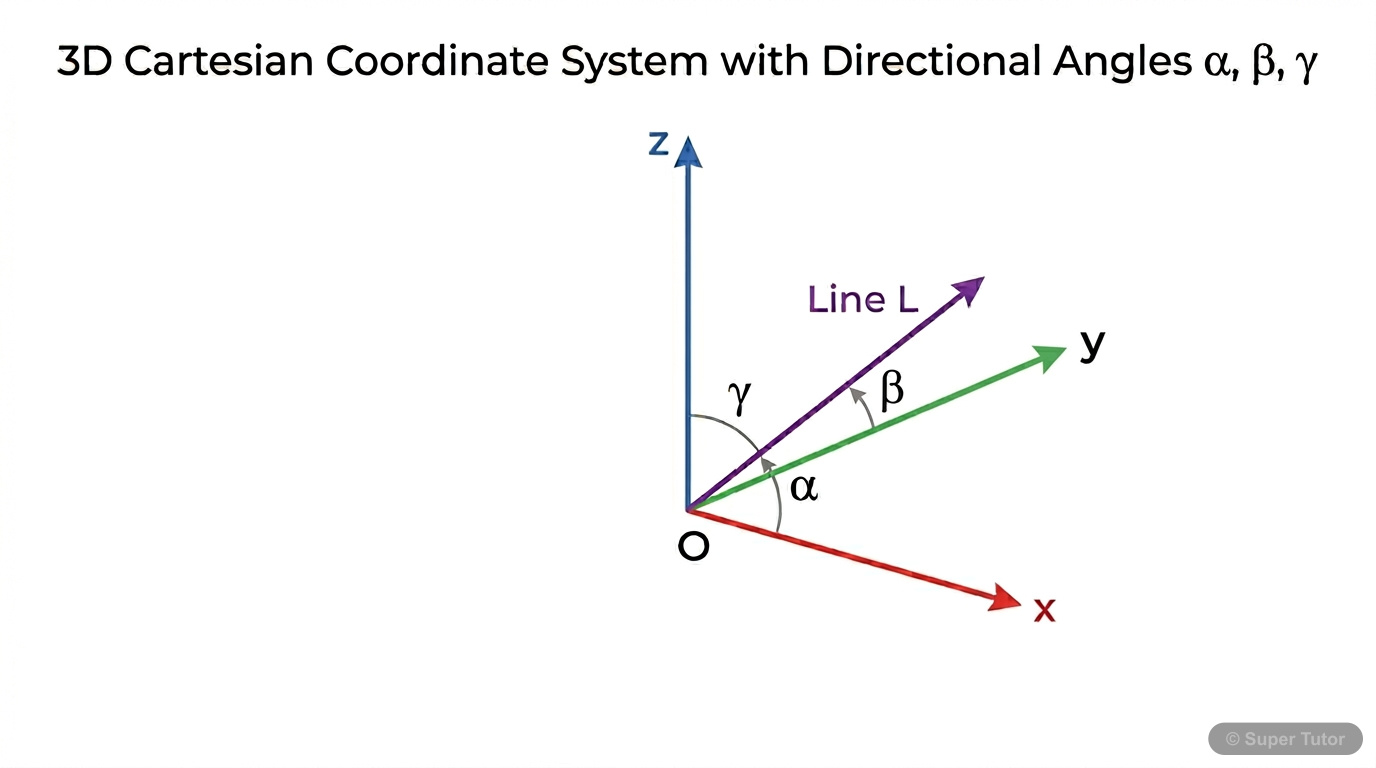
A 3D Cartesian coordinate system showing x, y, and z axes with a directed line L passing through the origin. The angles alpha, beta, and gamma are shown between line L and the positive x, y, and z axe
Super Tutor

Learn better with visuals Super Tutor has hundreds of illustrations like this across every chapter — all free to try.

Get started
25 Questions Solved · 3 Sections

Exercise 11.1

1If a line makes angles 90,135,4590^\circ, 135^\circ, 45^\circ with the x,yx, y and zz-axes respectively, find its direction cosines.Show solution
Given: A line makes angles α=90\alpha = 90^\circ, β=135\beta = 135^\circ, γ=45\gamma = 45^\circ with the xx-, yy- and zz-axes respectively.

Formula: Direction cosines are l=cosα, m=cosβ, n=cosγl = \cos\alpha,\ m = \cos\beta,\ n = \cos\gamma.

Working:
l=cos90=0l = \cos 90^\circ = 0
m=cos135=12m = \cos 135^\circ = -\frac{1}{\sqrt{2}}
n=cos45=12n = \cos 45^\circ = \frac{1}{\sqrt{2}}

Verification: l2+m2+n2=0+12+12=1l^2 + m^2 + n^2 = 0 + \dfrac{1}{2} + \dfrac{1}{2} = 1

Answer: The direction cosines are 0, 12, 120,\ -\dfrac{1}{\sqrt{2}},\ \dfrac{1}{\sqrt{2}}.
2Find the direction cosines of a line which makes equal angles with the coordinate axes.Show solution
Given: The line makes equal angles with all three coordinate axes, i.e., α=β=γ\alpha = \beta = \gamma.

Concept: If l,m,nl, m, n are direction cosines, then l2+m2+n2=1l^2 + m^2 + n^2 = 1.

Working:
Since α=β=γ\alpha = \beta = \gamma, we have l=m=n=cosαl = m = n = \cos\alpha.

Substituting in the identity:
l2+l2+l2=1    3l2=1    l=±13l^2 + l^2 + l^2 = 1 \implies 3l^2 = 1 \implies l = \pm\frac{1}{\sqrt{3}}

Answer: The direction cosines are 13, 13, 13\dfrac{1}{\sqrt{3}},\ \dfrac{1}{\sqrt{3}},\ \dfrac{1}{\sqrt{3}} or 13, 13, 13-\dfrac{1}{\sqrt{3}},\ -\dfrac{1}{\sqrt{3}},\ -\dfrac{1}{\sqrt{3}}.
3If a line has the direction ratios 18,12,4-18, 12, -4, then what are its direction cosines?Show solution
Given: Direction ratios are a=18, b=12, c=4a = -18,\ b = 12,\ c = -4.

Formula:
l=aa2+b2+c2,m=ba2+b2+c2,n=ca2+b2+c2l = \frac{a}{\sqrt{a^2+b^2+c^2}},\quad m = \frac{b}{\sqrt{a^2+b^2+c^2}},\quad n = \frac{c}{\sqrt{a^2+b^2+c^2}}

Working:
a2+b2+c2=(18)2+(12)2+(4)2=324+144+16=484=22\sqrt{a^2+b^2+c^2} = \sqrt{(-18)^2+(12)^2+(-4)^2} = \sqrt{324+144+16} = \sqrt{484} = 22

l=1822=911,m=1222=611,n=422=211l = \frac{-18}{22} = -\frac{9}{11},\quad m = \frac{12}{22} = \frac{6}{11},\quad n = \frac{-4}{22} = -\frac{2}{11}

Answer: The direction cosines are 911, 611, 211-\dfrac{9}{11},\ \dfrac{6}{11},\ -\dfrac{2}{11}.
4Show that the points (2,3,4), (1,2,1), (5,8,7)(2, 3, 4),\ (-1, -2, 1),\ (5, 8, 7) are collinear.Show solution
Given: Points A(2,3,4)A(2,3,4), B(1,2,1)B(-1,-2,1), C(5,8,7)C(5,8,7).

Concept: Three points are collinear if the direction ratios of ABAB and BCBC are proportional.

Direction ratios of AB:
(12, 23, 14)=(3, 5, 3)(-1-2,\ -2-3,\ 1-4) = (-3,\ -5,\ -3)

Direction ratios of BC:
(5(1), 8(2), 71)=(6, 10, 6)(5-(-1),\ 8-(-2),\ 7-1) = (6,\ 10,\ 6)

Check proportionality:
36=510=36=12\frac{-3}{6} = \frac{-5}{10} = \frac{-3}{6} = -\frac{1}{2}

The direction ratios of ABAB and BCBC are proportional, so ABBCAB \parallel BC. Since point BB is common to both, the points AA, BB, CC are collinear. \hfill\hfill\blacksquare
5Find the direction cosines of the sides of the triangle whose vertices are (3,5,4), (1,1,2)(3, 5, -4),\ (-1, 1, 2) and (5,5,2)(-5, -5, -2).Show solution
Given: Vertices A(3,5,4)A(3,5,-4), B(1,1,2)B(-1,1,2), C(5,5,2)C(-5,-5,-2).

Side AB:
Direction ratios: (13, 15, 2(4))=(4, 4, 6)(-1-3,\ 1-5,\ 2-(-4)) = (-4,\ -4,\ 6)
AB=16+16+36=68=217|AB| = \sqrt{16+16+36} = \sqrt{68} = 2\sqrt{17}
Direction cosines of ABAB:
4217, 4217, 6217=217, 217, 317\frac{-4}{2\sqrt{17}},\ \frac{-4}{2\sqrt{17}},\ \frac{6}{2\sqrt{17}} = -\frac{2}{\sqrt{17}},\ -\frac{2}{\sqrt{17}},\ \frac{3}{\sqrt{17}}

Side BC:
Direction ratios: (5(1), 51, 22)=(4, 6, 4)(-5-(-1),\ -5-1,\ -2-2) = (-4,\ -6,\ -4)
BC=16+36+16=68=217|BC| = \sqrt{16+36+16} = \sqrt{68} = 2\sqrt{17}
Direction cosines of BCBC:
4217, 6217, 4217=217, 317, 217\frac{-4}{2\sqrt{17}},\ \frac{-6}{2\sqrt{17}},\ \frac{-4}{2\sqrt{17}} = -\frac{2}{\sqrt{17}},\ -\frac{3}{\sqrt{17}},\ -\frac{2}{\sqrt{17}}

Side CA:
Direction ratios: (3(5), 5(5), 4(2))=(8, 10, 2)(3-(-5),\ 5-(-5),\ -4-(-2)) = (8,\ 10,\ -2)
CA=64+100+4=168=242|CA| = \sqrt{64+100+4} = \sqrt{168} = 2\sqrt{42}
Direction cosines of CACA:
8242, 10242, 2242=442, 542, 142\frac{8}{2\sqrt{42}},\ \frac{10}{2\sqrt{42}},\ \frac{-2}{2\sqrt{42}} = \frac{4}{\sqrt{42}},\ \frac{5}{\sqrt{42}},\ -\frac{1}{\sqrt{42}}

Answer:
- Direction cosines of ABAB: 217, 217, 317-\dfrac{2}{\sqrt{17}},\ -\dfrac{2}{\sqrt{17}},\ \dfrac{3}{\sqrt{17}}
- Direction cosines of BCBC: 217, 317, 217-\dfrac{2}{\sqrt{17}},\ -\dfrac{3}{\sqrt{17}},\ -\dfrac{2}{\sqrt{17}}
- Direction cosines of CACA: 442, 542, 142\dfrac{4}{\sqrt{42}},\ \dfrac{5}{\sqrt{42}},\ -\dfrac{1}{\sqrt{42}}

Exercise 11.2

1Show that the three lines with direction cosines 1213,313,413\dfrac{12}{13}, \dfrac{-3}{13}, \dfrac{-4}{13}; 413,1213,313\dfrac{4}{13}, \dfrac{12}{13}, \dfrac{3}{13}; 313,413,1213\dfrac{3}{13}, \dfrac{-4}{13}, \dfrac{12}{13} are mutually perpendicular.Show solution
Concept: Two lines are perpendicular if l1l2+m1m2+n1n2=0l_1 l_2 + m_1 m_2 + n_1 n_2 = 0.

Let the three lines be L1L_1, L2L_2, L3L_3 with the given direction cosines.

Check L1L2L_1 \perp L_2:
1213413+3131213+413313=483612169=0169=0\frac{12}{13}\cdot\frac{4}{13} + \frac{-3}{13}\cdot\frac{12}{13} + \frac{-4}{13}\cdot\frac{3}{13} = \frac{48 - 36 - 12}{169} = \frac{0}{169} = 0 \checkmark

Check L2L3L_2 \perp L_3:
413313+1213413+3131213=1248+36169=0169=0\frac{4}{13}\cdot\frac{3}{13} + \frac{12}{13}\cdot\frac{-4}{13} + \frac{3}{13}\cdot\frac{12}{13} = \frac{12 - 48 + 36}{169} = \frac{0}{169} = 0 \checkmark

Check L1L3L_1 \perp L_3:
1213313+313413+4131213=36+1248169=0169=0\frac{12}{13}\cdot\frac{3}{13} + \frac{-3}{13}\cdot\frac{-4}{13} + \frac{-4}{13}\cdot\frac{12}{13} = \frac{36 + 12 - 48}{169} = \frac{0}{169} = 0 \checkmark

Since each pair of lines satisfies the perpendicularity condition, the three lines are mutually perpendicular. \hfill\hfill\blacksquare
2Show that the line through the points (1,1,2)(1, -1, 2), (3,4,2)(3, 4, -2) is perpendicular to the line through the points (0,3,2)(0, 3, 2) and (3,5,6)(3, 5, 6).Show solution
Direction ratios of line L1L_1 through (1,1,2)(1,-1,2) and (3,4,2)(3,4,-2):
(31, 4(1), 22)=(2, 5, 4)(3-1,\ 4-(-1),\ -2-2) = (2,\ 5,\ -4)

Direction ratios of line L2L_2 through (0,3,2)(0,3,2) and (3,5,6)(3,5,6):
(30, 53, 62)=(3, 2, 4)(3-0,\ 5-3,\ 6-2) = (3,\ 2,\ 4)

Check perpendicularity: a1a2+b1b2+c1c2=0a_1 a_2 + b_1 b_2 + c_1 c_2 = 0
2(3)+5(2)+(4)(4)=6+1016=02(3) + 5(2) + (-4)(4) = 6 + 10 - 16 = 0 \checkmark

Hence, the two lines are perpendicular to each other. \hfill\hfill\blacksquare
3Show that the line through the points (4,7,8)(4, 7, 8), (2,3,4)(2, 3, 4) is parallel to the line through the points (1,2,1)(-1, -2, 1), (1,2,5)(1, 2, 5).Show solution
Direction ratios of line L1L_1 through (4,7,8)(4,7,8) and (2,3,4)(2,3,4):
(24, 37, 48)=(2, 4, 4)(2-4,\ 3-7,\ 4-8) = (-2,\ -4,\ -4)

Direction ratios of line L2L_2 through (1,2,1)(-1,-2,1) and (1,2,5)(1,2,5):
(1(1), 2(2), 51)=(2, 4, 4)(1-(-1),\ 2-(-2),\ 5-1) = (2,\ 4,\ 4)

Check proportionality:
22=44=44=1\frac{-2}{2} = \frac{-4}{4} = \frac{-4}{4} = -1

The direction ratios are proportional, hence the two lines are parallel. \hfill\hfill\blacksquare
4Find the equation of the line which passes through the point (1,2,3)(1, 2, 3) and is parallel to the vector 3i^+2j^2k^3\hat{i} + 2\hat{j} - 2\hat{k}.Show solution
Given: Point A(1,2,3)A(1,2,3), so position vector a=i^+2j^+3k^\vec{a} = \hat{i} + 2\hat{j} + 3\hat{k}; direction vector b=3i^+2j^2k^\vec{b} = 3\hat{i} + 2\hat{j} - 2\hat{k}.

Vector equation of the line:
r=a+λb\vec{r} = \vec{a} + \lambda\vec{b}
r=(i^+2j^+3k^)+λ(3i^+2j^2k^)\boxed{\vec{r} = (\hat{i} + 2\hat{j} + 3\hat{k}) + \lambda(3\hat{i} + 2\hat{j} - 2\hat{k})}

Cartesian form:
x13=y22=z32\frac{x-1}{3} = \frac{y-2}{2} = \frac{z-3}{-2}
5Find the equation of the line in vector and in cartesian form that passes through the point with position vector 2i^j^+4k^2\hat{i} - \hat{j} + 4\hat{k} and is in the direction i^+2j^k^\hat{i} + 2\hat{j} - \hat{k}.Show solution
Given: a=2i^j^+4k^\vec{a} = 2\hat{i} - \hat{j} + 4\hat{k}, b=i^+2j^k^\vec{b} = \hat{i} + 2\hat{j} - \hat{k}.

Vector equation:
r=a+λb\vec{r} = \vec{a} + \lambda\vec{b}
r=(2i^j^+4k^)+λ(i^+2j^k^)\boxed{\vec{r} = (2\hat{i} - \hat{j} + 4\hat{k}) + \lambda(\hat{i} + 2\hat{j} - \hat{k})}

Cartesian equation: The point is (2,1,4)(2, -1, 4) and direction ratios are (1,2,1)(1, 2, -1).
x21=y+12=z41\boxed{\frac{x-2}{1} = \frac{y+1}{2} = \frac{z-4}{-1}}
6Find the cartesian equation of the line which passes through the point (2,4,5)(-2, 4, -5) and parallel to the line given by x+33=y45=z+86\dfrac{x+3}{3} = \dfrac{y-4}{5} = \dfrac{z+8}{6}.Show solution
Given: Point (2,4,5)(-2, 4, -5); the given line has direction ratios (3,5,6)(3, 5, 6).

Since the required line is parallel to the given line, it has the same direction ratios (3,5,6)(3, 5, 6).

Cartesian equation:
x+23=y45=z+56\boxed{\frac{x+2}{3} = \frac{y-4}{5} = \frac{z+5}{6}}
7The cartesian equation of a line is x53=y+47=z62\dfrac{x-5}{3} = \dfrac{y+4}{7} = \dfrac{z-6}{2}. Write its vector form.Show solution
Given: Cartesian equation x53=y+47=z62\dfrac{x-5}{3} = \dfrac{y+4}{7} = \dfrac{z-6}{2}.

The line passes through the point (5,4,6)(5, -4, 6) and has direction ratios (3,7,2)(3, 7, 2).

So a=5i^4j^+6k^\vec{a} = 5\hat{i} - 4\hat{j} + 6\hat{k} and b=3i^+7j^+2k^\vec{b} = 3\hat{i} + 7\hat{j} + 2\hat{k}.

Vector equation:
r=(5i^4j^+6k^)+λ(3i^+7j^+2k^)\boxed{\vec{r} = (5\hat{i} - 4\hat{j} + 6\hat{k}) + \lambda(3\hat{i} + 7\hat{j} + 2\hat{k})}
8Find the angle between the following pairs of lines:
(i) r=2i^5j^+k^+λ(3i^+2j^+6k^)\vec{r} = 2\hat{i} - 5\hat{j} + \hat{k} + \lambda(3\hat{i} + 2\hat{j} + 6\hat{k}) and r=7i^6k^+μ(i^+2j^+2k^)\vec{r} = 7\hat{i} - 6\hat{k} + \mu(\hat{i} + 2\hat{j} + 2\hat{k})
(ii) r=3i^+j^2k^+λ(i^j^2k^)\vec{r} = 3\hat{i} + \hat{j} - 2\hat{k} + \lambda(\hat{i} - \hat{j} - 2\hat{k}) and r=2i^j^56k^+μ(3i^5j^4k^)\vec{r} = 2\hat{i} - \hat{j} - 56\hat{k} + \mu(3\hat{i} - 5\hat{j} - 4\hat{k})
Show solution
Formula: cosθ=b1b2b1b2\cos\theta = \left|\dfrac{\vec{b}_1 \cdot \vec{b}_2}{|\vec{b}_1||\vec{b}_2|}\right|

(i) b1=3i^+2j^+6k^\vec{b}_1 = 3\hat{i}+2\hat{j}+6\hat{k}, b2=i^+2j^+2k^\vec{b}_2 = \hat{i}+2\hat{j}+2\hat{k}

b1b2=3(1)+2(2)+6(2)=3+4+12=19\vec{b}_1 \cdot \vec{b}_2 = 3(1)+2(2)+6(2) = 3+4+12 = 19
b1=9+4+36=49=7,b2=1+4+4=9=3|\vec{b}_1| = \sqrt{9+4+36} = \sqrt{49} = 7,\quad |\vec{b}_2| = \sqrt{1+4+4} = \sqrt{9} = 3
cosθ=197×3=1921\cos\theta = \left|\frac{19}{7 \times 3}\right| = \frac{19}{21}
θ=cos1(1921)\boxed{\theta = \cos^{-1}\left(\frac{19}{21}\right)}

(ii) b1=i^j^2k^\vec{b}_1 = \hat{i}-\hat{j}-2\hat{k}, b2=3i^5j^4k^\vec{b}_2 = 3\hat{i}-5\hat{j}-4\hat{k}

b1b2=1(3)+(1)(5)+(2)(4)=3+5+8=16\vec{b}_1 \cdot \vec{b}_2 = 1(3)+(-1)(-5)+(-2)(-4) = 3+5+8 = 16
b1=1+1+4=6,b2=9+25+16=50=52|\vec{b}_1| = \sqrt{1+1+4} = \sqrt{6},\quad |\vec{b}_2| = \sqrt{9+25+16} = \sqrt{50} = 5\sqrt{2}
cosθ=16652=16512=16103=853\cos\theta = \left|\frac{16}{\sqrt{6}\cdot 5\sqrt{2}}\right| = \frac{16}{5\sqrt{12}} = \frac{16}{10\sqrt{3}} = \frac{8}{5\sqrt{3}}
θ=cos1(853)\boxed{\theta = \cos^{-1}\left(\frac{8}{5\sqrt{3}}\right)}
9Find the angle between the following pair of lines:
(i) x22=y15=z+33\dfrac{x-2}{2} = \dfrac{y-1}{5} = \dfrac{z+3}{-3} and x+21=y48=z54\dfrac{x+2}{-1} = \dfrac{y-4}{8} = \dfrac{z-5}{4}
(ii) x2=y2=z1\dfrac{x}{2} = \dfrac{y}{2} = \dfrac{z}{1} and x54=y21=z38\dfrac{x-5}{4} = \dfrac{y-2}{1} = \dfrac{z-3}{8}
Show solution
Formula: cosθ=a1a2+b1b2+c1c2a12+b12+c12a22+b22+c22\cos\theta = \left|\dfrac{a_1a_2+b_1b_2+c_1c_2}{\sqrt{a_1^2+b_1^2+c_1^2}\,\sqrt{a_2^2+b_2^2+c_2^2}}\right|

(i) Direction ratios: (a1,b1,c1)=(2,5,3)(a_1,b_1,c_1)=(2,5,-3) and (a2,b2,c2)=(1,8,4)(a_2,b_2,c_2)=(-1,8,4)

a1a2+b1b2+c1c2=2(1)+5(8)+(3)(4)=2+4012=26a_1a_2+b_1b_2+c_1c_2 = 2(-1)+5(8)+(-3)(4) = -2+40-12 = 26
4+25+9=38,1+64+16=81=9\sqrt{4+25+9}=\sqrt{38},\quad \sqrt{1+64+16}=\sqrt{81}=9
cosθ=26938\cos\theta = \frac{26}{9\sqrt{38}}
θ=cos1(26938)\boxed{\theta = \cos^{-1}\left(\frac{26}{9\sqrt{38}}\right)}

(ii) Direction ratios: (a1,b1,c1)=(2,2,1)(a_1,b_1,c_1)=(2,2,1) and (a2,b2,c2)=(4,1,8)(a_2,b_2,c_2)=(4,1,8)

a1a2+b1b2+c1c2=8+2+8=18a_1a_2+b_1b_2+c_1c_2 = 8+2+8 = 18
4+4+1=9=3,16+1+64=81=9\sqrt{4+4+1}=\sqrt{9}=3,\quad \sqrt{16+1+64}=\sqrt{81}=9
cosθ=183×9=1827=23\cos\theta = \frac{18}{3\times 9} = \frac{18}{27} = \frac{2}{3}
θ=cos1(23)\boxed{\theta = \cos^{-1}\left(\frac{2}{3}\right)}
10Find the values of pp so that the lines 1x3=7y142p=z32\dfrac{1-x}{3} = \dfrac{7y-14}{2p} = \dfrac{z-3}{2} and 77x3p=y51=6z5\dfrac{7-7x}{3p} = \dfrac{y-5}{1} = \dfrac{6-z}{5} are at right angles.Show solution
Rewrite in standard form:

Line 1: x13=y22p/7=z32\dfrac{x-1}{-3} = \dfrac{y-2}{2p/7} = \dfrac{z-3}{2}

So direction ratios: a1=3, b1=2p7, c1=2a_1 = -3,\ b_1 = \dfrac{2p}{7},\ c_1 = 2.

Line 2: x13p/7=y51=z65\dfrac{x-1}{-3p/7} = \dfrac{y-5}{1} = \dfrac{z-6}{-5}

So direction ratios: a2=3p7, b2=1, c2=5a_2 = -\dfrac{3p}{7},\ b_2 = 1,\ c_2 = -5.

Condition for perpendicularity: a1a2+b1b2+c1c2=0a_1a_2 + b_1b_2 + c_1c_2 = 0

(3)(3p7)+2p7(1)+(2)(5)=0(-3)\left(-\frac{3p}{7}\right) + \frac{2p}{7}(1) + (2)(-5) = 0
9p7+2p710=0\frac{9p}{7} + \frac{2p}{7} - 10 = 0
11p7=10\frac{11p}{7} = 10
p=7011p = \frac{70}{11}

p=7011\boxed{p = \frac{70}{11}}
11Show that the lines x57=y+25=z1\dfrac{x-5}{7} = \dfrac{y+2}{-5} = \dfrac{z}{1} and x1=y2=z3\dfrac{x}{1} = \dfrac{y}{2} = \dfrac{z}{3} are perpendicular to each other.Show solution
Direction ratios of L1L_1: (7,5,1)(7, -5, 1)

Direction ratios of L2L_2: (1,2,3)(1, 2, 3)

Check: a1a2+b1b2+c1c2=7(1)+(5)(2)+1(3)=710+3=0a_1a_2 + b_1b_2 + c_1c_2 = 7(1) + (-5)(2) + 1(3) = 7 - 10 + 3 = 0

Since the dot product of direction ratios is zero, the two lines are perpendicular to each other. \hfill\hfill\blacksquare
12Find the shortest distance between the lines
r=(i^+2j^+k^)+λ(i^j^+k^)\vec{r} = (\hat{i}+2\hat{j}+\hat{k})+\lambda(\hat{i}-\hat{j}+\hat{k})
r=2i^j^k^+μ(2i^+j^+2k^)\vec{r} = 2\hat{i}-\hat{j}-\hat{k}+\mu(2\hat{i}+\hat{j}+2\hat{k})
Show solution
Given:
a1=i^+2j^+k^\vec{a}_1 = \hat{i}+2\hat{j}+\hat{k}, b1=i^j^+k^\vec{b}_1 = \hat{i}-\hat{j}+\hat{k}
a2=2i^j^k^\vec{a}_2 = 2\hat{i}-\hat{j}-\hat{k}, b2=2i^+j^+2k^\vec{b}_2 = 2\hat{i}+\hat{j}+2\hat{k}

Formula: d=(b1×b2)(a2a1)b1×b2d = \left|\dfrac{(\vec{b}_1\times\vec{b}_2)\cdot(\vec{a}_2-\vec{a}_1)}{|\vec{b}_1\times\vec{b}_2|}\right|

Step 1: a2a1=(21)i^+(12)j^+(11)k^=i^3j^2k^\vec{a}_2 - \vec{a}_1 = (2-1)\hat{i}+(-1-2)\hat{j}+(-1-1)\hat{k} = \hat{i}-3\hat{j}-2\hat{k}

Step 2: b1×b2=i^amp;j^amp;k^1amp;1amp;12amp;1amp;2\vec{b}_1\times\vec{b}_2 = \begin{vmatrix}\hat{i}&\hat{j}&\hat{k}\\1&-1&1\\2&1&2\end{vmatrix}
=i^[(1)(2)(1)(1)]j^[(1)(2)(1)(2)]+k^[(1)(1)(1)(2)]= \hat{i}[(-1)(2)-(1)(1)] - \hat{j}[(1)(2)-(1)(2)] + \hat{k}[(1)(1)-(-1)(2)]
=i^(21)j^(22)+k^(1+2)= \hat{i}(-2-1) - \hat{j}(2-2) + \hat{k}(1+2)
=3i^+0j^+3k^= -3\hat{i} + 0\hat{j} + 3\hat{k}

Step 3: b1×b2=9+0+9=32|\vec{b}_1\times\vec{b}_2| = \sqrt{9+0+9} = 3\sqrt{2}

Step 4: (b1×b2)(a2a1)=(3)(1)+(0)(3)+(3)(2)=3+06=9(\vec{b}_1\times\vec{b}_2)\cdot(\vec{a}_2-\vec{a}_1) = (-3)(1)+(0)(-3)+(3)(-2) = -3+0-6 = -9

Step 5: d=932=932=32=322d = \left|\dfrac{-9}{3\sqrt{2}}\right| = \dfrac{9}{3\sqrt{2}} = \dfrac{3}{\sqrt{2}} = \dfrac{3\sqrt{2}}{2}

d=322\boxed{d = \frac{3\sqrt{2}}{2}}
13Find the shortest distance between the lines
x+17=y+16=z+11andx31=y52=z71\frac{x+1}{7} = \frac{y+1}{-6} = \frac{z+1}{1} \quad \text{and} \quad \frac{x-3}{1} = \frac{y-5}{-2} = \frac{z-7}{1}
Show solution
Given:
(x1,y1,z1)=(1,1,1)(x_1,y_1,z_1)=(-1,-1,-1), (a1,b1,c1)=(7,6,1)(a_1,b_1,c_1)=(7,-6,1)
(x2,y2,z2)=(3,5,7)(x_2,y_2,z_2)=(3,5,7), (a2,b2,c2)=(1,2,1)(a_2,b_2,c_2)=(1,-2,1)

Formula (Cartesian):
d=x2x1amp;y2y1amp;z2z1a1amp;b1amp;c1a2amp;b2amp;c2(b1c2b2c1)2+(c1a2c2a1)2+(a1b2a2b1)2d = \frac{\begin{vmatrix} x_2-x_1 & y_2-y_1 & z_2-z_1 \\ a_1 & b_1 & c_1 \\ a_2 & b_2 & c_2 \end{vmatrix}}{\sqrt{(b_1c_2-b_2c_1)^2+(c_1a_2-c_2a_1)^2+(a_1b_2-a_2b_1)^2}}

Numerator determinant:
4amp;6amp;87amp;6amp;11amp;2amp;1\begin{vmatrix} 4 & 6 & 8 \\ 7 & -6 & 1 \\ 1 & -2 & 1 \end{vmatrix}
=4[(6)(1)(2)(1)]6[(7)(1)(1)(1)]+8[(7)(2)(6)(1)]= 4[(-6)(1)-(-2)(1)] - 6[(7)(1)-(1)(1)] + 8[(7)(-2)-(-6)(1)]
=4(6+2)6(71)+8(14+6)= 4(-6+2) - 6(7-1) + 8(-14+6)
=4(4)6(6)+8(8)= 4(-4) - 6(6) + 8(-8)
=163664=116= -16 - 36 - 64 = -116

Denominator:
b1c2b2c1=(6)(1)(2)(1)=6+2=4b_1c_2 - b_2c_1 = (-6)(1)-(-2)(1) = -6+2 = -4
c1a2c2a1=(1)(1)(1)(7)=17=6c_1a_2 - c_2a_1 = (1)(1)-(1)(7) = 1-7 = -6
a1b2a2b1=(7)(2)(1)(6)=14+6=8a_1b_2 - a_2b_1 = (7)(-2)-(1)(-6) = -14+6 = -8

(4)2+(6)2+(8)2=16+36+64=116=229\sqrt{(-4)^2+(-6)^2+(-8)^2} = \sqrt{16+36+64} = \sqrt{116} = 2\sqrt{29}

d=116229=116229=5829=5829×2929=582929=229d = \frac{|-116|}{2\sqrt{29}} = \frac{116}{2\sqrt{29}} = \frac{58}{\sqrt{29}} = \frac{58}{\sqrt{29}}\times\frac{\sqrt{29}}{\sqrt{29}} = \frac{58\sqrt{29}}{29} = 2\sqrt{29}

d=229\boxed{d = 2\sqrt{29}}
14Find the shortest distance between the lines whose vector equations are
r=(i^+2j^+3k^)+λ(i^3j^+2k^)\vec{r} = (\hat{i}+2\hat{j}+3\hat{k})+\lambda(\hat{i}-3\hat{j}+2\hat{k})
r=4i^+5j^+6k^+μ(2i^+3j^+k^)\vec{r} = 4\hat{i}+5\hat{j}+6\hat{k}+\mu(2\hat{i}+3\hat{j}+\hat{k})
Show solution
Given:
a1=i^+2j^+3k^\vec{a}_1 = \hat{i}+2\hat{j}+3\hat{k}, b1=i^3j^+2k^\vec{b}_1 = \hat{i}-3\hat{j}+2\hat{k}
a2=4i^+5j^+6k^\vec{a}_2 = 4\hat{i}+5\hat{j}+6\hat{k}, b2=2i^+3j^+k^\vec{b}_2 = 2\hat{i}+3\hat{j}+\hat{k}

Step 1: a2a1=3i^+3j^+3k^\vec{a}_2-\vec{a}_1 = 3\hat{i}+3\hat{j}+3\hat{k}

Step 2: b1×b2=i^amp;j^amp;k^1amp;3amp;22amp;3amp;1\vec{b}_1\times\vec{b}_2 = \begin{vmatrix}\hat{i}&\hat{j}&\hat{k}\\1&-3&2\\2&3&1\end{vmatrix}
=i^[(3)(1)(2)(3)]j^[(1)(1)(2)(2)]+k^[(1)(3)(3)(2)]= \hat{i}[(-3)(1)-(2)(3)] - \hat{j}[(1)(1)-(2)(2)] + \hat{k}[(1)(3)-(-3)(2)]
=i^(36)j^(14)+k^(3+6)= \hat{i}(-3-6) - \hat{j}(1-4) + \hat{k}(3+6)
=9i^+3j^+9k^= -9\hat{i}+3\hat{j}+9\hat{k}

Step 3: b1×b2=81+9+81=171=319|\vec{b}_1\times\vec{b}_2| = \sqrt{81+9+81} = \sqrt{171} = 3\sqrt{19}

Step 4: (b1×b2)(a2a1)=(9)(3)+(3)(3)+(9)(3)=27+9+27=9(\vec{b}_1\times\vec{b}_2)\cdot(\vec{a}_2-\vec{a}_1) = (-9)(3)+(3)(3)+(9)(3) = -27+9+27 = 9

Step 5: d=9319=319=31919d = \left|\dfrac{9}{3\sqrt{19}}\right| = \dfrac{3}{\sqrt{19}} = \dfrac{3\sqrt{19}}{19}

d=319=31919\boxed{d = \frac{3}{\sqrt{19}} = \frac{3\sqrt{19}}{19}}
15Find the shortest distance between the lines whose vector equations are
r=(1t)i^+(t2)j^+(32t)k^\vec{r} = (1-t)\hat{i}+(t-2)\hat{j}+(3-2t)\hat{k}
r=(s+1)i^+(2s1)j^(2s+1)k^\vec{r} = (s+1)\hat{i}+(2s-1)\hat{j}-(2s+1)\hat{k}
Show solution
Rewrite in standard form:

Line 1: r=(i^2j^+3k^)+t(i^+j^2k^)\vec{r} = (\hat{i}-2\hat{j}+3\hat{k}) + t(-\hat{i}+\hat{j}-2\hat{k})
So a1=i^2j^+3k^\vec{a}_1 = \hat{i}-2\hat{j}+3\hat{k}, b1=i^+j^2k^\vec{b}_1 = -\hat{i}+\hat{j}-2\hat{k}

Line 2: r=(i^j^k^)+s(i^+2j^2k^)\vec{r} = (\hat{i}-\hat{j}-\hat{k}) + s(\hat{i}+2\hat{j}-2\hat{k})
So a2=i^j^k^\vec{a}_2 = \hat{i}-\hat{j}-\hat{k}, b2=i^+2j^2k^\vec{b}_2 = \hat{i}+2\hat{j}-2\hat{k}

Step 1: a2a1=(11)i^+(1+2)j^+(13)k^=0i^+j^4k^\vec{a}_2-\vec{a}_1 = (1-1)\hat{i}+(-1+2)\hat{j}+(-1-3)\hat{k} = 0\hat{i}+\hat{j}-4\hat{k}

Step 2: b1×b2=i^amp;j^amp;k^1amp;1amp;21amp;2amp;2\vec{b}_1\times\vec{b}_2 = \begin{vmatrix}\hat{i}&\hat{j}&\hat{k}\\-1&1&-2\\1&2&-2\end{vmatrix}
=i^[(1)(2)(2)(2)]j^[(1)(2)(2)(1)]+k^[(1)(2)(1)(1)]= \hat{i}[(1)(-2)-(-2)(2)] - \hat{j}[(-1)(-2)-(-2)(1)] + \hat{k}[(-1)(2)-(1)(1)]
=i^(2+4)j^(2+2)+k^(21)= \hat{i}(-2+4) - \hat{j}(2+2) + \hat{k}(-2-1)
=2i^4j^3k^= 2\hat{i}-4\hat{j}-3\hat{k}

Step 3: b1×b2=4+16+9=29|\vec{b}_1\times\vec{b}_2| = \sqrt{4+16+9} = \sqrt{29}

Step 4: (b1×b2)(a2a1)=(2)(0)+(4)(1)+(3)(4)=04+12=8(\vec{b}_1\times\vec{b}_2)\cdot(\vec{a}_2-\vec{a}_1) = (2)(0)+(-4)(1)+(-3)(-4) = 0-4+12 = 8

Step 5: d=829=829=82929d = \left|\dfrac{8}{\sqrt{29}}\right| = \dfrac{8}{\sqrt{29}} = \dfrac{8\sqrt{29}}{29}

d=829=82929\boxed{d = \frac{8}{\sqrt{29}} = \frac{8\sqrt{29}}{29}}

Miscellaneous Exercise on Chapter 11

1Find the angle between the lines whose direction ratios are a,b,ca, b, c and bc,ca,abb-c, c-a, a-b.Show solution
Given: Direction ratios of L1L_1: (a,b,c)(a, b, c) and L2L_2: (bc,ca,ab)(b-c, c-a, a-b).

Formula: cosθ=a1a2+b1b2+c1c2a12+b12+c12a22+b22+c22\cos\theta = \left|\dfrac{a_1a_2+b_1b_2+c_1c_2}{\sqrt{a_1^2+b_1^2+c_1^2}\,\sqrt{a_2^2+b_2^2+c_2^2}}\right|

Numerator:
a(bc)+b(ca)+c(ab)=abac+bcab+cacb=0a(b-c)+b(c-a)+c(a-b) = ab-ac+bc-ab+ca-cb = 0

Since the numerator is 00, we have cosθ=0\cos\theta = 0, which gives θ=90\theta = 90^\circ.

θ=90\boxed{\theta = 90^\circ}

The two lines are perpendicular to each other.
2Find the equation of a line parallel to xx-axis and passing through the origin.Show solution
Given: The line passes through the origin O(0,0,0)O(0,0,0) and is parallel to the xx-axis.

The xx-axis has direction ratios (1,0,0)(1, 0, 0), so the required line also has direction ratios (1,0,0)(1, 0, 0).

Vector equation:
r=0+λi^    r=λi^\vec{r} = \vec{0} + \lambda\hat{i} \implies \boxed{\vec{r} = \lambda\hat{i}}

Cartesian equation:
x01=y00=z00    x1=y0=z0\frac{x-0}{1} = \frac{y-0}{0} = \frac{z-0}{0} \implies \boxed{\frac{x}{1} = \frac{y}{0} = \frac{z}{0}}

This represents the xx-axis itself (any line through the origin parallel to the xx-axis is the xx-axis).
3If the lines x13=y22k=z32\dfrac{x-1}{-3} = \dfrac{y-2}{2k} = \dfrac{z-3}{2} and x13k=y11=z65\dfrac{x-1}{3k} = \dfrac{y-1}{1} = \dfrac{z-6}{-5} are perpendicular, find the value of kk.Show solution
Direction ratios of L1L_1: (3,2k,2)(-3, 2k, 2)

Direction ratios of L2L_2: (3k,1,5)(3k, 1, -5)

Condition for perpendicularity: a1a2+b1b2+c1c2=0a_1a_2+b_1b_2+c_1c_2 = 0

(3)(3k)+(2k)(1)+(2)(5)=0(-3)(3k)+(2k)(1)+(2)(-5) = 0
9k+2k10=0-9k+2k-10 = 0
7k=10-7k = 10
k=107k = -\frac{10}{7}

k=107\boxed{k = -\frac{10}{7}}
4Find the shortest distance between lines r=6i^+2j^+2k^+λ(i^2j^+2k^)\vec{r} = 6\hat{i}+2\hat{j}+2\hat{k}+\lambda(\hat{i}-2\hat{j}+2\hat{k}) and r=4i^k^+μ(3i^2j^2k^)\vec{r} = -4\hat{i}-\hat{k}+\mu(3\hat{i}-2\hat{j}-2\hat{k}).Show solution
Given:
a1=6i^+2j^+2k^\vec{a}_1 = 6\hat{i}+2\hat{j}+2\hat{k}, b1=i^2j^+2k^\vec{b}_1 = \hat{i}-2\hat{j}+2\hat{k}
a2=4i^+0j^k^\vec{a}_2 = -4\hat{i}+0\hat{j}-\hat{k}, b2=3i^2j^2k^\vec{b}_2 = 3\hat{i}-2\hat{j}-2\hat{k}

Step 1: a2a1=(46)i^+(02)j^+(12)k^=10i^2j^3k^\vec{a}_2-\vec{a}_1 = (-4-6)\hat{i}+(0-2)\hat{j}+(-1-2)\hat{k} = -10\hat{i}-2\hat{j}-3\hat{k}

Step 2: b1×b2=i^amp;j^amp;k^1amp;2amp;23amp;2amp;2\vec{b}_1\times\vec{b}_2 = \begin{vmatrix}\hat{i}&\hat{j}&\hat{k}\\1&-2&2\\3&-2&-2\end{vmatrix}
=i^[(2)(2)(2)(2)]j^[(1)(2)(2)(3)]+k^[(1)(2)(2)(3)]= \hat{i}[(-2)(-2)-(2)(-2)] - \hat{j}[(1)(-2)-(2)(3)] + \hat{k}[(1)(-2)-(-2)(3)]
=i^(4+4)j^(26)+k^(2+6)= \hat{i}(4+4) - \hat{j}(-2-6) + \hat{k}(-2+6)
=8i^+8j^+4k^= 8\hat{i}+8\hat{j}+4\hat{k}

Step 3: b1×b2=64+64+16=144=12|\vec{b}_1\times\vec{b}_2| = \sqrt{64+64+16} = \sqrt{144} = 12

Step 4: (b1×b2)(a2a1)=(8)(10)+(8)(2)+(4)(3)=801612=108(\vec{b}_1\times\vec{b}_2)\cdot(\vec{a}_2-\vec{a}_1) = (8)(-10)+(8)(-2)+(4)(-3) = -80-16-12 = -108

Step 5: d=10812=9d = \left|\dfrac{-108}{12}\right| = 9

d=9\boxed{d = 9}
5Find the vector equation of the line passing through the point (1,2,4)(1, 2, -4) and perpendicular to the two lines:
x83=y+1916=z107andx153=y298=z55\frac{x-8}{3} = \frac{y+19}{-16} = \frac{z-10}{7} \quad \text{and} \quad \frac{x-15}{3} = \frac{y-29}{8} = \frac{z-5}{-5}
Show solution
Given: The required line passes through A(1,2,4)A(1, 2, -4) and is perpendicular to both given lines.

Let direction vector of required line be b=xi^+yj^+zk^\vec{b} = x\hat{i}+y\hat{j}+z\hat{k}.

Direction vectors of given lines: b1=3i^16j^+7k^\vec{b}_1 = 3\hat{i}-16\hat{j}+7\hat{k} and b2=3i^+8j^5k^\vec{b}_2 = 3\hat{i}+8\hat{j}-5\hat{k}.

Since b\vec{b} is perpendicular to both, b=b1×b2\vec{b} = \vec{b}_1 \times \vec{b}_2:

b=i^amp;j^amp;k^3amp;16amp;73amp;8amp;5\vec{b} = \begin{vmatrix}\hat{i}&\hat{j}&\hat{k}\\3&-16&7\\3&8&-5\end{vmatrix}
=i^[(16)(5)(7)(8)]j^[(3)(5)(7)(3)]+k^[(3)(8)(16)(3)]= \hat{i}[(-16)(-5)-(7)(8)] - \hat{j}[(3)(-5)-(7)(3)] + \hat{k}[(3)(8)-(-16)(3)]
=i^(8056)j^(1521)+k^(24+48)= \hat{i}(80-56) - \hat{j}(-15-21) + \hat{k}(24+48)
=24i^+36j^+72k^= 24\hat{i}+36\hat{j}+72\hat{k}
=12(2i^+3j^+6k^)= 12(2\hat{i}+3\hat{j}+6\hat{k})

So direction vector is b=2i^+3j^+6k^\vec{b} = 2\hat{i}+3\hat{j}+6\hat{k}.

Vector equation of the required line:
r=(i^+2j^4k^)+λ(2i^+3j^+6k^)\vec{r} = (\hat{i}+2\hat{j}-4\hat{k}) + \lambda(2\hat{i}+3\hat{j}+6\hat{k})

r=(i^+2j^4k^)+λ(2i^+3j^+6k^)\boxed{\vec{r} = (\hat{i}+2\hat{j}-4\hat{k}) + \lambda(2\hat{i}+3\hat{j}+6\hat{k})}

Stuck on a step?

Ask Super Tutor AI to explain any solution on this page in a simpler way — free, 24x7.

Ask a Doubt Free

Frequently Asked Questions

What are the important topics in Three Dimensional Geometry for Madhya Pradesh Board Class 12 Mathematics?
Three Dimensional Geometry covers several key topics that are frequently asked in Madhya Pradesh Board Class 12 board exams. Focus on the core concepts listed on this page and practise related questions to build confidence.
How to score full marks in Three Dimensional Geometry — Madhya Pradesh Board Class 12 Mathematics?
Understand the core concepts first, then work through the 18 practice questions available for this chapter. Revise formulas and definitions regularly, and use flashcards for quick recall before the exam.
Where can I get free NCERT Solutions for Three Dimensional Geometry Class 12 Mathematics?
This page has free step-by-step NCERT Solutions for every exercise question in Three Dimensional Geometry (Madhya Pradesh Board Class 12 Mathematics) — written the way examiners award marks: given, formula, working, answer.

Sources & Official References

Content is aligned to the official syllabus. Refer to the board website for the latest curriculum.

For serious students

Get the full Three Dimensional Geometry chapter — for free.

Quizzes, flashcards, AI doubt-solver and a step-by-step study plan for Madhya Pradesh Board Class 12 Mathematics.