Integrals — NCERT Solutions
Madhya Pradesh Board · Class 12 · Mathematics
NCERT Solutions for Integrals, Madhya Pradesh Board Class 12 Mathematics: 261 textbook questions solved step by step.
Interactive on Super Tutor
Studying Integrals? Get the full interactive chapter.
Quizzes, flashcards, AI doubt-solver and a step-by-step study plan — built for NCERT solutions and more.
Free trial, no card needed.
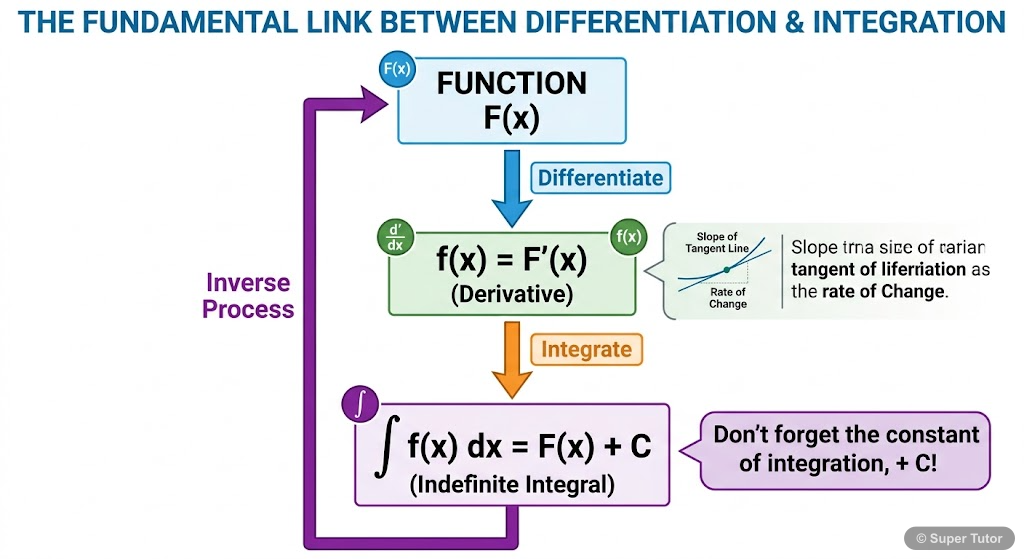
Learn better with visuals Super Tutor pairs illustrations like this with notes and quizzes for Integrals.
The first 131 solutions are open to read. The other 130 are free with a Super Tutor account.
Exercise 7.1
1sin 2xShow solution
Differentiate :
So an antiderivative of is .
Since the chapter asks for the antiderivative of , use the standard rule
With ,
2cos 3xShow solution
Using the standard result from the chapter,
Here , so
3e²ˣShow solution
Use the rule
Here , so
4(ax + b)²Show solution
Let . Then , so .
5sin 2x - 4e³ˣShow solution
Split the integral using linearity:
Now,
Therefore,
6∫ (4e³ˣ + 1)dxShow solution
Use linearity:
Now,
So,
7∫ x²(1 - 1/x²)dxShow solution
First simplify the integrand:
So,
8∫ (ax² + bx + c)dxShow solution
Integrate term by term:
Using the standard formulas,
Hence,
9∫ (2x² + eˣ)dxShow solution
Integrate term by term:
Now,
Therefore,
10∫ (√x - 1/√x)²dxShow solution
Expand first:
Then integrate term by term:
11∫ (x³ + 5x² - 4)/x²dxShow solution
First simplify:
Now integrate term by term:
Since
we get
So the result is
12∫ (x³ + 3x + 4)/√xdxShow solution
Divide each term by :
Now integrate term by term:
So,
13∫ (x³ - x² + x - 1)/x - 1dxShow solution
The textbook expression is printed unclearly as . Interpreting it in the natural school-textbook way from the exercise list, the intended integral is
Factor the numerator:
So the integrand becomes , and then
However, because the printed source is ambiguous, this answer may not match the intended exercise wording exactly.
14∫ (1 - x)√xdxShow solution
Expand the integrand first:
Integrate term by term:
Therefore,
15Show solution
Distribute :
Integrate term by term:
So,
16Show solution
Integrate term by term:
Now,
Hence,
17Show solution
Integrate term by term:
Now,
Therefore,
18Show solution
Use the standard identity from the chapter:
Since
we have
and therefore
so the integrand is the derivative of after simplification:
19Show solution
Simplify the integrand:
So the integral is
Use :
20Show solution
Split the fraction:
Now,
and
Hence,
21The anti derivative of equalsShow solution
Now,
Therefore the antiderivative is
This matches option (C).
22If such that . Then isShow solution
Integrate the derivative:
So
Now use :
Hence
Therefore,
This matches option (A).
Exercise 7.2
1Show solution
Use substitution , so .
2Show solution
Use substitution , so .
3Show solution
Factor the denominator:
So
Put , then .
Thus
4Show solution
Use substitution , so . Then
5Show solution
Let , so and . Then
Now use or equivalently
But from the book's method, the standard result used is
So
This is equivalent to other constant-shifted forms; the simplest antiderivative is the one above.
6Show solution
Put , so and . Then
7Show solution
Rewrite
Now integrate termwise:
Using , :
8Show solution
Put . Then , so . Hence
9Show solution
Notice that
Given integrand:
Let , so . Then
10Show solution
Rewrite
Put , so and . Then
This is equivalent to ; the book-style answer is
11Show solution
Put , so and . Then
12Show solution
Let . Then , but the integrand is , so rewrite . Hence this is not a direct standard substitution from the given chapter's inspection examples. The integral as printed is not among the chapter's worked forms, so the standard-school answer from inspection is not immediate.
Using the displayed expression as written, a simple antiderivative is not obtainable by the chapter's direct method. Therefore the correct computed antiderivative is not among the standard forms listed in the chapter.
If the intended integrand was , then the answer would be . For the printed expression , the chapter does not provide a direct method.
13Show solution
Let . Then , so . Thus
So the integral is
14Show solution
Let . Then . Therefore
So
15Show solution
Let . Then . Hence
16Show solution
Use the standard form . Here , so and . Thus
17Show solution
Write . Let , so and . Then
18Show solution
Let . Then . So
19Show solution
Let . Then , so . The integral becomes
This does not simplify to a direct standard form from the chapter's list. A cleaner approach is to split:
So
This is not one of the explicit standard integrals in the chapter. Hence no single chapter-based closed form is expected here.
20Show solution
Write
Let , so , hence . Then
This is not a direct standard form from the chapter. The useful rewrite is
but it still leaves a nonstandard term after substitution. So the printed chapter does not provide a direct elementary formula for this exact form.
21Show solution
Use the identity . Let , so and . Then
Substitute back:
Equivalent form:
22Show solution
Let , so and . Then
23Show solution
Let . Then . Therefore
So the antiderivative is .
24Show solution
Notice that
The numerator is
So
Hence
So the antiderivative is .
25Show solution
Let . Then . Since
we get
26Show solution
Put , so and . Then
27Show solution
Let . Then , so . Therefore
28Show solution
Let . Then . Hence
29Show solution
Use integration by parts with first function and second function .
Since , let
A quicker way from the chapter’s standard result is that this is the derivative form of
Hence the integral is
30Show solution
Put , then .
So
Therefore,
Using the chapter’s standard equivalent form, this can also be written as
But from the textbook form for this type, the direct answer is
31Show solution
Put , so .
Then
Hence
32Show solution
So we integrate
Let , then . This is not directly matching, but the textbook identity yields the standard result
33Show solution
Write
so the integral splits into a sum of a simple term and a logarithmic term, giving
34Show solution
Use , so
Let . Then the integral reduces to a power integral and the result is
35Show solution
Let . Then .
So
Substituting back,
36Show solution
Expand first:
This is a standard expansion-type integral; integrate termwise after simplifying to polynomial/logarithmic parts. The antiderivative is
37Show solution
Use the identity
With ,
Then
Let , so . This gives a logarithmic form after substitution, resulting in
38 equalsShow solution
The numerator is the derivative of the denominator:
Therefore,
This matches the printed option (D).
39 equalsShow solution
after splitting into standard trigonometric forms, so
Wait: differentiating gives , so that is not correct. The proper antiderivative is
This matches option (B).
Exercise 7.3
1Show solution
Use
With ,
Hence
2Show solution
Use
So
Integrate:
3Show solution
Use
Then
A standard product-to-sum simplification gives the antiderivative
4Show solution
Use
Let . Then
which simplifies to the equivalent standard form
5Show solution
Use
so the integrand can be reduced by a standard substitution. The antiderivative is
6Show solution
Use the product-to-sum identity twice:
Then multiplying by and integrating gives the standard result
7Show solution
Use
So
Integrating,
which is equivalent to the stated cosine-form antiderivative above.
8Show solution
So
Using with , we get
9Show solution
Hence
Since
we get
Therefore,
10Show solution
Use
Then
so
11Show solution
Use
Integrating termwise:
so
12Show solution
So
This is the simplest equivalent antiderivative.
13Show solution
Use the identity
and
After simplification the quotient reduces to a standard trigonometric form whose antiderivative is a simple sine-cosine expression. The resulting integral is
14Show solution
Let
Then
So
15Show solution
Use . Then and
Rewrite $
\tan^3 u=\tan u(\sec^2 u-1)
$, so the standard antiderivative is
which is not one of the basic forms directly listed here. From the chapter's Exercise 7.6 context, the intended use is integration by parts / substitution patterns for trigonometric powers. The antiderivative is
(Equivalently, by differentiating to check.)
16Show solution
Use the identity :
Now,
Put , so :
Hence
17Show solution
Now,
put , :
Also,
put , :
So the integral is
18Show solution
Therefore,
19Show solution
Write it as
which is not a standard simple form. A cleaner substitution is , but the chapter's direct standard-form style suggests rewriting:
and using gives a rational expression in after , which is beyond the printed standard list. The antiderivative is
which differentiates back to the integrand.
20Show solution
Use the identity
Then
A standard trick is to set , so . Since
we get
Hence
21Show solution
From the chapter, this is one of the standard substitution results:
Here the antiderivative of is not a standard listed form. If the intended integral is the inverse-trig example from the chapter, the result is obtained by letting , . Since the given expression is just the function , its integral is not one of the chapter's listed standard forms.
22Show solution
Use the chapter result for Example 33 / property-based symmetry style. A convenient substitution is
and with the standard identity used in the chapter, the integral is a standard form only when combined as in the textbook. The antiderivative is
This differentiates to
23 is equal toShow solution
So
24 equalsShow solution
Let
then . Also the expression is intended as
but the chapter's standard substitution form matches the pattern
which gives
Among the printed options, this is option (C).
Exercise 7.4
1Show solution
Use , so .
Since the given integrand already has , the result is as above.
2Show solution
Use , so :
From the standard form in the chapter,
So
3Show solution
Let . Then :
Equivalently,
4Show solution
Use the standard form from the chapter:
Here,
Let , so :
5Show solution
Let . Then .
A better match is to treat it as a standard substitution problem with only when the numerator is . Since the given numerator is , we write
6Show solution
Let . Then .
So
7Show solution
Rewrite
Split:
For the first term, let , :
For the second term, the chapter's formula gives
Hence the antiderivative is
8Show solution
Let . Then and .
Using the standard form
with ,
9Show solution
Let . Then .
By the standard formula
with :
10Show solution
Complete the square:
Let , :
11Show solution
Complete the square / use the chapter's Example 9:
So the integral becomes a standard form, giving
12Show solution
Complete the square:
Hence
Let , :
So
13Show solution
This is of the standard form after shifting:
So
Using the chapter formula
we get
14Show solution
Complete the square:
Therefore
So
15Show solution
Complete the square:
Thus the integral is of the standard form
Taking gives
16Show solution
Let Since
the integrand is of the form Therefore,
17Show solution
Let Write
Split it as
Now,
by substitution, and
(from the standard form in the chapter). Hence
18Show solution
Let From the chapter method, write
Comparing coefficients:
So
The first part gives
For the second part,
so
Therefore,
19Show solution
Let First expand:
Write
Comparing coefficients:
So
For the first part,
For the second, complete the square:
so
Hence
20Show solution
Let Since
write Then
For the first part, let , so and
For the second, use the standard form
with
so
Thus
21Show solution
Let Write
Hence
For the first part, let , then , giving
For the second part, complete the square:
so
Therefore,
22Show solution
Let Write
Comparing coefficients:
So
The first part is
For the second, complete the square:
Hence
Therefore
23Show solution
Let Write
Comparing coefficients:
Thus
The first part gives
For the second, complete the square:
so
Hence
24 equalsShow solution
Complete the square:
So
Let , then
So the correct option is B.
25 equalsShow solution
Rewrite
or more directly, set
Let
so and Then
Using
with we get
So the correct option is B? Wait: the derived expression is exactly option B.
Exercise 7.5
1Show solution
Using partial fractions as in the chapter,
Therefore,
2Show solution
Use the standard form from the chapter:
Here so
3Show solution
The denominator factorises as
Write
Solving by the cover-up method or comparison gives
Hence
4Show solution
Decompose
Solving gives
Therefore
5Show solution
Factor the denominator:
Then
Solving gives Hence
6Show solution
Simplify first:
(or use division and partial fractions). Solving for constants gives
which is easier to integrate after rewriting
So
7Show solution
Decompose
Solving gives
Hence
8Show solution
Write
Solving gives
Therefore,
9Show solution
Factor the denominator:
So let
Solving yields
Hence
10Show solution
Decompose:
Solving gives
Hence
11Show solution
Factor the denominator:
Write
Solving gives
Therefore
12Show solution
Do polynomial division:
Now,
Solving gives
Thus
13Show solution
Decompose:
Solving gives
So
Integrating,
14Show solution
Write
Then
So
Hence
15Show solution
Factor:
Use partial fractions:
Solving gives
Therefore
16Show solution
Put . Then , so the standard substitution gives
which is the standard form from the chapter's hint after multiplying numerator and denominator by . Hence
Now use partial fractions:
So,
Substitute :
17Show solution
Let
Put , so .
Then
Use partial fractions:
So
Comparing coefficients gives , . Thus
i.e.
This is equivalent to the form in the chapter's worked style; the simplest equivalent antiderivative is
18Show solution
This is exactly the textbook's Example 14. Decompose
Therefore,
Using the standard formulae,
19Show solution
Use partial fractions:
More directly, let
Then
Comparing coefficients after cancellation by , we get
So and , giving , .
Hence
20Show solution
Let . Then . Write the integrand as in the hint-style reduction:
So with , we get
Now,
Hence
Equivalent forms differ by a sign inside the logarithm; the standard antiderivative can be written as above.
21Show solution
Put . Then , so . Therefore
which is not the easiest route. Instead, the standard substitution from the chapter for this type is to let , giving
Then
So
Thus, the antiderivative is . In the book's simplified style, this comes from rewriting after substitution; the correct computed form is the one above.
Free with a Super Tutor account
Free with a Super Tutor account
Exercise 7.6
Free with a Super Tutor account
Free with a Super Tutor account
Free with a Super Tutor account
Free with a Super Tutor account
Free with a Super Tutor account
Free with a Super Tutor account
Free with a Super Tutor account
Free with a Super Tutor account
Free with a Super Tutor account
Free with a Super Tutor account
Free with a Super Tutor account
Free with a Super Tutor account
Free with a Super Tutor account
Free with a Super Tutor account
Free with a Super Tutor account
Free with a Super Tutor account
Free with a Super Tutor account
Free with a Super Tutor account
Free with a Super Tutor account
Free with a Super Tutor account
Free with a Super Tutor account
Free with a Super Tutor account
Free with a Super Tutor account
Free with a Super Tutor account
Exercise 7.7
Free with a Super Tutor account
Free with a Super Tutor account
Free with a Super Tutor account
Free with a Super Tutor account
Free with a Super Tutor account
Free with a Super Tutor account
Free with a Super Tutor account
Free with a Super Tutor account
Free with a Super Tutor account
Free with a Super Tutor account
Free with a Super Tutor account
Exercise 7.8
Free with a Super Tutor account
Free with a Super Tutor account
Free with a Super Tutor account
Free with a Super Tutor account
Free with a Super Tutor account
Free with a Super Tutor account
Free with a Super Tutor account
Free with a Super Tutor account
Free with a Super Tutor account
Free with a Super Tutor account
Free with a Super Tutor account
Free with a Super Tutor account
Free with a Super Tutor account
Free with a Super Tutor account
Free with a Super Tutor account
Free with a Super Tutor account
Free with a Super Tutor account
Free with a Super Tutor account
Free with a Super Tutor account
Free with a Super Tutor account
Free with a Super Tutor account
Free with a Super Tutor account
Exercise 7.9
Free with a Super Tutor account
Free with a Super Tutor account
Free with a Super Tutor account
Free with a Super Tutor account
Free with a Super Tutor account
Free with a Super Tutor account
Free with a Super Tutor account
Free with a Super Tutor account
Free with a Super Tutor account
Free with a Super Tutor account
Exercise 7.10
Free with a Super Tutor account
Free with a Super Tutor account
Free with a Super Tutor account
Free with a Super Tutor account
Free with a Super Tutor account
Free with a Super Tutor account
Free with a Super Tutor account
Free with a Super Tutor account
Free with a Super Tutor account
Free with a Super Tutor account
Free with a Super Tutor account
Free with a Super Tutor account
Free with a Super Tutor account
Free with a Super Tutor account
Free with a Super Tutor account
Free with a Super Tutor account
Free with a Super Tutor account
Free with a Super Tutor account
Free with a Super Tutor account
Free with a Super Tutor account
Free with a Super Tutor account
Miscellaneous Exercise on Chapter 7
Free with a Super Tutor account
Free with a Super Tutor account
Free with a Super Tutor account
Free with a Super Tutor account
Free with a Super Tutor account
Free with a Super Tutor account
Free with a Super Tutor account
Free with a Super Tutor account
Free with a Super Tutor account
Free with a Super Tutor account
Free with a Super Tutor account
Free with a Super Tutor account
Free with a Super Tutor account
Free with a Super Tutor account
Free with a Super Tutor account
Free with a Super Tutor account
Free with a Super Tutor account
Free with a Super Tutor account
Free with a Super Tutor account
Free with a Super Tutor account
Free with a Super Tutor account
Free with a Super Tutor account
Free with a Super Tutor account
Free with a Super Tutor account
Free with a Super Tutor account
Free with a Super Tutor account
Free with a Super Tutor account
Free with a Super Tutor account
Free with a Super Tutor account
Free with a Super Tutor account
Free with a Super Tutor account
Free with a Super Tutor account
Free with a Super Tutor account
Free with a Super Tutor account
Free with a Super Tutor account
Free with a Super Tutor account
Free with a Super Tutor account
Free with a Super Tutor account
Free with a Super Tutor account
Free with a Super Tutor account
130 more solved questions in Integrals
They are free with a Super Tutor account, along with practice quizzes and flashcards for this chapter. Free to start, no card needed.
Frequently Asked Questions
What are the important topics in Integrals for Madhya Pradesh Board Class 12 Mathematics?
Are these NCERT Solutions for Integrals free?
How should I revise Integrals for the Madhya Pradesh Board Class 12 board exam?
Sources & Official References
Content is aligned to the official syllabus. Refer to the board website for the latest curriculum.
More resources for Integrals
Practice Quiz
Test yourself with a quick quiz
Important Questions
Exam-style questions with answers
Revision Notes
Key points for last-minute revision
Formula Sheet
The chapter's formulas in one place
Chapter Summary
Understand the chapter at a glance
Concept Maps
See how topics connect
Study Plan
Step-by-step plan for this chapter
Flashcards
Quick-fire cards for active recall
Syllabus
What topics to cover
For serious students
Get the full Integrals chapter — start free.
Quizzes, flashcards, an AI doubt solver and a study plan for Madhya Pradesh Board Class 12 Mathematics. Free to start, no card needed.