Ray Optics and Optical Instruments — Important Questions
Madhya Pradesh Board · Class 12 · Physics
96 important questions from Ray Optics and Optical Instruments for Madhya Pradesh Board Class 12 Physics, with answers. Written for the board exams 2027.
Interactive on Super Tutor
Studying Ray Optics and Optical Instruments? Get the full interactive chapter.
Quizzes, flashcards, AI doubt-solver and a step-by-step study plan — built for important questions and more.
Free trial, no card needed.
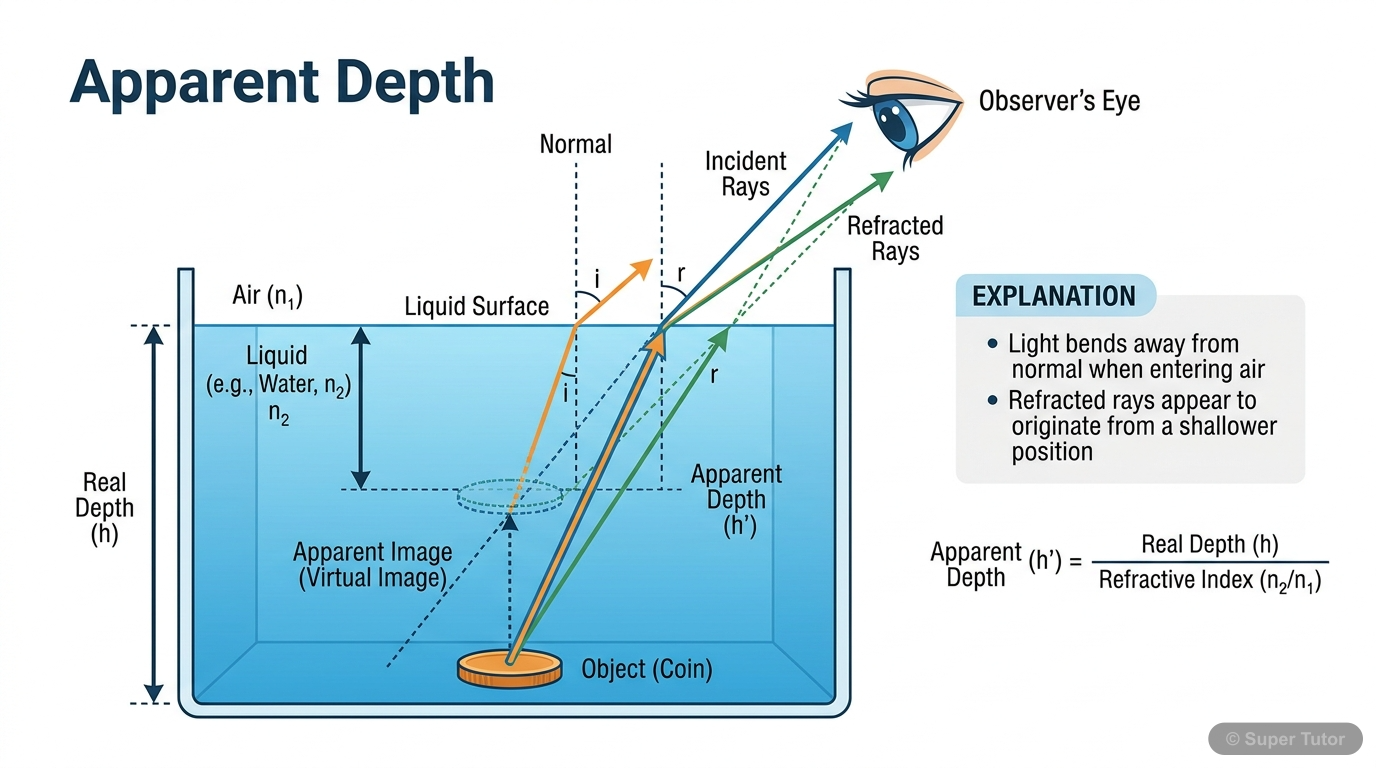
One of 27 illustrations for Ray Optics and Optical Instruments in Super Tutor — alongside flashcards, concept maps and practice questions.
Important Questions from Ray Optics and Optical Instruments
According to Snell's law, which of the following statements are correct?
Show answer
sin i / sin r = n₂₁ (constant), The incident ray, refracted ray and normal lie in the same plane, n₁₂ = 1/n₂₁
Snell's law states that the ratio of sine of angle of incidence to sine of angle of refraction is constant (refractive index). All three rays lie in the same plane. The refractive index is independent of angle of incidence and refraction occurs in both directions.
For a convex lens, the focal length is positive.
Show answer
True
According to the Cartesian sign convention, focal length is positive for converging lenses (convex) and negative for diverging lenses (concave). Convex lenses converge parallel rays to a real focus.
Which of the following are applications of total internal reflection?
Show answer
Optical fibres, Totally reflecting prisms, Mirage formation, Diamond's brilliance
Total internal reflection is used in optical fibres for signal transmission, in prisms to bend light, in mirage formation due to temperature gradients, and gives diamond its brilliance. Rainbow formation involves dispersion, not total internal reflection.
In a compound microscope, the final image formed is:
Show answer
Virtual and inverted
In a compound microscope, the objective forms a real, inverted, magnified image. The eyepiece then forms a virtual, magnified image of this first image. Since there are two inversions (one by objective, but eyepiece maintains the inverted nature), the final image is virtual and inverted.
+92 more questions on Ray Optics and Optical Instruments (Madhya Pradesh Board Class 12 Physics)
Practise AllFrequently Asked Questions
What are the important topics in Ray Optics and Optical Instruments for Madhya Pradesh Board Class 12 Physics?
How many important questions are there in Ray Optics and Optical Instruments?
Sources & Official References
Content is aligned to the official syllabus. Refer to the board website for the latest curriculum.
More resources for Ray Optics and Optical Instruments
Practice Quiz
Test yourself with a quick quiz
Revision Notes
Key points for last-minute revision
Formula Sheet
The chapter's formulas in one place
Chapter Summary
Understand the chapter at a glance
Concept Maps
See how topics connect
Study Plan
Step-by-step plan for this chapter
Flashcards
Quick-fire cards for active recall
Syllabus
What topics to cover
NCERT Solutions
Every textbook question solved step by step
For serious students
Get the full Ray Optics and Optical Instruments chapter — start free.
Quizzes, flashcards, an AI doubt solver and a study plan for Madhya Pradesh Board Class 12 Physics. Free to start, no card needed.