Ray Optics and Optical Instruments — NCERT Solutions
Madhya Pradesh Board · Class 12 · Physics
NCERT Solutions for Ray Optics and Optical Instruments, Madhya Pradesh Board Class 12 Physics: 31 textbook questions solved step by step. Covers Exercises.
Interactive on Super Tutor
Studying Ray Optics and Optical Instruments? Get the full interactive chapter.
Quizzes, flashcards, AI doubt-solver and a step-by-step study plan — built for NCERT solutions and more.
Free trial, no card needed.
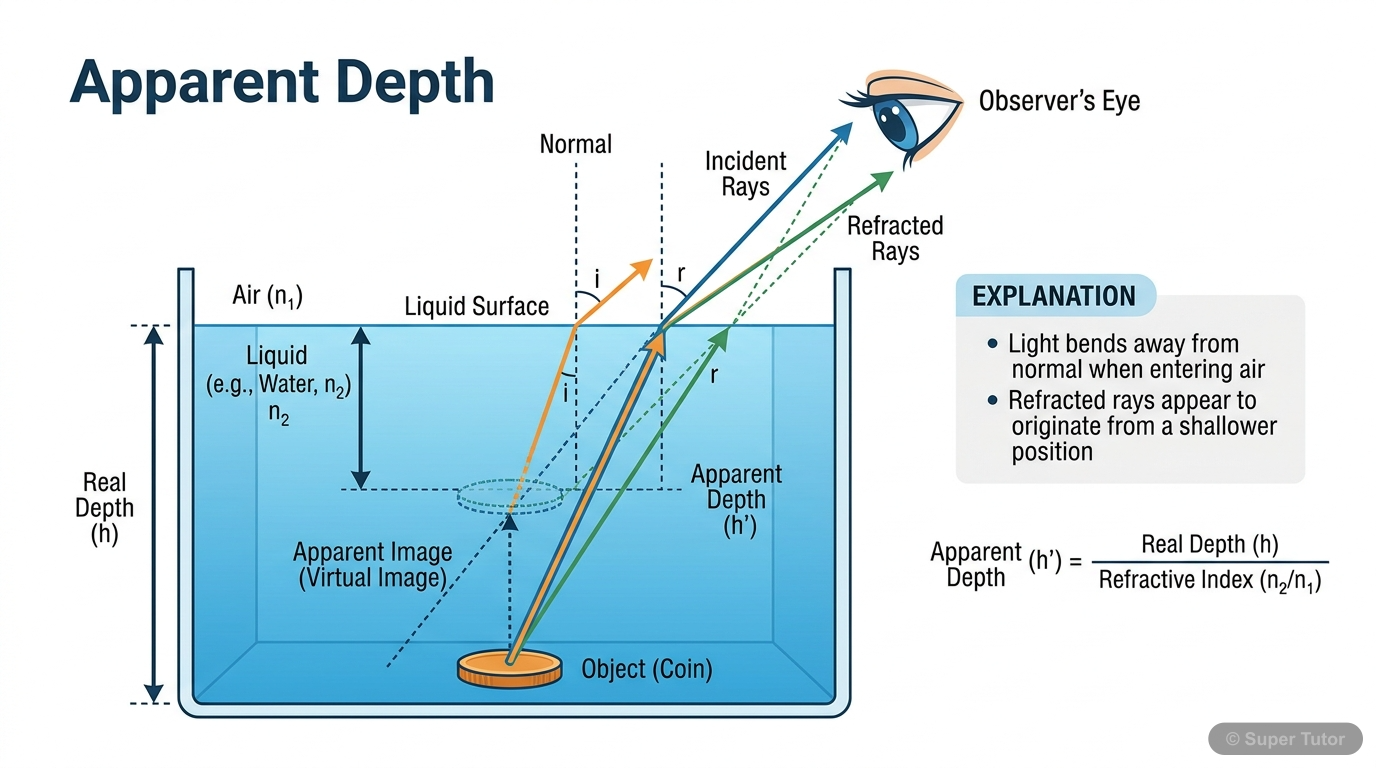
One of 27 illustrations for Ray Optics and Optical Instruments in Super Tutor — alongside flashcards, concept maps and practice questions.
The first 16 solutions are open to read. The other 15 are free with a Super Tutor account.
Exercises
9.1A small candle, 2.5 cm in size is placed at 27 cm in front of a concave mirror of radius of curvature 36 cm. At what distance from the mirror should a screen be placed in order to obtain a sharp image? Describe the nature and size of the image. If the candle is moved closer to the mirror, how would the screen have to be moved?Show solution
Given:
- Size of candle (object height): cm
- Object distance: cm (negative by sign convention, object in front of mirror)
- Radius of curvature: cm (concave mirror)
- Focal length: cm
Formula used (Mirror equation):
Calculation:
The screen should be placed 54 cm in front of the mirror (on the same side as the object).
Magnification:
Size of image:
Nature of image: Real, inverted, and magnified (size = 5.0 cm, twice the object size).
Effect of moving candle closer: As the candle is moved closer to the mirror (but still beyond ), the image moves farther away from the mirror. So the screen must be moved farther away from the mirror to obtain a sharp image. When the object is between and the pole, no real image is formed and the screen cannot capture the image.
9.2A 4.5 cm needle is placed 12 cm away from a convex mirror of focal length 15 cm. Give the location of the image and the magnification. Describe what happens as the needle is moved farther from the mirror.Show solution
Given:
- Object height: cm
- Object distance: cm
- Focal length of convex mirror: cm
Formula used:
Calculation:
The image is formed 6.7 cm behind the mirror (virtual image).
Magnification:
Size of image:
Nature: Virtual, erect, and diminished.
As the needle is moved farther from the mirror: The image moves closer to the focus of the mirror (i.e., towards cm behind the mirror) but never goes beyond the focus. The size of the image goes on decreasing. As , cm and the image size approaches zero.
9.3A tank is filled with water to a height of 12.5 cm. The apparent depth of a needle lying at the bottom of the tank is measured by a microscope to be 9.4 cm. What is the refractive index of water? If water is replaced by a liquid of refractive index 1.63 up to the same height, by what distance would the microscope have to be moved to focus on the needle again?Show solution
Given:
- Real depth of needle (in water): cm
- Apparent depth (in water): cm
Part 1: Refractive index of water
Part 2: New apparent depth with liquid of
Distance the microscope must be moved:
The microscope was focused at 9.4 cm (apparent depth in water). Now the apparent depth is 7.67 cm.
The microscope must be moved down by approximately 1.7 cm to focus on the needle again.
9.4Figures 9.27(a) and (b) show refraction of a ray in air incident at 60° with the normal to a glass-air and water-air interface, respectively. Predict the angle of refraction in glass when the angle of incidence in water is 45° with the normal to a water-glass interface [Fig. 9.27(c)].Show solution
Given from figures:
- Fig 9.27(a): Ray in air incident at on glass-air interface. From the figure, angle of refraction in glass .
So:
- Fig 9.27(b): Ray in air incident at on water-air interface. From the figure, angle of refraction in water .
So:
(Note: The exact values from the figures give and ; using standard values: , .)
For water-glass interface [Fig. 9.27(c)]:
Angle of incidence in water:
Using Snell's law:
The angle of refraction in glass is approximately .
9.5A small bulb is placed at the bottom of a tank containing water to a depth of 80 cm. What is the area of the surface of water through which light from the bulb can emerge out? Refractive index of water is 1.33. (Consider the bulb to be a point source.)Show solution
Given:
- Depth of water: cm m
- Refractive index of water:
Step 1: Find the critical angle
Step 2: Find the radius of the circular area
Light can emerge only within a cone of half-angle at the surface. The radius of the circle on the surface is:
Step 3: Calculate the area
The area of the water surface through which light can emerge is approximately .
9.6A prism is made of glass of unknown refractive index. A parallel beam of light is incident on a face of the prism. The angle of minimum deviation is measured to be 40°. What is the refractive index of the material of the prism? The refracting angle of the prism is 60°. If the prism is placed in water (refractive index 1.33), predict the new angle of minimum deviation of a parallel beam of light.Show solution
Given:
- Angle of prism:
- Angle of minimum deviation (in air):
- Refractive index of water:
Part 1: Refractive index of glass
The refractive index of the glass is .
Part 2: New angle of minimum deviation in water
When the prism is placed in water, the effective refractive index is:
Using the prism formula:
The new angle of minimum deviation in water is approximately .
9.7Double-convex lenses are to be manufactured from a glass of refractive index 1.55, with both faces of the same radius of curvature. What is the radius of curvature required if the focal length is to be 20 cm?Show solution
Given:
- Refractive index of glass:
- Focal length: cm
- Double-convex lens with equal radii: and (by sign convention)
Formula used (Lens Maker's equation):
Substituting:
The required radius of curvature is cm.
9.8A beam of light converges at a point P. Now a lens is placed in the path of the convergent beam 12 cm from P. At what point does the beam converge if the lens is (a) a convex lens of focal length 20 cm, and (b) a concave lens of focal length 16 cm?Show solution
Concept: The converging beam would meet at P in the absence of the lens. With the lens placed 12 cm from P, the point P acts as a virtual object for the lens. So cm (the object is on the other side of the lens, i.e., behind the lens).
Part (a): Convex lens, cm
Using lens formula:
The beam converges at a point 7.5 cm on the other side (transmission side) of the convex lens.
Part (b): Concave lens, cm
The beam converges at a point 48 cm on the other side (transmission side) of the concave lens.
9.9An object of size 3.0 cm is placed 14 cm in front of a concave lens of focal length 21 cm. Describe the image produced by the lens. What happens if the object is moved further away from the lens?Show solution
Given:
- Object size: cm
- Object distance: cm
- Focal length (concave lens): cm
Using lens formula:
The image is formed 8.4 cm on the same side as the object (virtual image).
Magnification:
Size of image:
Nature of image: Virtual, erect, and diminished (1.8 cm in size).
As the object is moved farther from the lens: The image continues to be virtual, erect, and diminished. As , cm. The image moves towards the focus but never goes beyond it. The size of the image decreases further.
9.10What is the focal length of a convex lens of focal length 30 cm in contact with a concave lens of focal length 20 cm? Is the system a converging or a diverging lens? Ignore thickness of the lenses.Show solution
Given:
- Focal length of convex lens: cm
- Focal length of concave lens: cm
Formula for combination of lenses in contact:
The focal length of the combination is cm.
Since is negative, the combination acts as a diverging lens.
9.11A compound microscope consists of an objective lens of focal length 2.0 cm and an eyepiece of focal length 6.25 cm separated by a distance of 15 cm. How far from the objective should an object be placed in order to obtain the final image at (a) the least distance of distinct vision (25 cm), and (b) at infinity? What is the magnifying power of the microscope in each case?Show solution
Given:
- Focal length of objective: cm
- Focal length of eyepiece: cm
- Tube length (separation between lenses): cm
- Least distance of distinct vision: cm
Part (a): Final image at cm
For the eyepiece (image at cm, i.e., cm):
So the object for the eyepiece is 5 cm to the left of the eyepiece.
Image distance for objective:
Wait — the separation between lenses is 15 cm. The object for the eyepiece is at cm from the eyepiece, so the image formed by the objective is at cm from the objective.
For the objective:
The object should be placed 2.5 cm in front of the objective.
Magnifying power:
Magnitude of magnifying power = 20 (negative sign indicates inverted image).
Part (b): Final image at infinity
For the eyepiece to form image at infinity, the object for the eyepiece must be at its focus:
Image distance for objective:
For the objective:
The object should be placed approximately 2.59 cm in front of the objective.
Magnifying power:
Magnitude of magnifying power (image at infinity).
9.12A person with a normal near point (25 cm) using a compound microscope with objective of focal length 8.0 mm and an eyepiece of focal length 2.5 cm can bring an object placed at 9.0 mm from the objective in sharp focus. What is the separation between the two lenses? Calculate the magnifying power of the microscope.Show solution
Given:
- mm cm
- cm
- mm cm
- cm
Step 1: Find image distance for objective
Step 2: Find object distance for eyepiece
For the final image to be at the near point ( cm):
Step 3: Separation between lenses
The separation between the two lenses is approximately 9.47 cm.
Step 4: Magnifying power
The magnifying power of the microscope is 88.
9.13A small telescope has an objective lens of focal length 144 cm and an eyepiece of focal length 6.0 cm. What is the magnifying power of the telescope? What is the separation between the objective and the eyepiece?Show solution
Given:
- Focal length of objective: cm
- Focal length of eyepiece: cm
Magnifying power (normal adjustment, image at infinity):
The magnifying power of the telescope is 24.
Separation between objective and eyepiece (in normal adjustment):
The separation between the objective and eyepiece is 150 cm.
9.14(a) A giant refracting telescope at an observatory has an objective lens of focal length 15 m. If an eyepiece of focal length 1.0 cm is used, what is the angular magnification of the telescope?
(b) If this telescope is used to view the moon, what is the diameter of the image of the moon formed by the objective lens? The diameter of the moon is 3.48 × 10⁸ m, and the radius of lunar orbit is 3.8 × 10⁸ m.Show solution
Given:
- m
- cm m
- Diameter of moon: m
- Radius of lunar orbit: m
Part (a): Angular magnification
The angular magnification is 1500.
Part (b): Diameter of image of moon formed by objective
The angle subtended by the moon at the objective:
The image of the moon is formed at the focal plane of the objective. The diameter of the image:
The diameter of the image of the moon formed by the objective is approximately 13.74 cm.
9.15Use the mirror equation to deduce that:
(a) an object placed between f and 2f of a concave mirror produces a real image beyond 2f.
(b) a convex mirror always produces a virtual image independent of the location of the object.
(c) the virtual image produced by a convex mirror is always diminished in size and is located between the focus and the pole.
(d) an object placed between the pole and focus of a concave mirror produces a virtual and enlarged image.Show solution
Mirror equation:
For a concave mirror: (i.e., )
For a convex mirror: (i.e., )
Object is always in front of mirror:
Part (a): Object between and of concave mirror → real image beyond
For concave mirror, . Object between and means:
From mirror equation:
Since is between and , let where .
Since , we have , so .
Also since , , so .
Therefore , which gives .
This means is negative (real image, in front of mirror) and , i.e., image is beyond . ✓
Part (b): Convex mirror always produces virtual image
For convex mirror: , object: (always negative).
Both terms are positive, so , hence .
A positive means the image is behind the mirror → virtual image, for all positions of the object. ✓
Part (c): Virtual image by convex mirror is diminished and between focus and pole
From part (b):
Since , we have . So , meaning image is between pole and focus. ✓
Magnification:
Since , we get . So the image is diminished. ✓
Part (d): Object between pole and focus of concave mirror → virtual and enlarged image
For concave mirror: . Object between pole and focus: , i.e., .
With :
Since , , so , hence .
Positive means image is behind the mirror → virtual. ✓
Magnification:
Since and (with ), and is not necessarily true, but:
So , meaning the image is enlarged. ✓
9.16A small pin fixed on a table top is viewed from above from a distance of 50 cm. By what distance would the pin appear to be raised if it is viewed from the same point through a 15 cm thick glass slab held parallel to the table? Refractive index of glass = 1.5. Does the answer depend on the location of the slab?Show solution
Given:
- Thickness of glass slab: cm
- Refractive index of glass:
Concept: When an object is viewed through a glass slab of thickness and refractive index , the apparent shift (the distance by which the object appears to be raised) is:
Calculation:
The pin appears to be raised by 5 cm.
Does the answer depend on the location of the slab?
No, the apparent shift depends only on the thickness and refractive index of the slab, not on where the slab is placed between the observer and the pin.
(b) What is the answer if there is no outer covering of the pipe?
Free with a Super Tutor account
Free with a Super Tutor account
Free with a Super Tutor account
(b) An object 1.5 cm in size is placed on the side of the convex lens in the arrangement (a) above. The distance between the object and the convex lens is 40 cm. Determine the magnification produced by the two-lens system, and the size of the image.
Free with a Super Tutor account
Free with a Super Tutor account
(a) What is the magnification produced by the lens? How much is the area of each square in the virtual image?
(b) What is the angular magnification (magnifying power) of the lens?
(c) Is the magnification in (a) equal to the magnifying power in (b)? Explain.
Free with a Super Tutor account
(b) What is the magnification in this case?
(c) Is the magnification equal to the magnifying power in this case? Explain.
Free with a Super Tutor account
Free with a Super Tutor account
(a) The angle subtended at the eye by an object is equal to the angle subtended at the eye by the virtual image produced by a magnifying glass. In what sense then does a magnifying glass provide angular magnification?
(b) In viewing through a magnifying glass, one usually positions one's eyes very close to the lens. Does angular magnification change if the eye is moved back?
(c) Magnifying power of a simple microscope is inversely proportional to the focal length of the lens. What then stops us from using a convex lens of smaller and smaller focal length and achieving greater and greater magnifying power?
(d) Why must both the objective and the eyepiece of a compound microscope have short focal lengths?
(e) When viewing through a compound microscope, our eyes should be positioned not on the eyepiece but a short distance away from it for best viewing. Why? How much should be that short distance between the eye and eyepiece?
Free with a Super Tutor account
Free with a Super Tutor account
(a) the telescope is in normal adjustment (i.e., when the final image is at infinity)?
(b) the final image is formed at the least distance of distinct vision (25 cm)?
Free with a Super Tutor account
(b) If this telescope is used to view a 100 m tall tower 3 km away, what is the height of the image of the tower formed by the objective lens?
(c) What is the height of the final image of the tower if it is formed at 25 cm?
Free with a Super Tutor account
Free with a Super Tutor account
Free with a Super Tutor account
Free with a Super Tutor account
15 more solved questions in Ray Optics and Optical Instruments
They are free with a Super Tutor account, along with practice quizzes and flashcards for this chapter. Free to start, no card needed.
Frequently Asked Questions
What are the important topics in Ray Optics and Optical Instruments for Madhya Pradesh Board Class 12 Physics?
Are these NCERT Solutions for Ray Optics and Optical Instruments free?
How should I revise Ray Optics and Optical Instruments for the Madhya Pradesh Board Class 12 board exam?
Sources & Official References
Content is aligned to the official syllabus. Refer to the board website for the latest curriculum.
More resources for Ray Optics and Optical Instruments
Practice Quiz
Test yourself with a quick quiz
Important Questions
Exam-style questions with answers
Revision Notes
Key points for last-minute revision
Formula Sheet
The chapter's formulas in one place
Chapter Summary
Understand the chapter at a glance
Concept Maps
See how topics connect
Study Plan
Step-by-step plan for this chapter
Flashcards
Quick-fire cards for active recall
Syllabus
What topics to cover
For serious students
Get the full Ray Optics and Optical Instruments chapter — start free.
Quizzes, flashcards, an AI doubt solver and a study plan for Madhya Pradesh Board Class 12 Physics. Free to start, no card needed.