Ray Optics and Optical Instruments — Syllabus
Madhya Pradesh Board · Class 12 · Physics
What Ray Optics and Optical Instruments covers in Madhya Pradesh Board Class 12 Physics: 4 topics, for the 2026-27 session.
Interactive on Super Tutor
Studying Ray Optics and Optical Instruments? Get the full interactive chapter.
Quizzes, flashcards, AI doubt-solver and a step-by-step study plan — built for syllabus and more.
Free trial, no card needed.
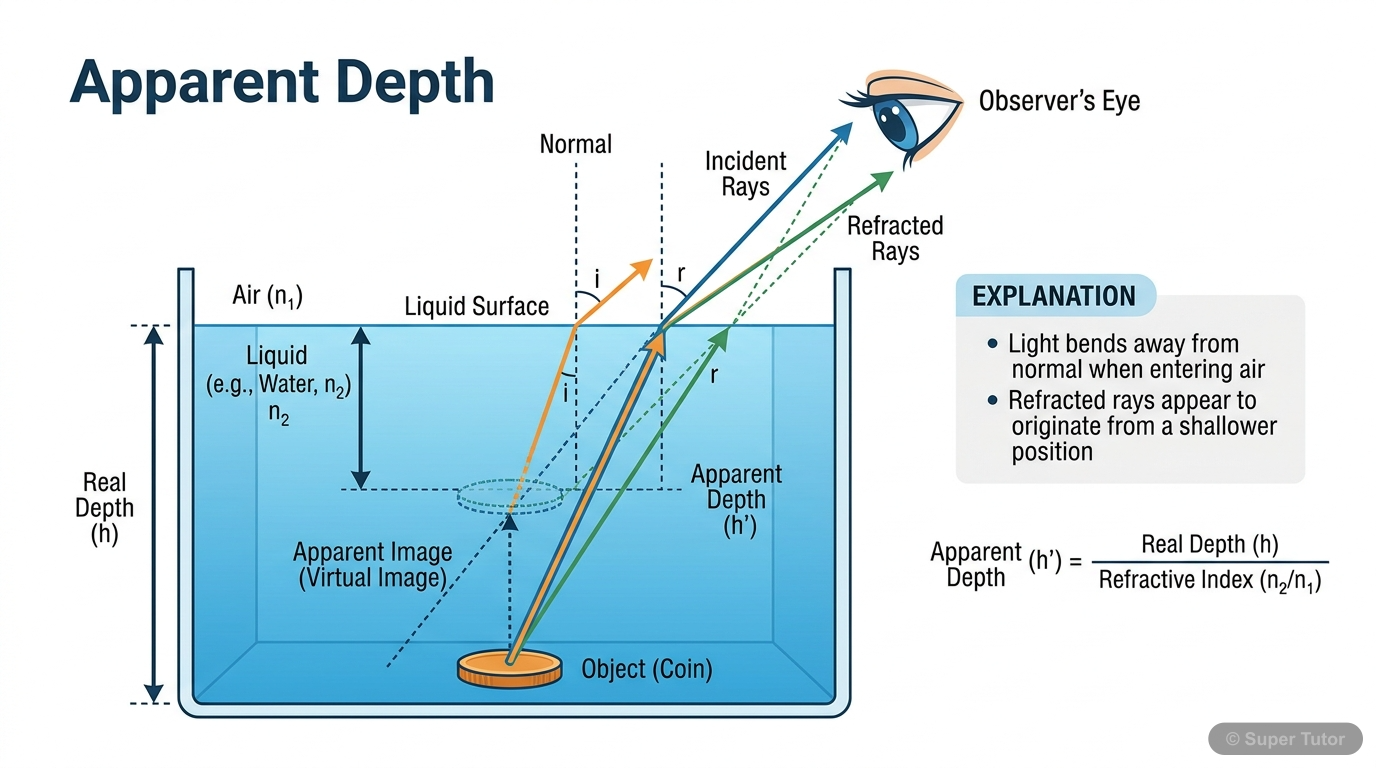
One of 27 illustrations for Ray Optics and Optical Instruments in Super Tutor — alongside flashcards, concept maps and practice questions.
Topics in Ray Optics and Optical Instruments
1. Basics of Light, Rays, and Reflection
- Light is electromagnetic radiation of wavelength about 400 nm to 750 nm.
- The accepted value of the speed of light in vacuum is 2.99792458×10^8 m/s, often taken as 3×10^8 m/s.
- The speed of light in vacuum is the highest speed attainable in nature.
2. Refraction, Refractive Index, and Apparent Depth
- Refraction is the change in direction of light when it passes from one transparent medium to another.
- The incident ray, refracted ray, and normal lie in the same plane.
- Snell’s law gives the relation between angles of incidence and refraction.
3. Total Internal Reflection and Optical Fibre
- When light travels from a denser medium to a rarer medium, partial reflection and partial refraction normally occur.
- At the critical angle, the refracted ray grazes the surface, making the angle of refraction 90°.
- For angles greater than the critical angle, total internal reflection occurs.
4. Refraction at Lenses and Lens Maker’s Formula
- A thin lens is a transparent medium bounded by two surfaces, at least one of which is spherical.
- A convex lens is a converging lens and has positive power.
- A concave lens is a diverging lens and has negative power.
Key Concepts
Central concept: Ray optics and optical instruments explain how light travels, reflects, refracts, and forms images in mirrors, lenses, prisms, fibres, microscopes, and telescopes.
Work through every topic in Ray Optics and Optical Instruments with notes and quizzes
Start This ChapterFrequently Asked Questions
What are the important topics in Ray Optics and Optical Instruments for Madhya Pradesh Board Class 12 Physics?
How should I revise Ray Optics and Optical Instruments for the Madhya Pradesh Board Class 12 board exam?
Sources & Official References
Content is aligned to the official syllabus. Refer to the board website for the latest curriculum.
More resources for Ray Optics and Optical Instruments
Practice Quiz
Test yourself with a quick quiz
Important Questions
Exam-style questions with answers
Revision Notes
Key points for last-minute revision
Formula Sheet
The chapter's formulas in one place
Chapter Summary
Understand the chapter at a glance
Concept Maps
See how topics connect
Study Plan
Step-by-step plan for this chapter
Flashcards
Quick-fire cards for active recall
NCERT Solutions
Every textbook question solved step by step
For serious students
Get the full Ray Optics and Optical Instruments chapter — start free.
Quizzes, flashcards, an AI doubt solver and a study plan for Madhya Pradesh Board Class 12 Physics. Free to start, no card needed.