Ray Optics and Optical Instruments — Chapter Summary
Madhya Pradesh Board · Class 12 · Physics
Summary of Ray Optics and Optical Instruments for Madhya Pradesh Board Class 12 Physics. Part of the Madhya Pradesh Board Class 12 Physics syllabus.
Interactive on Super Tutor
Studying Ray Optics and Optical Instruments? Get the full interactive chapter.
Quizzes, flashcards, AI doubt-solver and a step-by-step study plan — built for chapter summary and more.
Free trial, no card needed.
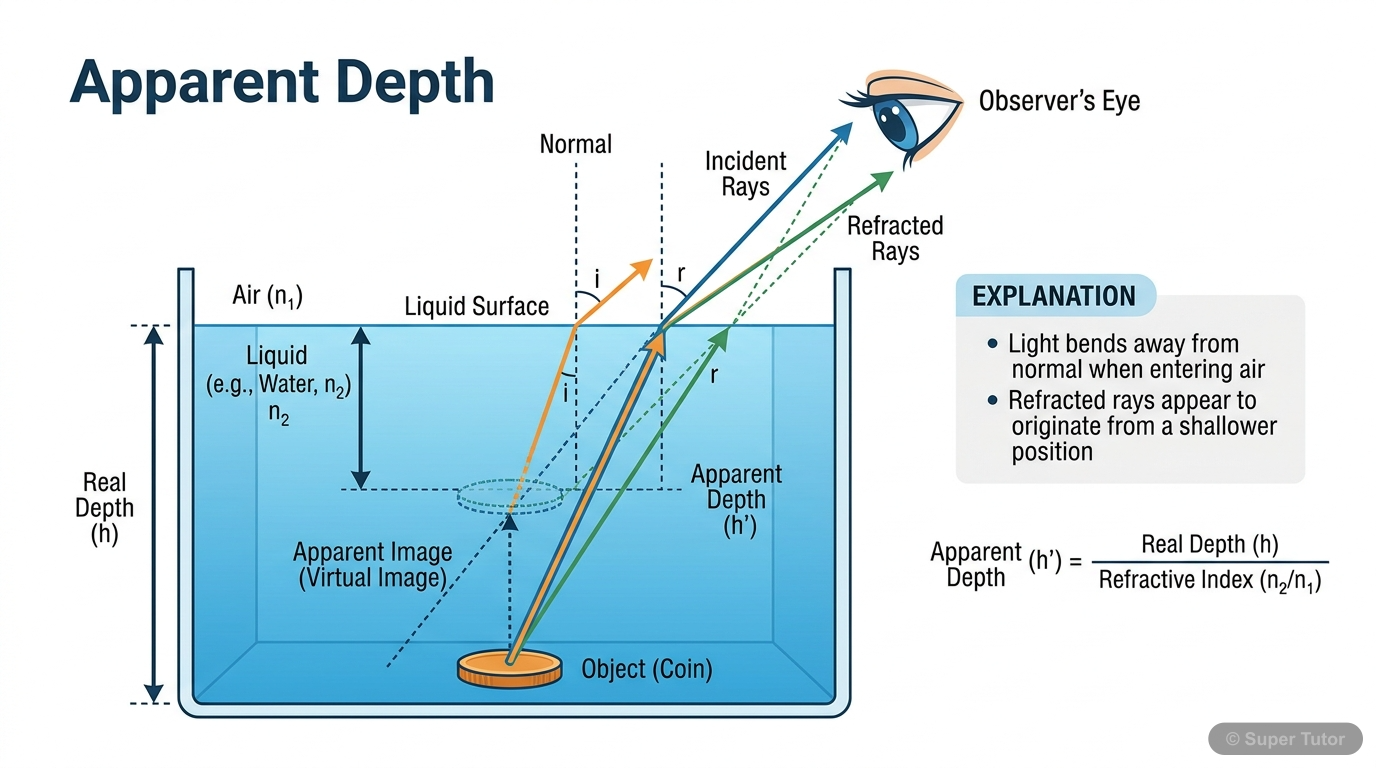
One of 27 illustrations for Ray Optics and Optical Instruments in Super Tutor — alongside flashcards, concept maps and practice questions.
Overview
Ray optics treats light as rays when its wavelength is very small compared with ordinary objects. Light is electromagnetic radiation in the visible range of about 400 nm to 750 nm. It travels with a very large speed in vacuum, c = 2.99792458×10^8 m/s, commonly taken as 3×10^8 m/s, and this is the hi
Key Concepts
A concave mirror converges parallel paraxial
A concave mirror converges parallel paraxial rays to a real focus and has negative focal length by sign convention, while a convex mirror makes parall
Distances measured in the direction
Distances measured in the direction of incident light are positive, and distances measured opposite to it are negative. Heights above the principal ax
Refraction is the change in direction
Refraction is the change in direction of light when it passes between transparent media. Snell's law is sin i / sin r = n21, where n21 is the refracti
For a spherical interface between two
For a spherical interface between two media, the relation is n2/v - n1/u = (n2 - n1)/R. It connects object position, image position, refractive indice
The lens maker's formula is 1/f
The lens maker's formula is 1/f = (n21 - 1)(1/R1 - 1/R2). For a thin lens, the image relation is 1/v - 1/u = 1/f. A convex lens has positive focal len
Learning Objectives
- Understand reflection by spherical mirrors and use the mirror equation and magnification formula.
- Apply the Cartesian sign convention correctly in mirror and lens problems.
- Study refraction at plane and spherical surfaces using Snell's law and the spherical surface formula.
- Use the lens maker's formula, thin lens formula, and power of a lens.
- Explain total internal reflection and its applications in prisms and optical fibres.
Frequently Asked Questions
What are the important topics in Ray Optics and Optical Instruments for Madhya Pradesh Board Class 12 Physics?
How should I revise Ray Optics and Optical Instruments for the Madhya Pradesh Board Class 12 board exam?
Sources & Official References
Content is aligned to the official syllabus. Refer to the board website for the latest curriculum.
More resources for Ray Optics and Optical Instruments
Practice Quiz
Test yourself with a quick quiz
Important Questions
Exam-style questions with answers
Revision Notes
Key points for last-minute revision
Formula Sheet
The chapter's formulas in one place
Concept Maps
See how topics connect
Study Plan
Step-by-step plan for this chapter
Flashcards
Quick-fire cards for active recall
Syllabus
What topics to cover
NCERT Solutions
Every textbook question solved step by step
For serious students
Get the full Ray Optics and Optical Instruments chapter — start free.
Quizzes, flashcards, an AI doubt solver and a study plan for Madhya Pradesh Board Class 12 Physics. Free to start, no card needed.