Ray Optics and Optical Instruments — Flashcards
Madhya Pradesh Board · Class 12 · Physics
64 flashcards for Ray Optics and Optical Instruments (Madhya Pradesh Board Class 12 Physics) to test yourself on key terms and facts.
Interactive on Super Tutor
Studying Ray Optics and Optical Instruments? Get the full interactive chapter.
Quizzes, flashcards, AI doubt-solver and a step-by-step study plan — built for flashcards and more.
Free trial, no card needed.
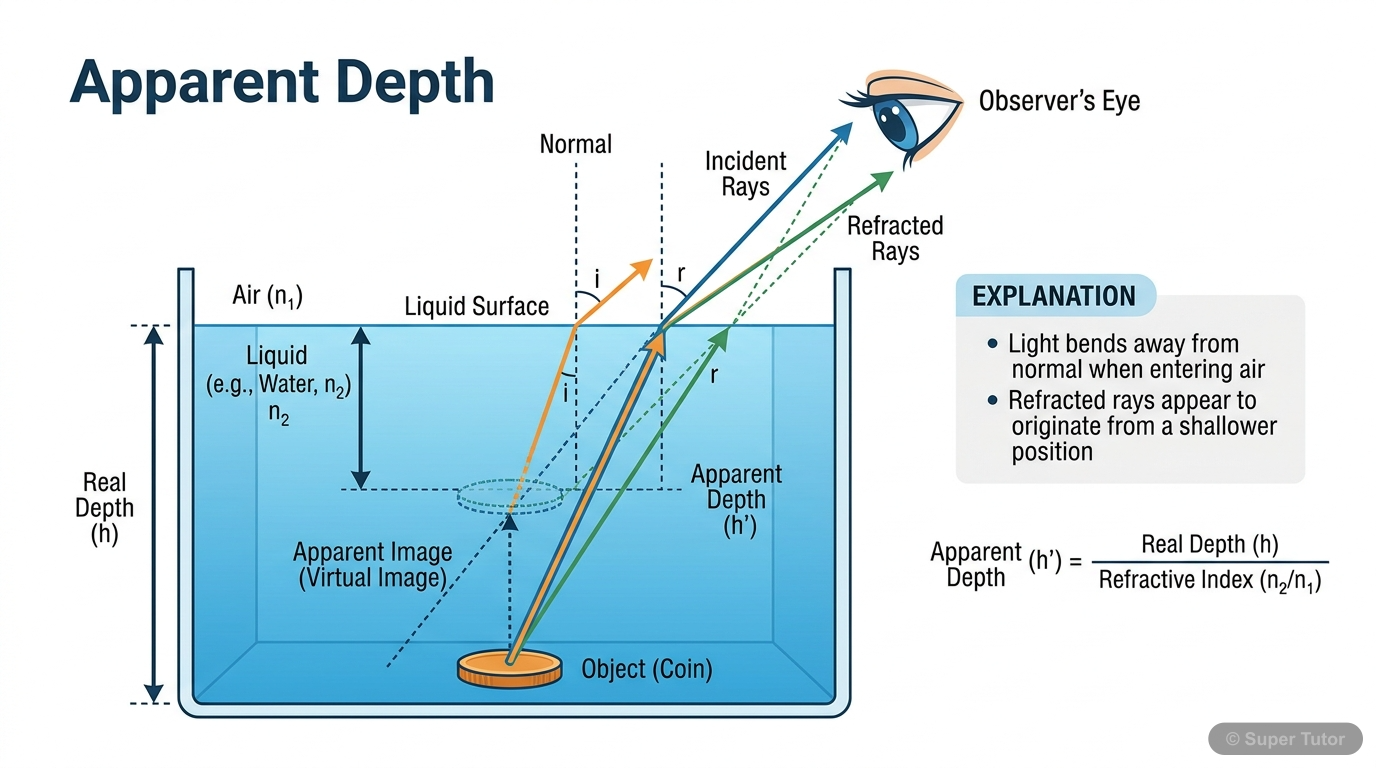
One of 27 illustrations for Ray Optics and Optical Instruments in Super Tutor — alongside flashcards, concept maps and practice questions.
State the accepted value of the speed of light in vacuum and its approximate value.
Answer
The accepted value of speed of light in vacuum is c = 2.99792458×10^8 m/s. For many purposes, c ≈ 3×10^8 m/s. It is the highest speed attainable in nature.
निर्वात में प्रकाश की गति का स्वीकृत मान और उसका लगभग मान बताइए।
Answer
निर्वात में प्रकाश की गति का स्वीकृत मान c = 2.99792458×10^8 m/s है। कई उद्देश्यों के लिए, c ≈ 3×10^8 m/s लिया जाता है। यह प्रकृति में प्राप्त की जा सकने वाली सबसे अधिक गति है।…
ज्यामितीय प्रकाशिकी में प्रकाश को किरण के रूप में क्यों माना जाता है?
Answer
प्रकाश की तरंगदैर्ध्य साधारण वस्तुओं की तुलना में बहुत छोटी होती है, इसलिए प्रकाश को किरणें कहलाने वाली सीधी रेखाओं के साथ चलता हुआ माना जा सकता है। किरणों का समूह प्रकाश का पुंज बनाता है।…
Why is light treated as a ray in geometrical optics?
Answer
The wavelength of light is very small compared to ordinary objects, so light can be treated as travelling along straight lines called rays. A bundle of rays forms a beam of light.
State the law of reflection for spherical mirrors.
Answer
The angle of reflection equals the angle of incidence. The incident ray, reflected ray, and the normal at the point of incidence lie in the same plane.
गोलीय दर्पणों के लिए परावर्तन का नियम बताइए।
Answer
परावर्तन कोण, आपतन कोण के बराबर होता है। आपतित किरण, परावर्तित किरण, और आपतन बिंदु पर अभिलंब एक ही तल में स्थित होते हैं।…
एक अवतल दर्पण की वक्रता त्रिज्या 30 cm है। उसकी फोकस दूरी ज्ञात कीजिए।
Answer
दिया है: R = 30 cm सूत्र: f = R/2 चरण 1: f = 30/2 cm चरण 2: f = 15 cm अवतल दर्पण के लिए, संकेत परिपाटी के अनुसार फोकस दूरी ऋणात्मक होती है। उत्तर: f = -15 cm…
A concave mirror has radius of curvature 30 cm. Find its focal length.
Answer
Given: R = 30 cm Formula: f = R/2 Step 1: f = 30/2 cm Step 2: f = 15 cm For a concave mirror, focal length is negative by sign convention. Answer: f = -15 cm…
+56 more flashcards
Practise AllFrequently Asked Questions
What are the important topics in Ray Optics and Optical Instruments for Madhya Pradesh Board Class 12 Physics?
How many flashcards are available for Ray Optics and Optical Instruments?
How should I revise Ray Optics and Optical Instruments for the Madhya Pradesh Board Class 12 board exam?
Sources & Official References
Content is aligned to the official syllabus. Refer to the board website for the latest curriculum.
More resources for Ray Optics and Optical Instruments
Practice Quiz
Test yourself with a quick quiz
Important Questions
Exam-style questions with answers
Revision Notes
Key points for last-minute revision
Formula Sheet
The chapter's formulas in one place
Chapter Summary
Understand the chapter at a glance
Concept Maps
See how topics connect
Study Plan
Step-by-step plan for this chapter
Syllabus
What topics to cover
NCERT Solutions
Every textbook question solved step by step
For serious students
Get the full Ray Optics and Optical Instruments chapter — start free.
Quizzes, flashcards, an AI doubt solver and a study plan for Madhya Pradesh Board Class 12 Physics. Free to start, no card needed.