Chapter 10 of 14
NCERT Solutions

Nucle — NCERT Solutions

Madhya Pradesh Board · Class 12 · Physics

NCERT Solutions for Nucle, Madhya Pradesh Board Class 12 Physics: 10 textbook questions solved step by step. Covers Exercises.

93 questions64 flashcards14 formulas & key relations5 concepts

Interactive on Super Tutor

Studying Nucle? Get the full interactive chapter.

Quizzes, flashcards, AI doubt-solver and a step-by-step study plan — built for NCERT solutions and more.

Free trial, no card needed.
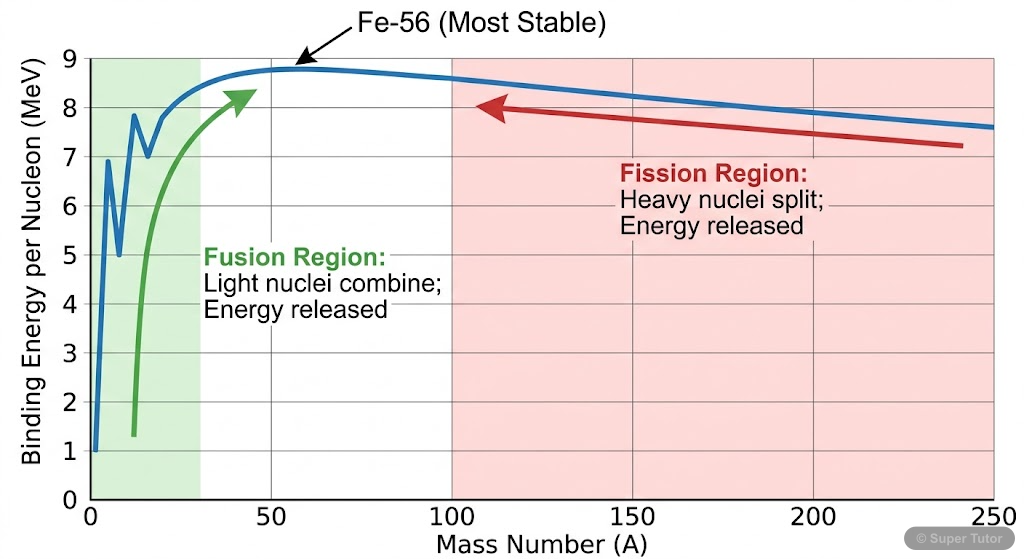
A graph showing the binding energy per nucleon as a function of mass number, highlighting regions of stability, and explaining nuclear fission and fusion processes.
Super Tutor

One of 15 illustrations for Nucle in Super Tutor — alongside flashcards, concept maps and practice questions.

10 Questions Solved · 1 Section

The first 5 solutions are open to read. The other 5 are free with a Super Tutor account.

Exercises

13.1Obtain the binding energy (in MeV) of a nitrogen nucleus (147N)\left(\frac{14}{7}\mathrm{N}\right), given m(147N)=14.00307 um\left(\frac{14}{7}\mathrm{N}\right) = 14.00307\,\mathrm{u}.Show solution

Given:

  • Z=7Z = 7 (protons), N=A−Z=14−7=7N = A - Z = 14 - 7 = 7 (neutrons)
  • m(147N)=14.00307 um\left(\frac{14}{7}\mathrm{N}\right) = 14.00307\,\mathrm{u}
  • mp=mH=1.007825 um_p = m_H = 1.007825\,\mathrm{u}, mn=1.008665 um_n = 1.008665\,\mathrm{u}

Formula:
ΔM=[Z mH+(A−Z) mn]−M\Delta M = \bigl[Z\,m_H + (A-Z)\,m_n\bigr] - M

Step 1: Calculate total mass of constituents.
Σm=7×1.007825+7×1.008665\Sigma m = 7 \times 1.007825 + 7 \times 1.008665
=7.054775+7.060655=14.115430 u= 7.054775 + 7.060655 = 14.115430\,\mathrm{u}

Step 2: Calculate mass defect.
ΔM=14.115430−14.00307=0.11236 u\Delta M = 14.115430 - 14.00307 = 0.11236\,\mathrm{u}

Step 3: Convert to energy.
ΔEb=ΔM×931.5 MeV/u\Delta E_b = \Delta M \times 931.5\,\mathrm{MeV/u}
=0.11236×931.5=104.66 MeV= 0.11236 \times 931.5 = 104.66\,\mathrm{MeV}

Binding energy of 147N\frac{14}{7}\mathrm{N} nucleus ≈104.66 MeV\approx 104.66\,\mathrm{MeV}.

13.2Obtain the binding energy of the nuclei 5626Fe\frac{56}{26}\mathrm{Fe} and 20983Bi\frac{209}{83}\mathrm{Bi} in units of MeV from the following data:
m(5626Fe)=55.934939 u,m(20983Bi)=208.980388 um\left(\frac{56}{26}\mathrm{Fe}\right) = 55.934939\,\mathrm{u}, \quad m\left(\frac{209}{83}\mathrm{Bi}\right) = 208.980388\,\mathrm{u}
Show solution

Given data: mH=1.007825 um_H = 1.007825\,\mathrm{u}, mn=1.008665 um_n = 1.008665\,\mathrm{u}, 1 u=931.5 MeV/c21\,\mathrm{u} = 931.5\,\mathrm{MeV/c^2}


For 5626Fe\frac{56}{26}\mathrm{Fe}: Z=26Z=26, A=56A=56, N=30N=30

Step 1: Total mass of constituents.
Σm=26×1.007825+30×1.008665\Sigma m = 26 \times 1.007825 + 30 \times 1.008665
=26.20345+30.25995=56.46340 u= 26.20345 + 30.25995 = 56.46340\,\mathrm{u}

Step 2: Mass defect.
ΔM=56.46340−55.934939=0.528461 u\Delta M = 56.46340 - 55.934939 = 0.528461\,\mathrm{u}

Step 3: Binding energy.
ΔEb=0.528461×931.5=492.26 MeV\Delta E_b = 0.528461 \times 931.5 = 492.26\,\mathrm{MeV}

Binding energy per nucleon =492.2656≈8.79 MeV/nucleon= \dfrac{492.26}{56} \approx 8.79\,\mathrm{MeV/nucleon}


For 20983Bi\frac{209}{83}\mathrm{Bi}: Z=83Z=83, A=209A=209, N=126N=126

Step 1: Total mass of constituents.
Σm=83×1.007825+126×1.008665\Sigma m = 83 \times 1.007825 + 126 \times 1.008665
=83.64948+127.09179=210.74127 u= 83.64948 + 127.09179 = 210.74127\,\mathrm{u}

Step 2: Mass defect.
ΔM=210.74127−208.980388=1.760882 u\Delta M = 210.74127 - 208.980388 = 1.760882\,\mathrm{u}

Step 3: Binding energy.
ΔEb=1.760882×931.5=1640.26 MeV\Delta E_b = 1.760882 \times 931.5 = 1640.26\,\mathrm{MeV}

Binding energy per nucleon =1640.26209≈7.85 MeV/nucleon= \dfrac{1640.26}{209} \approx 7.85\,\mathrm{MeV/nucleon}

13.3A given coin has a mass of 3.0 g3.0\,\mathrm{g}. Calculate the nuclear energy that would be required to separate all the neutrons and protons from each other. For simplicity assume that the coin is entirely made of 6329Cu\frac{63}{29}\mathrm{Cu} atoms (of mass 62.92960 u62.92960\,\mathrm{u}).Show solution

Given:

  • Mass of coin =3.0 g= 3.0\,\mathrm{g}
  • A=63A = 63, Z=29Z = 29, N=34N = 34
  • m(6329Cu)=62.92960 um\left(\frac{63}{29}\mathrm{Cu}\right) = 62.92960\,\mathrm{u}
  • mH=1.007825 um_H = 1.007825\,\mathrm{u}, mn=1.008665 um_n = 1.008665\,\mathrm{u}
  • NA=6.023×10²³ mol−1N_A = 6.023 \times 10^{23}\,\mathrm{mol}^{-1}

Step 1: Number of Cu atoms in the coin.
n=3.063×6.023×1023=3.0×6.023×102363n = \frac{3.0}{63} \times 6.023 \times 10^{23} = \frac{3.0 \times 6.023 \times 10^{23}}{63}
=2.868×10²² atoms= 2.868 \times 10^{22}\,\text{atoms}

Step 2: Mass defect per nucleus.
Σm=29×1.007825+34×1.008665\Sigma m = 29 \times 1.007825 + 34 \times 1.008665
=29.22693+34.29461=63.52154 u= 29.22693 + 34.29461 = 63.52154\,\mathrm{u}
ΔM=63.52154−62.92960=0.59194 u\Delta M = 63.52154 - 62.92960 = 0.59194\,\mathrm{u}

Step 3: Binding energy per nucleus.
ΔEb=0.59194×931.5=551.38 MeV\Delta E_b = 0.59194 \times 931.5 = 551.38\,\mathrm{MeV}

Step 4: Total energy for all nuclei in the coin.
Etotal=551.38×2.868×1022 MeVE_{\text{total}} = 551.38 \times 2.868 \times 10^{22}\,\mathrm{MeV}
=1.5814×1025 MeV= 1.5814 \times 10^{25}\,\mathrm{MeV}

Converting to Joules:
Etotal=1.5814×1025×1.6×10−13 JE_{\text{total}} = 1.5814 \times 10^{25} \times 1.6 \times 10^{-13}\,\mathrm{J}
Etotal≈2.53×10¹² J\boxed{E_{\text{total}} \approx 2.53 \times 10^{12}\,\mathrm{J}}

13.4Obtain approximately the ratio of the nuclear radii of the gold isotope 19779Au\frac{197}{79}\mathrm{Au} and the silver isotope 10747Ag\frac{107}{47}\mathrm{Ag}.Show solution

Given:

  • AAu=197A_{\mathrm{Au}} = 197, AAg=107A_{\mathrm{Ag}} = 107
  • Nuclear radius formula: R=R0A1/3R = R_0 A^{1/3}

Step 1: Write the ratio of radii.
RAuRAg=R0(AAu)1/3R0(AAg)1/3=(197107)1/3\frac{R_{\mathrm{Au}}}{R_{\mathrm{Ag}}} = \frac{R_0 (A_{\mathrm{Au}})^{1/3}}{R_0 (A_{\mathrm{Ag}})^{1/3}} = \left(\frac{197}{107}\right)^{1/3}

Step 2: Calculate.
197107=1.8411\frac{197}{107} = 1.8411
(1.8411)1/3≈1.2285\left(1.8411\right)^{1/3} \approx 1.2285

RAuRAg≈1.23\boxed{\frac{R_{\mathrm{Au}}}{R_{\mathrm{Ag}}} \approx 1.23}

(Note: The question states 10779Au\frac{107}{79}\mathrm{Au} in the OCR but the standard problem uses 19779Au\frac{197}{79}\mathrm{Au}; the calculation above uses A=197A=197 for gold as is standard.)

13.5The QQ value of a nuclear reaction A+b→C+dA + b \rightarrow C + d is defined by Q=[mA+mb−mC−md]c2Q = [m_A + m_b - m_C - m_d]c^2. Determine the QQ-value of the following reactions and state whether the reactions are exothermic or endothermic.
(i) 11H+13H→12H+12H{}^1_1\mathrm{H} + {}^3_1\mathrm{H} \rightarrow {}^2_1\mathrm{H} + {}^2_1\mathrm{H}
(ii) 612C+612C→1020Ne+24He{}^{12}_6\mathrm{C} + {}^{12}_6\mathrm{C} \rightarrow {}^{20}_{10}\mathrm{Ne} + {}^4_2\mathrm{He}
Show solution

Given atomic masses:

  • m(12H)=2.014102 um({}^2_1\mathrm{H}) = 2.014102\,\mathrm{u}
  • m(13H)=3.016049 um({}^3_1\mathrm{H}) = 3.016049\,\mathrm{u}
  • m(612C)=12.000000 um({}^{12}_6\mathrm{C}) = 12.000000\,\mathrm{u}
  • m(1020Ne)=19.992439 um({}^{20}_{10}\mathrm{Ne}) = 19.992439\,\mathrm{u}
  • m(24He)=4.002603 um({}^4_2\mathrm{He}) = 4.002603\,\mathrm{u}
  • m(11H)=1.007825 um({}^1_1\mathrm{H}) = 1.007825\,\mathrm{u}

Note: Since the same number of electrons appear on both sides, atomic masses can be used directly in place of nuclear masses.


(i) 11H+13H→12H+12H{}^1_1\mathrm{H} + {}^3_1\mathrm{H} \rightarrow {}^2_1\mathrm{H} + {}^2_1\mathrm{H}

Initial mass:
mi=1.007825+3.016049=4.023874 um_i = 1.007825 + 3.016049 = 4.023874\,\mathrm{u}

Final mass:
mf=2×2.014102=4.028204 um_f = 2 \times 2.014102 = 4.028204\,\mathrm{u}

Mass difference:
Δm=mi−mf=4.023874−4.028204=−0.004330 u\Delta m = m_i - m_f = 4.023874 - 4.028204 = -0.004330\,\mathrm{u}

Q-value:
Q=−0.004330×931.5=−4.034 MeVQ = -0.004330 \times 931.5 = -4.034\,\mathrm{MeV}

Since Q<0Q < 0, the reaction is endothermic.


(ii) 612C+612C→1020Ne+24He{}^{12}_6\mathrm{C} + {}^{12}_6\mathrm{C} \rightarrow {}^{20}_{10}\mathrm{Ne} + {}^4_2\mathrm{He}

Initial mass:
mi=2×12.000000=24.000000 um_i = 2 \times 12.000000 = 24.000000\,\mathrm{u}

Final mass:
mf=19.992439+4.002603=23.995042 um_f = 19.992439 + 4.002603 = 23.995042\,\mathrm{u}

Mass difference:
Δm=24.000000−23.995042=0.004958 u\Delta m = 24.000000 - 23.995042 = 0.004958\,\mathrm{u}

Q-value:
Q=0.004958×931.5=4.618 MeVQ = 0.004958 \times 931.5 = 4.618\,\mathrm{MeV}

Since Q>0Q > 0, the reaction is exothermic.

13.6Suppose, we think of fission of a 5626Fe\frac{56}{26}\mathrm{Fe} nucleus into two equal fragments 2813Al\frac{28}{13}\mathrm{Al}. Is the fission energetically possible? Argue by working out QQ of the process. Given m(5626Fe)=55.93494 um\left(\frac{56}{26}\mathrm{Fe}\right) = 55.93494\,\mathrm{u} and m(2813Al)=27.98191 um\left(\frac{28}{13}\mathrm{Al}\right) = 27.98191\,\mathrm{u}.

Free with a Super Tutor account

13.7The fission properties of 94239Pu{}^{239}_{94}\mathrm{Pu} are very similar to those of 92235U{}^{235}_{92}\mathrm{U}. The average energy released per fission is 180 MeV. How much energy, in MeV, is released if all the atoms in 1 kg of pure 94239Pu{}^{239}_{94}\mathrm{Pu} undergo fission?

Free with a Super Tutor account

13.8How long can an electric lamp of 100 W be kept glowing by fusion of 2.0 kg2.0\,\mathrm{kg} of deuterium? Take the fusion reaction as
12H+12H→23He+n+3.27 MeV{}^2_1\mathrm{H} + {}^2_1\mathrm{H} \rightarrow {}^3_2\mathrm{He} + n + 3.27\,\mathrm{MeV}

Free with a Super Tutor account

13.9Calculate the height of the potential barrier for a head on collision of two deuterons. (Hint: The height of the potential barrier is given by the Coulomb repulsion between the two deuterons when they just touch each other. Assume that they can be taken as hard spheres of radius 2.0 fm.)

Free with a Super Tutor account

13.10From the relation R=R0A1/3R = R_0 A^{1/3}, where R0R_0 is a constant and AA is the mass number of a nucleus, show that the nuclear matter density is nearly constant (i.e. independent of AA).

Free with a Super Tutor account

5 more solved questions in Nucle

They are free with a Super Tutor account, along with practice quizzes and flashcards for this chapter. Free to start, no card needed.

Frequently Asked Questions

What are the important topics in Nucle for Madhya Pradesh Board Class 12 Physics?
Key topics in Nucle include Basic structure of the nucleus, Atomic masses, isotopes, isobars, and isotones, Discovery of neutron and neutron properties, Nuclear size and density. Study these first, then practise questions on each for the Madhya Pradesh Board Class 12 board exam.
Are these NCERT Solutions for Nucle free?
The first 5 of the 10 solutions on this page are open to read. The other 5 are free with a Super Tutor account — signing up is free and needs no card.
How should I revise Nucle for the Madhya Pradesh Board Class 12 board exam?
Learn the core ideas first, then work through the 93 practice questions on Nucle. Revise definitions regularly and use flashcards for quick recall before the exam.

Sources & Official References

Content is aligned to the official syllabus. Refer to the board website for the latest curriculum.

For serious students

Get the full Nucle chapter — start free.

Quizzes, flashcards, an AI doubt solver and a study plan for Madhya Pradesh Board Class 12 Physics. Free to start, no card needed.