Nucle — Chapter Summary
Madhya Pradesh Board · Class 12 · Physics
Summary of Nucle for Madhya Pradesh Board Class 12 Physics. Part of the Madhya Pradesh Board Class 12 Physics syllabus.
Interactive on Super Tutor
Studying Nucle? Get the full interactive chapter.
Quizzes, flashcards, AI doubt-solver and a step-by-step study plan — built for chapter summary and more.
Free trial, no card needed.
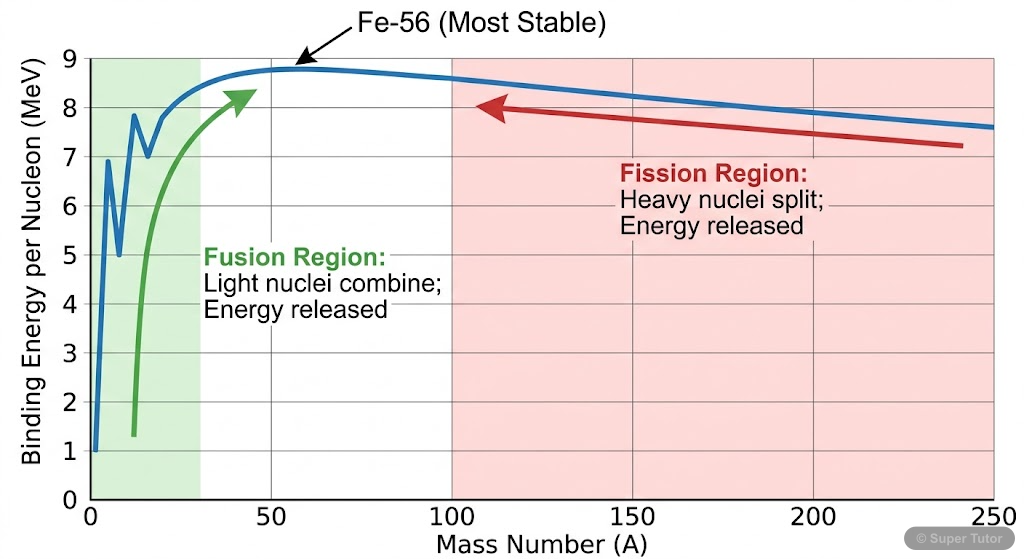
One of 15 illustrations for Nucle in Super Tutor — alongside flashcards, concept maps and practice questions.
Overview
Nuclear physics describes the structure, properties, and behavior of atomic nuclei. A nucleus is tiny compared with the atom, yet it contains more than 99.9% of the atomic mass. Important ideas in this chapter include atomic mass units, isotopes, isotobars, isotones, nuclear size, mass defect, bindi
Key Concepts
Atomic masses are measured in atomic
Atomic masses are measured in atomic mass unit, where 1u = mass of one 12C atom / 12 = 1.660539×10^-27 kg. This unit is convenient because atomic mass
The proton is the nucleus
The proton is the nucleus of the lightest hydrogen atom, which has a relative abundance of 99.985%. It carries one unit of fundamental charge and is s
The neutron is a neutral particle
The neutron is a neutral particle present in nuclei along with protons. Its mass is 1.00866 u = 1.6749×10^-27 kg. A free neutron is unstable and decay
The mass number is given by
The mass number is given by A = Z + N, where Z is the number of protons and N is the number of neutrons.
Isotopes have the same atomic number
Isotopes have the same atomic number Z but different mass number or neutron number. Isobars have the same mass number A. Isotones have the same neutro
Learning Objectives
- Understand the composition of the nucleus in terms of protons and neutrons
- Use atomic mass unit and mass number relations correctly
- Distinguish between isotopes, isobars, and isotones
- Explain nuclear size and constant nuclear density
- Calculate mass defect, binding energy, and binding energy per nucleon
Frequently Asked Questions
What are the important topics in Nucle for Madhya Pradesh Board Class 12 Physics?
How should I revise Nucle for the Madhya Pradesh Board Class 12 board exam?
Sources & Official References
Content is aligned to the official syllabus. Refer to the board website for the latest curriculum.
More resources for Nucle
Practice Quiz
Test yourself with a quick quiz
Important Questions
Exam-style questions with answers
Revision Notes
Key points for last-minute revision
Formula Sheet
The chapter's formulas in one place
Concept Maps
See how topics connect
Study Plan
Step-by-step plan for this chapter
Flashcards
Quick-fire cards for active recall
Syllabus
What topics to cover
NCERT Solutions
Every textbook question solved step by step
For serious students
Get the full Nucle chapter — start free.
Quizzes, flashcards, an AI doubt solver and a study plan for Madhya Pradesh Board Class 12 Physics. Free to start, no card needed.