Alternating Current — Chapter Summary
Madhya Pradesh Board · Class 12 · Physics
Summary of Alternating Current for Madhya Pradesh Board Class 12 Physics. Part of the Madhya Pradesh Board Class 12 Physics syllabus.
Interactive on Super Tutor
Studying Alternating Current? Get the full interactive chapter.
Quizzes, flashcards, AI doubt-solver and a step-by-step study plan — built for chapter summary and more.
Free trial, no card needed.
Learn better with visuals Super Tutor pairs illustrations like this with notes and quizzes for Alternating Current.
Overview
Alternating current is electric current that changes with time, usually in sinusoidal form. The chapter builds the idea of rms values, phase difference, reactance, impedance, resonance, power factor, and transformers. These ideas explain why ac is preferred for power transmission and how ac circuits
Key Concepts
An alternating voltage varies sinusoidally
An alternating voltage varies sinusoidally with time as v = v_m sin ωt. The current driven by it also varies with time and reverses direction periodic
The rms current and voltage
The rms current and voltage are the effective values used for power calculations. I = i_m/√2 = 0.707 i_m and V = v_m/√2 = 0.707 v_m. A 220 V household
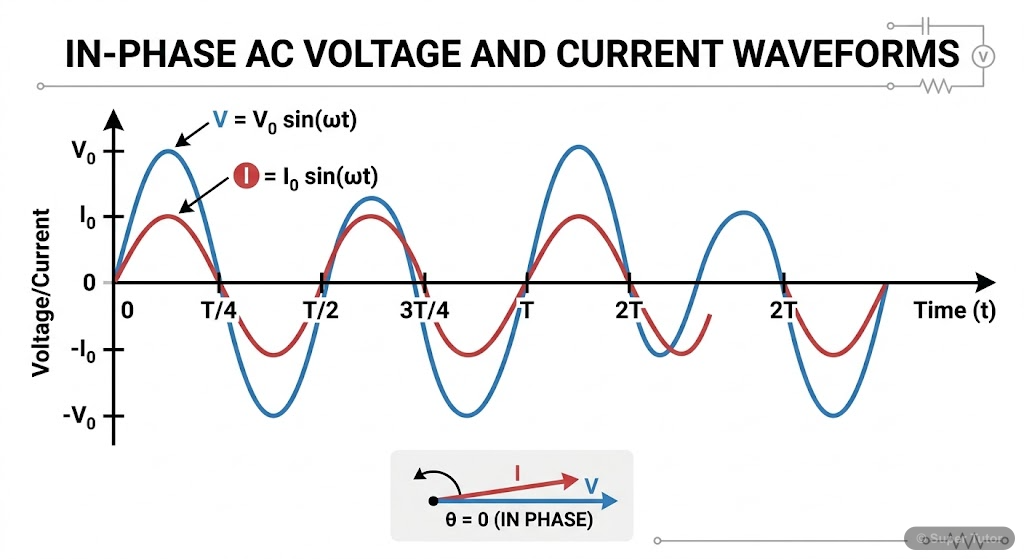
For a pure resistor
For a pure resistor, current is in phase with voltage. The current is i = i_m sin ωt, with i_m = v_m/R. The average power is P = I^2R = VI.
In a pure inductor
In a pure inductor, current lags voltage by π/2. The current is i = i_m sin(ωt − π/2), and i_m = v_m/X_L where X_L = ωL. Inductive reactance increases
In a pure capacitor
In a pure capacitor, current leads voltage by π/2. The current is i = i_m sin(ωt + π/2), and i_m = v_m/X_C where X_C = 1/ωC. Capacitive reactance decr
Learning Objectives
- Understand the meaning of alternating voltage and alternating current
- Relate peak values and rms values of ac quantities
- Explain current and voltage relation in resistor, inductor, and capacitor circuits
- Define inductive reactance, capacitive reactance, impedance, and power factor
- Describe series LCR circuits and the condition of resonance
Frequently Asked Questions
What are the important topics in Alternating Current for Madhya Pradesh Board Class 12 Physics?
How should I revise Alternating Current for the Madhya Pradesh Board Class 12 board exam?
Sources & Official References
Content is aligned to the official syllabus. Refer to the board website for the latest curriculum.
More resources for Alternating Current
Practice Quiz
Test yourself with a quick quiz
Important Questions
Exam-style questions with answers
Revision Notes
Key points for last-minute revision
Formula Sheet
The chapter's formulas in one place
Concept Maps
See how topics connect
Study Plan
Step-by-step plan for this chapter
Flashcards
Quick-fire cards for active recall
Syllabus
What topics to cover
NCERT Solutions
Every textbook question solved step by step
For serious students
Get the full Alternating Current chapter — start free.
Quizzes, flashcards, an AI doubt solver and a study plan for Madhya Pradesh Board Class 12 Physics. Free to start, no card needed.