The crisis of democratic order — Chapter Summary
Madhya Pradesh Board · Class 12 · Political Science
Summary of The crisis of democratic order for Madhya Pradesh Board Class 12 Political Science. The period around 1974-1977 marked a major crisis in Indian.
Interactive on Super Tutor
Studying The crisis of democratic order? Get the full interactive chapter.
Quizzes, flashcards, AI doubt-solver and a step-by-step study plan — built for chapter summary and more.
Free trial, no card needed.
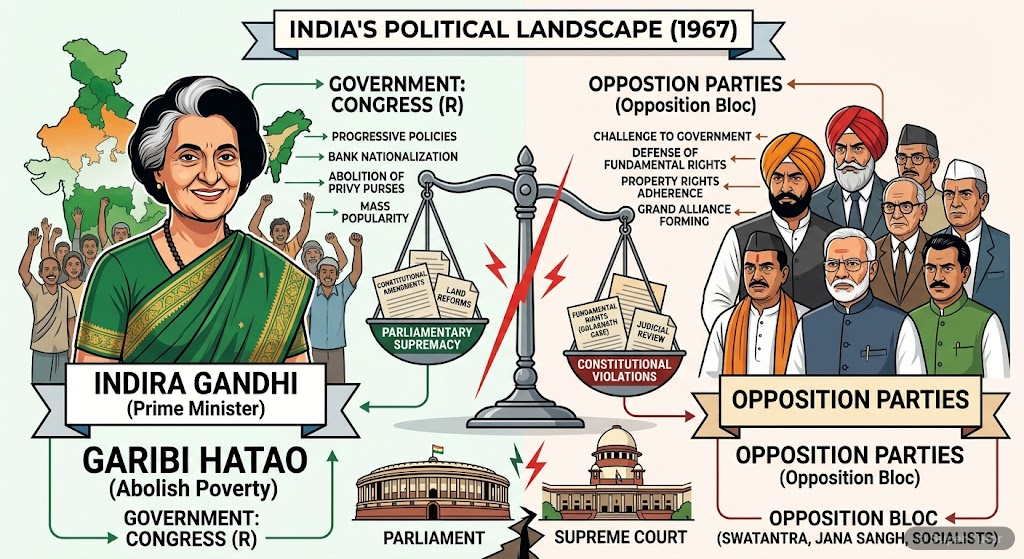
Learn better with visuals Super Tutor pairs illustrations like this with notes and quizzes for The crisis of democratic order.
Overview
The period around 1974-1977 marked a major crisis in Indian democracy. Economic hardship, student unrest, labour strikes, conflict between the government and the judiciary, and growing opposition to Indira Gandhi’s leadership created a tense political atmosphere. The Emergency declared on 25 June 19
Key Concepts
Inflation
Inflation, unemployment, and food shortage created public dissatisfaction. Prices rose by 23 per cent in 1973 and 30 per cent in 1974, while food grai
Students in Gujarat and Bihar led
Students in Gujarat and Bihar led protest movements against rising prices, corruption, unemployment, and poor governance. These movements gained wider
Jayaprakash Narayan became the central figure
Jayaprakash Narayan became the central figure of the Bihar movement. He called for total revolution in social, economic, and political life and became
The government and the judiciary clashed
The government and the judiciary clashed over constitutional interpretation. The Kesavananda Bharati Case established that Parliament could not alter
On 25 June 1975
On 25 June 1975, Indira Gandhi recommended Emergency to President Fakhruddin Ali Ahmed, who issued the proclamation immediately. It was declared under
Learning Objectives
- Understand the political and economic background that led to the Emergency.
- Identify the major protest movements in Gujarat, Bihar, and the railway strike of 1974.
- Explain the conflict between the executive and the judiciary before the Emergency.
- Describe how Emergency was declared and what powers were used during it.
- Recognise the effects of censorship, preventive detention, and suspension of Fundamental Rights.
Frequently Asked Questions
What are the important topics in The crisis of democratic order for Madhya Pradesh Board Class 12 Political Science?
How should I revise The crisis of democratic order for the Madhya Pradesh Board Class 12 board exam?
Sources & Official References
Content is aligned to the official syllabus. Refer to the board website for the latest curriculum.
More resources for The crisis of democratic order
Practice Quiz
Test yourself with a quick quiz
Important Questions
Exam-style questions with answers
Revision Notes
Key points for last-minute revision
Concept Maps
See how topics connect
Study Plan
Step-by-step plan for this chapter
Flashcards
Quick-fire cards for active recall
Syllabus
What topics to cover
NCERT Solutions
Every textbook question solved step by step
For serious students
Get the full The crisis of democratic order chapter — start free.
Quizzes, flashcards, an AI doubt solver and a study plan for Madhya Pradesh Board Class 12 Political Science. Free to start, no card needed.