The crisis of democratic order — NCERT Solutions
Madhya Pradesh Board · Class 12 · Political Science
NCERT Solutions for The crisis of democratic order, Madhya Pradesh Board Class 12 Political Science: 10 textbook questions solved step by step.
Interactive on Super Tutor
Studying The crisis of democratic order? Get the full interactive chapter.
Quizzes, flashcards, AI doubt-solver and a step-by-step study plan — built for NCERT solutions and more.
Free trial, no card needed.
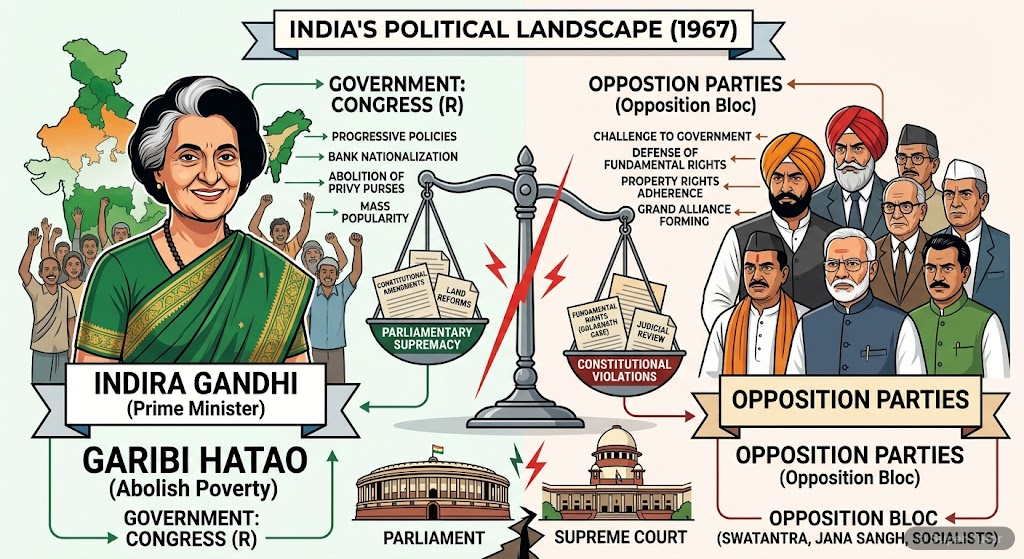
Learn better with visuals Super Tutor pairs illustrations like this with notes and quizzes for The crisis of democratic order.
The first 5 solutions are open to read. The other 5 are free with a Super Tutor account.
Exercise Questions
1State whether the following statements regarding the Emergency are correct or incorrect.
(a) It was declared in 1975 by Indira Gandhi.
(b) It led to the suspension of all fundamental rights.
(c) It was proclaimed due to the deteriorating economic conditions.
(d) Many Opposition leaders were arrested during the emergency.
(e) CPI supported the proclamation of the Emergency.Show solution
(a) Correct. The National Emergency was declared on 25 June 1975 by Prime Minister Indira Gandhi on the advice of the Cabinet, and was proclaimed by President Fakhruddin Ali Ahmed under Article 352 of the Constitution.
(b) Incorrect. The Emergency led to the suspension of most Fundamental Rights, but not all. Article 20 (protection against arbitrary conviction) and Article 21 (right to life and personal liberty) were initially retained, though the 44th Amendment later made them non-suspendable. In practice, however, even these rights were severely curtailed during the Emergency.
(c) Incorrect. The official reason given by the government for declaring the Emergency was internal disturbance and threat to the security of India. The Allahabad High Court verdict against Indira Gandhi and the political agitation led by Jayaprakash Narayan were the actual triggers, not deteriorating economic conditions.
(d) Correct. Immediately after the proclamation of Emergency, thousands of Opposition leaders and activists — including Jayaprakash Narayan, Morarji Desai, L.K. Advani, Atal Bihari Vajpayee, and others — were arrested under the Maintenance of Internal Security Act (MISA) and the Defence of India Rules (DIR).
(e) Correct. The Communist Party of India (CPI) supported the proclamation of Emergency, describing it as a necessary step to protect the country from reactionary and fascist forces. It was one of the few political parties that backed Indira Gandhi's decision.
2Find the odd one out in the context of proclamation of Emergency:
(a) The call for 'Total Revolution'
(b) The Railway Strike of 1974
(c) The Naxalite Movement
(d) The Allahabad High Court verdict
(e) The findings of the Shah Commission ReportShow solution
Odd one out: (e) The findings of the Shah Commission Report.
Reason: Options (a), (b), (c), and (d) were all events or developments that occurred before the proclamation of Emergency in June 1975 and are cited as factors that led to or provided the context for the Emergency. In contrast, the Shah Commission was appointed after the Emergency, in 1977, by the Janata Party Government to investigate the excesses committed during the Emergency. Therefore, it is the odd one out as it is a consequence/inquiry related to the Emergency, not a cause of it.
3Match the following:
(a) Total Revolution
(b) Garibi hatao
(c) Students' Protest
(d) Railway Strike
i. Indira Gandhi
ii. Jayaprakash Narayan
iii. Bihar Movement
iv. George FernandesShow solution
The correct matching is:
| Term | Leader/Event |
|---|---|
| (a) Total Revolution | (ii) Jayaprakash Narayan |
| (b) Garibi hatao | (i) Indira Gandhi |
| (c) Students' Protest | (iii) Bihar Movement |
| (d) Railway Strike | (iv) George Fernandes |
Explanation:
- (a) Total Revolution — Jayaprakash Narayan (JP): JP gave the call for 'Sampoorna Kranti' (Total Revolution) in 1974–75, urging a fundamental transformation of Indian society, economy, and polity.
- (b) Garibi hatao — Indira Gandhi: 'Garibi hatao' (Remove Poverty) was Indira Gandhi's famous slogan during the 1971 general elections, which helped her win a massive mandate.
- (c) Students' Protest — Bihar Movement: The students' agitation in Bihar in 1974 against corruption and misgovernance became the Bihar Movement, which later merged with JP's Total Revolution movement.
- (d) Railway Strike — George Fernandes: The historic nationwide Railway Strike of 1974 was led by George Fernandes, then the leader of the railway workers' union. The government crushed the strike with a heavy hand.
4What were the reasons which led to the mid-term elections in 1980?Show solution
Given: After the 1977 elections, the Janata Party came to power. However, mid-term elections were held in January 1980.
Reasons for mid-term elections in 1980:
- Internal conflicts within the Janata Party: The Janata Party was a coalition of diverse political groups — the Congress (O), Jana Sangh, Bharatiya Lok Dal, Socialists, and others — who had united only to defeat Indira Gandhi. Once in power, they were divided by ideological differences and personal rivalries.
- Issue of 'Dual Membership': A major controversy arose over the dual membership of Jana Sangh leaders in the Rashtriya Swayamsevak Sangh (RSS). The Socialists and Charan Singh's faction demanded that Jana Sangh members give up their RSS membership, which they refused. This deepened the rift.
- Leadership crisis: There was no consensus on leadership. Morarji Desai was the Prime Minister, but Charan Singh and Jagjivan Ram were also powerful claimants. This led to constant infighting.
- Collapse of the government: Charan Singh, with the support of the Congress (I), withdrew support from the Morarji Desai government, causing it to fall. Charan Singh became Prime Minister but could not prove majority in the Lok Sabha. He resigned without facing a confidence vote, and fresh elections were called.
- Failure of governance: The Janata government failed to provide stable and effective governance. It was seen as more focused on persecuting Indira Gandhi (through the Shah Commission) than on addressing people's problems.
Result: In the January 1980 mid-term elections, the Congress (I) under Indira Gandhi won a landslide victory, winning 353 seats out of 542.
5The Shah Commission was appointed in 1977 by the Janata Party Government. Why was it appointed and what were its findings?Show solution
Why was the Shah Commission appointed?
After the Emergency ended and the Janata Party came to power in 1977, there was widespread demand for an inquiry into the excesses and abuses of power committed during the Emergency period (1975–77). The Janata Government appointed the Shah Commission of Inquiry in May 1977, headed by Justice J.C. Shah (former Chief Justice of India), to:
- Inquire into the circumstances and reasons for the proclamation of Emergency.
- Investigate the excesses, abuses of authority, and malpractices committed during the Emergency.
Findings of the Shah Commission:
- Arbitrary arrests: The Commission found that a large number of people — political leaders, activists, journalists, and ordinary citizens — were arrested arbitrarily without proper legal basis under MISA and DIR.
- Suspension of civil liberties: Fundamental Rights were suspended and citizens had no recourse to courts. Habeas corpus petitions were not entertained.
- Censorship of the press: The media was subjected to strict censorship. Newspapers were not allowed to publish anything critical of the government. Some newspapers were even shut down.
- Forced sterilisation: The Commission found evidence of coercive family planning measures, particularly forced sterilisations, especially in Uttar Pradesh and other states. This caused great public resentment.
- Demolition drives: Slums were demolished in Delhi and other cities, displacing thousands of poor people, often without adequate notice or rehabilitation.
- Misuse of government machinery: The police, bureaucracy, and intelligence agencies were misused to serve the political interests of the ruling party rather than the public.
- Role of Sanjay Gandhi: The Commission noted that Sanjay Gandhi, who held no official position, wielded enormous extra-constitutional authority and was responsible for many excesses.
Significance: The Shah Commission's report is an important document that provides a detailed account of how democratic institutions and civil liberties were undermined during the Emergency.
Free with a Super Tutor account
Free with a Super Tutor account
- Effects on civil liberties for citizens.
- Impact on relationship between the Executive and Judiciary
- Functioning of Mass Media
- Working of the Police and Bureaucracy.
Free with a Super Tutor account
Free with a Super Tutor account
"Indian democracy was never so close to a two-party system as it was during the 1977 elections. However, the next few years saw a complete change. Soon after its defeat, the Indian National Congress split into two groups... The Janata Party also went through major convulsions..."
— David Butler, Ashok Lahiri and Prannoy Roy (quoted by Partha Chatterjee)
(a) What made the party system in India look like a two-party system in 1977?
(b) Many more than two parties existed in 1977. Why then are the authors describing this period as close to a two-party system?
(c) What caused splits in Congress and the Janata parties?
Free with a Super Tutor account
5 more solved questions in The crisis of democratic order
They are free with a Super Tutor account, along with practice quizzes and flashcards for this chapter. Free to start, no card needed.
Frequently Asked Questions
What are the important topics in The crisis of democratic order for Madhya Pradesh Board Class 12 Political Science?
Are these NCERT Solutions for The crisis of democratic order free?
How should I revise The crisis of democratic order for the Madhya Pradesh Board Class 12 board exam?
Sources & Official References
Content is aligned to the official syllabus. Refer to the board website for the latest curriculum.
More resources for The crisis of democratic order
Practice Quiz
Test yourself with a quick quiz
Important Questions
Exam-style questions with answers
Revision Notes
Key points for last-minute revision
Chapter Summary
Understand the chapter at a glance
Concept Maps
See how topics connect
Study Plan
Step-by-step plan for this chapter
Flashcards
Quick-fire cards for active recall
Syllabus
What topics to cover
For serious students
Get the full The crisis of democratic order chapter — start free.
Quizzes, flashcards, an AI doubt solver and a study plan for Madhya Pradesh Board Class 12 Political Science. Free to start, no card needed.