Social Influence and Group Processes — Chapter Summary
Madhya Pradesh Board · Class 12 · Psychology
Summary of Social Influence and Group Processes for Madhya Pradesh Board Class 12 Psychology. Social influence is visible in everyday life through family.
Interactive on Super Tutor
Studying Social Influence and Group Processes? Get the full interactive chapter.
Quizzes, flashcards, AI doubt-solver and a step-by-step study plan — built for chapter summary and more.
Free trial, no card needed.
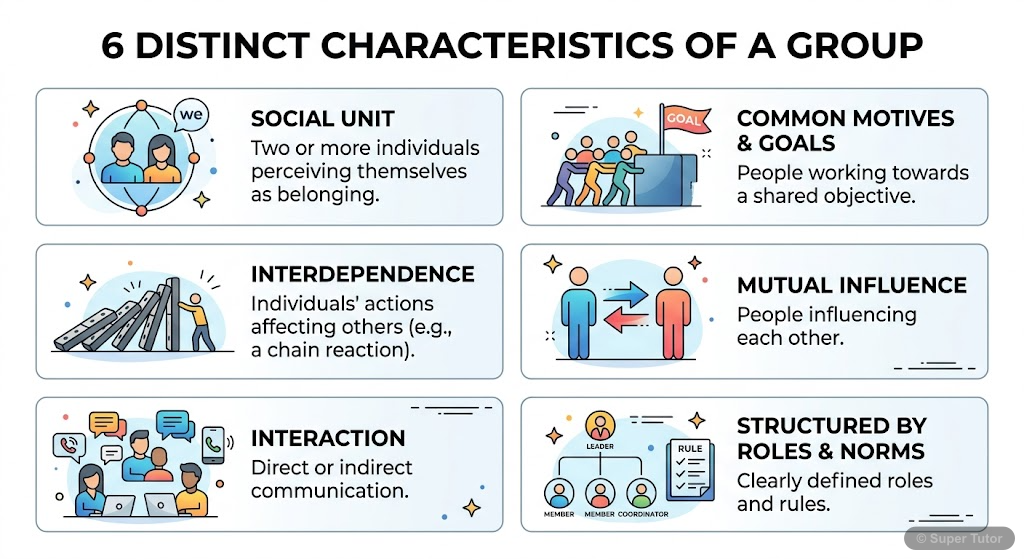
Learn better with visuals Super Tutor pairs illustrations like this with notes and quizzes for Social Influence and Group Processes.
Overview
Social influence is visible in everyday life through family, class, friends, and other associations. A group is an organised system of two or more individuals who interact, depend on one another, share common motives, and follow roles and norms. Groups shape behaviour, support growth, and influence
Key Concepts
A group is an organised system
A group is an organised system of two or more individuals who interact and are interdependent, have common motives, have role relationships, and follo
A crowd has no structure
A crowd has no structure, no belongingness, and no interdependence among members. An audience is usually passive and may sometimes turn into a mob. Mo
A team is a special kind
A team is a special kind of group in which members have complementary skills, share a common goal, and hold themselves mutually responsible. In groups
People join groups for security
People join groups for security, status, self-esteem, satisfaction of psychological and social needs, goal achievement, and knowledge and information.
Group formation is facilitated by proximity
Group formation is facilitated by proximity, similarity, and common motives and goals. Repeated contact and shared interests help people form groups.
Learning Objectives
- Understand the meaning and nature of a group
- Distinguish groups from crowds, audiences, and teams
- Explain why people join groups
- Describe the conditions and stages of group formation
- Identify the main elements of group structure
Frequently Asked Questions
What are the important topics in Social Influence and Group Processes for Madhya Pradesh Board Class 12 Psychology?
How should I revise Social Influence and Group Processes for the Madhya Pradesh Board Class 12 board exam?
Sources & Official References
Content is aligned to the official syllabus. Refer to the board website for the latest curriculum.
More resources for Social Influence and Group Processes
Practice Quiz
Test yourself with a quick quiz
Important Questions
Exam-style questions with answers
Revision Notes
Key points for last-minute revision
Concept Maps
See how topics connect
Study Plan
Step-by-step plan for this chapter
Flashcards
Quick-fire cards for active recall
Syllabus
What topics to cover
NCERT Solutions
Every textbook question solved step by step
For serious students
Get the full Social Influence and Group Processes chapter — start free.
Quizzes, flashcards, an AI doubt solver and a study plan for Madhya Pradesh Board Class 12 Psychology. Free to start, no card needed.