Psychological Disorders — Chapter Summary
Madhya Pradesh Board · Class 12 · Psychology
Summary of Psychological Disorders for Madhya Pradesh Board Class 12 Psychology. Part of the Madhya Pradesh Board Class 12 Psychology syllabus.
Interactive on Super Tutor
Studying Psychological Disorders? Get the full interactive chapter.
Quizzes, flashcards, AI doubt-solver and a step-by-step study plan — built for chapter summary and more.
Free trial, no card needed.
One of 11 illustrations for Psychological Disorders in Super Tutor — alongside flashcards, concept maps and practice questions.
Overview
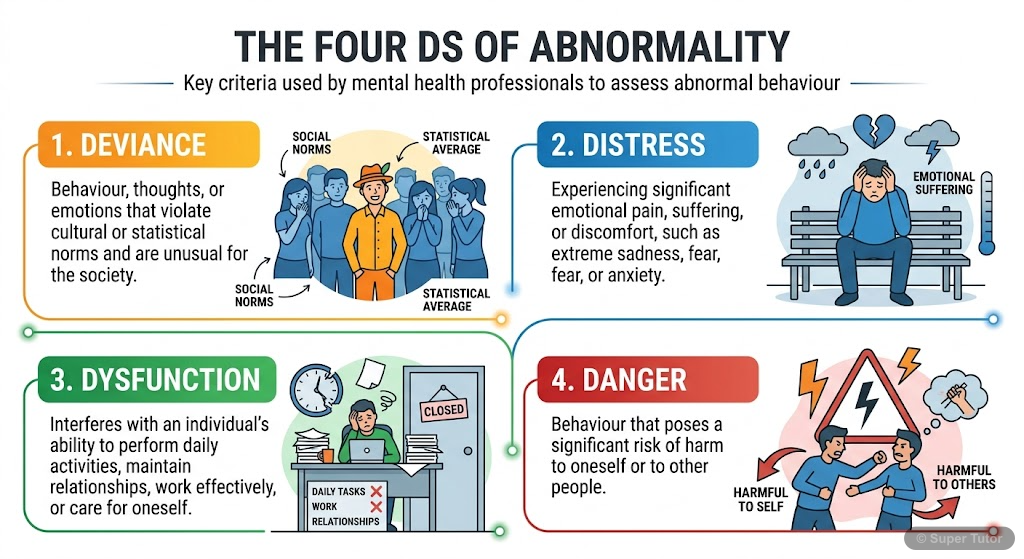
Psychological disorders are patterns of behaviour, thought, and emotion that are deviant, distressing, dysfunctional, and sometimes dangerous. Abnormal Psychology focuses on maladaptive behaviour, its causes, consequences, and treatment. The study of psychological disorders has intrigued cultures fo
Key Concepts
Abnormal behaviour is usually identified through
Abnormal behaviour is usually identified through deviance, distress, dysfunction, and danger. These features help describe behaviour that is far from
One way of judging abnormality
One way of judging abnormality is by comparing behaviour with a society's accepted rules and expectations. Behaviour that breaks these norms may be ca
A behaviour is abnormal if it
A behaviour is abnormal if it interferes with a person's well-being, growth, and ability to cope effectively with life demands.
Abnormal behaviour has been explained through
Abnormal behaviour has been explained through supernatural forces, biological or organic causes, and psychological causes. Ancient Greek thinkers emph
Galen linked four humours
Galen linked four humours—blood, black bile, yellow bile, and phlegm—to temperament and disorder through imbalance. The Indian idea of three doshas, v
Learning Objectives
- Understand the meaning of abnormal behaviour and the four Ds: deviance, distress, dysfunction, and danger
- Distinguish between deviation from social norms and maladaptive behaviour
- Trace the historical views of abnormal behaviour from supernatural explanations to modern approaches
- Explain the main biological, psychological, and socio-cultural factors underlying abnormal behaviour
- Describe how psychological disorders are classified using DSM-5 and ICD-10
Frequently Asked Questions
What are the important topics in Psychological Disorders for Madhya Pradesh Board Class 12 Psychology?
How should I revise Psychological Disorders for the Madhya Pradesh Board Class 12 board exam?
Sources & Official References
Content is aligned to the official syllabus. Refer to the board website for the latest curriculum.
More resources for Psychological Disorders
Practice Quiz
Test yourself with a quick quiz
Important Questions
Exam-style questions with answers
Revision Notes
Key points for last-minute revision
Concept Maps
See how topics connect
Study Plan
Step-by-step plan for this chapter
Flashcards
Quick-fire cards for active recall
Syllabus
What topics to cover
NCERT Solutions
Every textbook question solved step by step
For serious students
Get the full Psychological Disorders chapter — start free.
Quizzes, flashcards, an AI doubt solver and a study plan for Madhya Pradesh Board Class 12 Psychology. Free to start, no card needed.