Food and Its Nutrients — Practice Quiz
NIOS · Class 10 · Home Science
Try a 4-question quiz on Food and Its Nutrients for NIOS Class 10 Home Science: tap an answer to check it and see why.
Interactive on Super Tutor
Studying Food and Its Nutrients? Get the full interactive chapter.
Quizzes, flashcards, AI doubt-solver and a step-by-step study plan — built for practice quiz and more.
Free trial, no card needed.
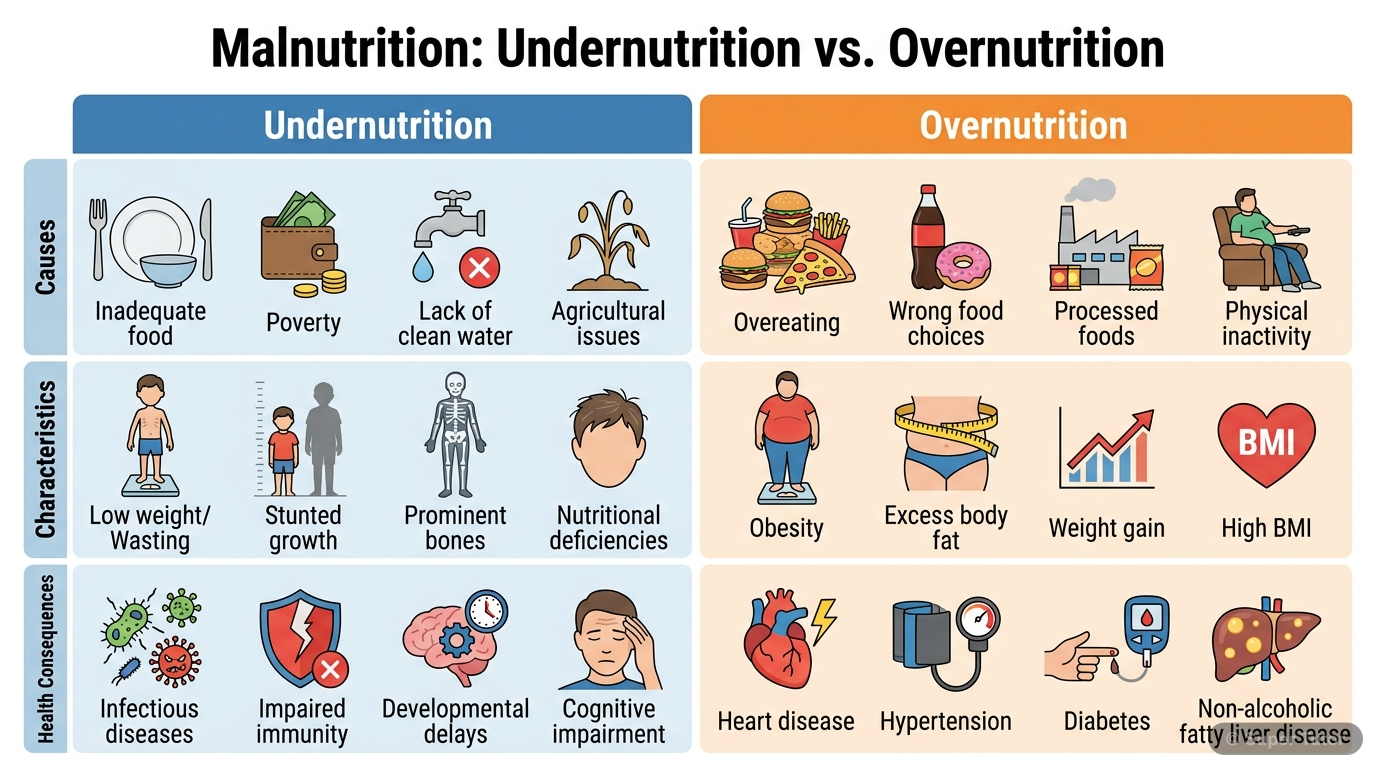
Learn better with visuals Super Tutor pairs illustrations like this with notes and quizzes for Food and Its Nutrients.
Quick Quiz: Food and Its Nutrients
0/4Tap an answer to check it instantly. No sign-up needed for these 4.
An adult weighing 65 kg requires protein at the rate of 1g per kg of body weight per day. If one gram of protein provides 4 kcal, how many kilocalories does this adult get from protein alone per day?
Kavya eats polished white rice daily and avoids whole grains. Over time she develops sore mouth, sore tongue and cuts at the corners of her mouth. Which nutrient deficiency is MOST likely responsible for these symptoms?
Which of the following correctly explains why fat-soluble vitamins are different from water-soluble vitamins in terms of storage and toxicity risk?
Iodized salt is recommended to prevent Iodine Deficiency Disorders (IDD). However, if iodized salt is stored in open containers and added to food at the beginning of cooking, the effectiveness is greatly reduced. What is the BEST reason for this?
Sample Questions
A child below 5 years shows a pot-like distended belly, swollen face, thin limbs, and general weakness. The child's calorie intake from carbohydrates is adequate. Which specific condition is this child MOST likely suffering from?
Show answer
Kwashiorkor
Step 1: Analyze the key clue. The child has an adequate calorie intake from carbohydrates but shows severe deficiency symptoms. This means the deficiency is specifically of protein, not of total energy. Step 2: Match with PEM types. Kwashiorkor occurs when protein intake is deficient but calorie intake from carbohydrates is adequate. The characteristic sign is a pot-like or distended belly (edema in the abdomen). Step 3: Distinguish from Marasmus. Marasmus occurs when BOTH protein and total energy are severely deficient. These children appear extremely thin and wasted, not edematous. Step 4: E
Which of the following statements CORRECTLY describes the role of haemoglobin and explains why iron deficiency leads to fatigue?
Show answer
Haemoglobin carries oxygen to cells; iron deficiency reduces haemoglobin, so cells receive less oxygen, causing fatigue.
Step 1: Understand haemoglobin. Haemoglobin is the red pigment found in red blood cells. Its primary function is to carry oxygen from the lungs to all cells of the body. Step 2: Role of iron. Iron is a critical component of the haemoglobin molecule. Without adequate iron, the body cannot produce enough haemoglobin. Step 3: Effect of iron deficiency. When haemoglobin levels drop (anaemia), cells receive less oxygen. Without oxygen, cells cannot produce energy efficiently. Step 4: Result. This reduced energy production at the cellular level leads to constant fatigue, weakness, and an inability t
One gram of fat provides 9 kcal of energy. If an adult consumes 30 grams of fat per day (the recommended amount), how many kilocalories does fat contribute to their daily energy intake?
Show answer
270 kcal
Step 1: Recall the energy value of fat. One gram of fat provides 9 kcal of energy. Step 2: Apply the formula. Energy from fat = grams of fat × 9 kcal/g = 30 × 9 = 270 kcal. Step 3: Compare with carbohydrates and proteins. Both carbohydrates and proteins give only 4 kcal per gram, making fat the most concentrated source of energy. Step 4: Why other options are wrong. 120 kcal = 30 × 4 (wrong factor – that is carbohydrate/protein value). 300 kcal = 30 × 10 (incorrect energy value). 180 kcal = 30 × 6 (no nutrient provides 6 kcal/g). Always use 9 kcal/g for fat.
Vitamin D is called the 'sunshine vitamin'. Which of the following BEST explains the biochemical significance of this name and its relationship with calcium?
Show answer
The skin synthesizes Vitamin D when exposed to sunlight, and Vitamin D works with calcium and phosphorus to build strong bones and teeth.
Step 1: Understand vitamin D synthesis. When ultraviolet (UV) rays from sunlight fall on the skin, a chemical reaction converts a precursor compound in the skin into Vitamin D. This is why it is called the 'sunshine vitamin'. Step 2: Role of Vitamin D. Vitamin D is essential for the absorption of calcium and phosphorus from food in the intestines. Without adequate Vitamin D, calcium cannot be properly absorbed even if diet contains sufficient calcium. Step 3: Combined effect on bones. Working together, Vitamin D, calcium, and phosphorus ensure bones and teeth remain strong and dense. Step 4: D
+41 more questions on Food and Its Nutrients (NIOS Class 10 Home Science)
Practise AllFrequently Asked Questions
What are the important topics in Food and Its Nutrients for NIOS Class 10 Home Science?
How many practice questions are there for Food and Its Nutrients?
Sources & Official References
Content is aligned to the official syllabus. Refer to the board website for the latest curriculum.
More resources for Food and Its Nutrients
Important Questions
Exam-style questions with answers
Revision Notes
Key points for last-minute revision
Formula Sheet
The chapter's formulas in one place
Chapter Summary
Understand the chapter at a glance
Concept Maps
See how topics connect
Study Plan
Step-by-step plan for this chapter
Flashcards
Quick-fire cards for active recall
Syllabus
What topics to cover
For serious students
Get the full Food and Its Nutrients chapter — start free.
Quizzes, flashcards, an AI doubt solver and a study plan for NIOS Class 10 Home Science. Free to start, no card needed.