Concurrent Lines — Chapter Summary
NIOS · Class 10 · Maths
Summary of Concurrent Lines for NIOS Class 10 Maths. Key concepts: Three or more lines that meet, A triangle has three angle and A triangle has three.
Interactive on Super Tutor
Studying Concurrent Lines? Get the full interactive chapter.
Quizzes, flashcards, AI doubt-solver and a step-by-step study plan — built for chapter summary and more.
Free trial, no card needed.
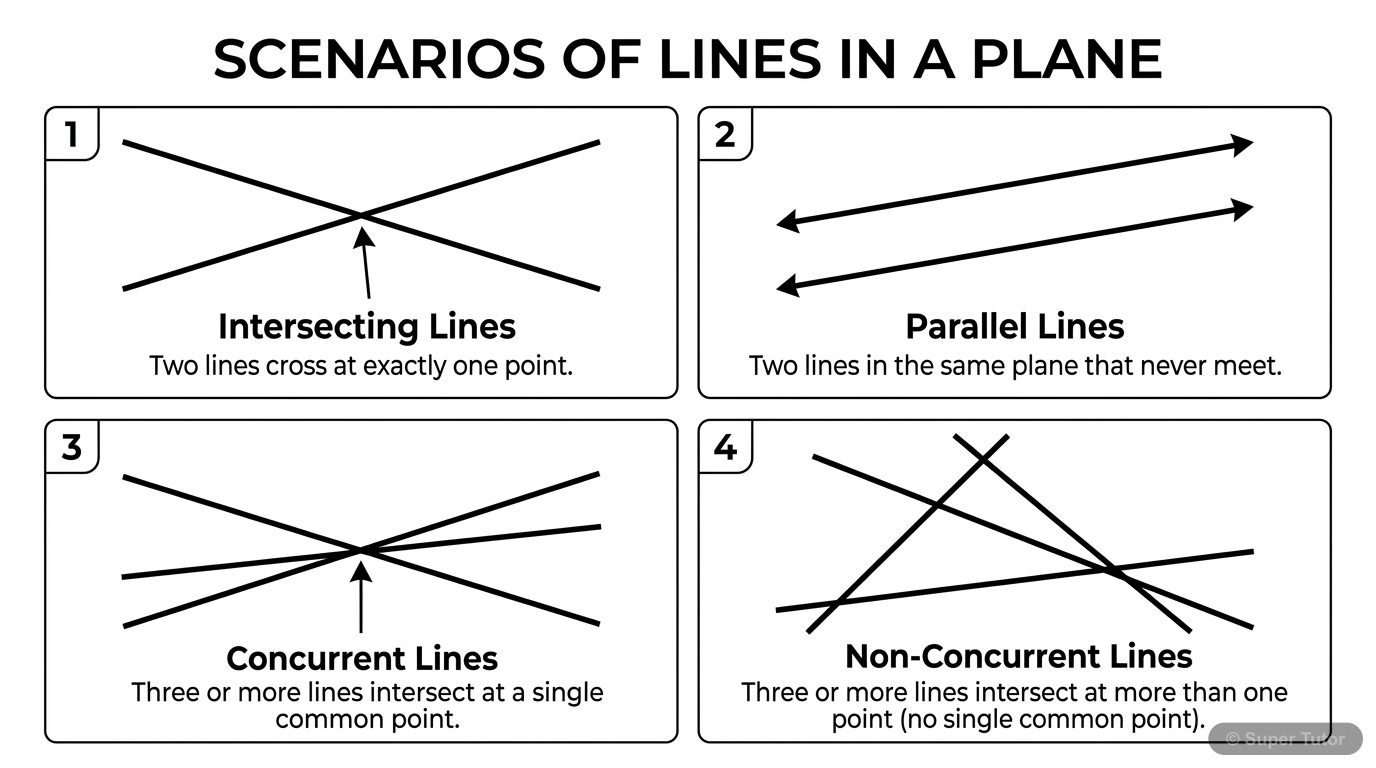
Learn better with visuals Super Tutor pairs illustrations like this with notes and quizzes for Concurrent Lines.
Overview
Concurrent lines are lines in a plane that meet at one common point. In triangle geometry, four important sets of lines are studied: angle bisectors, perpendicular bisectors, altitudes, and medians. Each set has a special point of concurrency. These points are the incentre, circumcentre, orthocentre
Key Concepts
Three or more lines that meet
Three or more lines that meet at exactly one point are called concurrent lines. The common point is the point of concurrency.
A triangle has three angle bisectors
A triangle has three angle bisectors. They are concurrent at the incentre I. The incentre is equidistant from all three sides, so IL = IM = IN. A circ
A triangle has three perpendicular bisectors
A triangle has three perpendicular bisectors. They are concurrent at the circumcentre O. The circumcentre is equidistant from all three vertices, so A
An altitude is a perpendicular drawn
An altitude is a perpendicular drawn from a vertex to the opposite side. The three altitudes of a triangle are concurrent at the orthocentre H.
A median joins a vertex
A median joins a vertex to the midpoint of the opposite side. The three medians are concurrent at the centroid G. The centroid divides each median in
Learning Objectives
- Understand the meaning of concurrent lines and point of concurrency
- Identify the angle bisectors, perpendicular bisectors, altitudes, and medians of a triangle
- Learn the special points formed by these lines: incentre, circumcentre, orthocentre, and centroid
- Use key properties such as equal distances, ratio 2:1, and special positions in different triangles
- Apply the results to equilateral and isosceles triangles
Frequently Asked Questions
What are the important topics in Concurrent Lines for NIOS Class 10 Maths?
How should I revise Concurrent Lines for the NIOS Class 10 board exam?
Sources & Official References
Content is aligned to the official syllabus. Refer to the board website for the latest curriculum.
More resources for Concurrent Lines
Practice Quiz
Test yourself with a quick quiz
Important Questions
Exam-style questions with answers
Revision Notes
Key points for last-minute revision
Formula Sheet
The chapter's formulas in one place
Concept Maps
See how topics connect
Study Plan
Step-by-step plan for this chapter
Flashcards
Quick-fire cards for active recall
Syllabus
What topics to cover
For serious students
Get the full Concurrent Lines chapter — start free.
Quizzes, flashcards, an AI doubt solver and a study plan for NIOS Class 10 Maths. Free to start, no card needed.