Concurrent Lines — Flashcards
NIOS · Class 10 · Maths
24 flashcards for Concurrent Lines (NIOS Class 10 Maths) to test yourself on key terms and facts. Sample: "In triangle ABC, AD, BE, and CF are angle"
Interactive on Super Tutor
Studying Concurrent Lines? Get the full interactive chapter.
Quizzes, flashcards, AI doubt-solver and a step-by-step study plan — built for flashcards and more.
Free trial, no card needed.
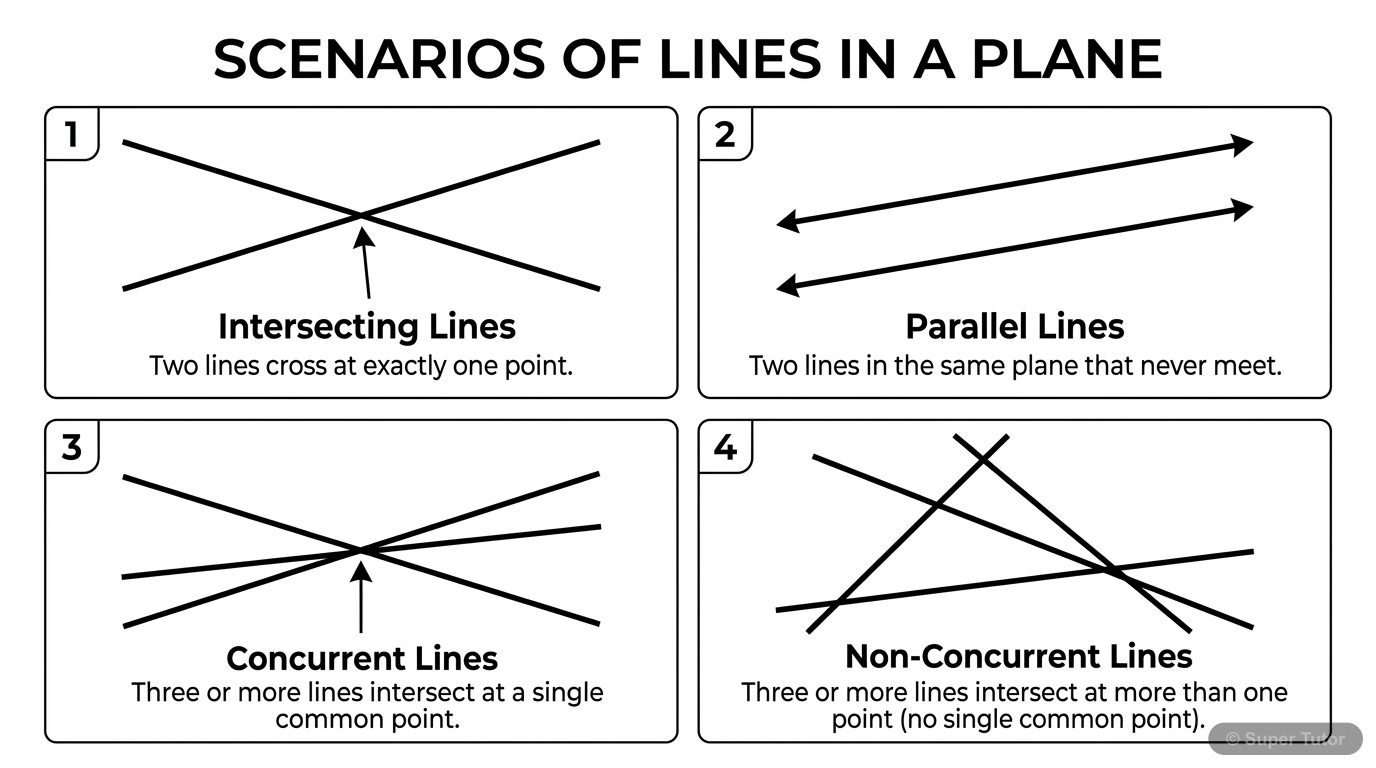
Learn better with visuals Super Tutor pairs illustrations like this with notes and quizzes for Concurrent Lines.
In triangle ABC, AD, BE, and CF are angle bisectors. What do you conclude?
Answer
Step 1: A triangle has three angles, so three angle bisectors can be drawn. Step 2: The three angle bisectors of a triangle are concurrent. Step 3: Their point of concurrency is called the incentre, I…
In triangle ABC, the angle bisectors meet at I. What key distance property does I have?
Answer
Step 1: A point on an angle bisector is equidistant from the two sides of the angle. Step 2: Since I lies on the angle bisectors of the triangle, it is equidistant from all three sides. Step 3: Let L,…
Why does a circle with centre I and radius IL touch all three sides of the triangle?
Answer
Step 1: I is the incentre, so IL = IM = IN. Step 2: Equal perpendicular distances from the centre to the sides mean the same radius reaches each side. Step 3: A circle drawn with centre I and radius I…
What is the difference between incentre and circumcentre?
Answer
Step 1: The incentre is equidistant from the sides of a triangle. Step 2: The circumcentre is equidistant from the vertices of a triangle. Step 3: The incentre is the intersection of angle bisectors.
In triangle ABC, DP, EQ, and FR are perpendicular bisectors. What do you conclude?
Answer
Step 1: A triangle has three sides, so three perpendicular bisectors can be drawn. Step 2: The three perpendicular bisectors of a triangle are concurrent. Step 3: Their point of concurrency is called …
In triangle ABC, O is the circumcentre. What equality holds for the distances to the vertices?
Answer
Step 1: O lies on the perpendicular bisector of BC, so BO = CO. Step 2: O lies on the perpendicular bisector of AC, so AO = CO. Step 3: Therefore all three distances are equal. Answer: AO = BO = CO.
A circle is drawn with centre O and radius AO. What does this circle do?
Answer
Step 1: O is the circumcentre, so AO = BO = CO. Step 2: A circle with centre O and radius AO passes through A, B, and C. Step 3: A circle passing through all three vertices is the circumcircle. Answer…
Where is the circumcentre of a right triangle located?
Answer
Step 1: The circumcentre changes position with triangle type. Step 2: For a right triangle, it lies on the hypotenuse. Answer: On the hypotenuse.
+16 more flashcards
Practise AllFrequently Asked Questions
What are the important topics in Concurrent Lines for NIOS Class 10 Maths?
How many flashcards are available for Concurrent Lines?
How should I revise Concurrent Lines for the NIOS Class 10 board exam?
Sources & Official References
Content is aligned to the official syllabus. Refer to the board website for the latest curriculum.
More resources for Concurrent Lines
Practice Quiz
Test yourself with a quick quiz
Important Questions
Exam-style questions with answers
Revision Notes
Key points for last-minute revision
Formula Sheet
The chapter's formulas in one place
Chapter Summary
Understand the chapter at a glance
Concept Maps
See how topics connect
Study Plan
Step-by-step plan for this chapter
Syllabus
What topics to cover
For serious students
Get the full Concurrent Lines chapter — start free.
Quizzes, flashcards, an AI doubt solver and a study plan for NIOS Class 10 Maths. Free to start, no card needed.