Congruence Of Triangles
NIOS · Class 10 · Maths
Most important questions from Congruence Of Triangles for NIOS Class 10 Maths board exam 2026. MCQs, short answer, and long answer questions with marks.
Interactive on Super Tutor
Studying Congruence Of Triangles? Get the full interactive chapter.
Quizzes, flashcards, AI doubt-solver and a step-by-step study plan — built for important questions and more.
1,000+ Class 10 students started this chapter today
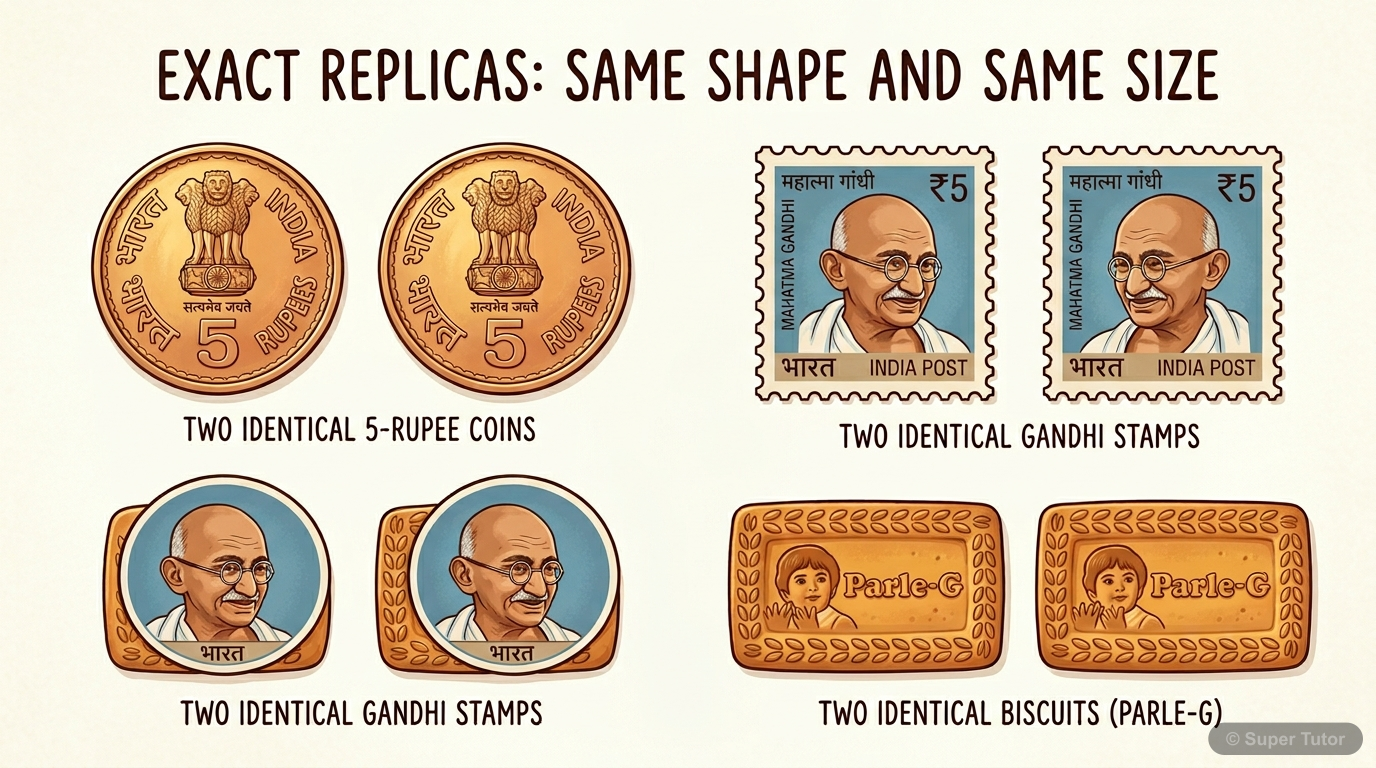
This is just one of 8+ visuals inside Super Tutor's Congruence Of Triangles chapter
Explore the full setSample Questions
In triangle PQR, if PQ = 7 cm, QR = 5 cm, and PR = 9 cm, which angle is the largest?
Show answer
∠Q
Step 1: Identify the longest side - comparing PQ = 7 cm, QR = 5 cm, PR = 9 cm, we see PR is the longest. Step 2: Apply the theorem that the largest angle is opposite to the longest side. Step 3: The angle opposite to side PR is ∠Q (angle at vertex Q). Step 4: Therefore, ∠Q is the largest angle. This follows from the property that in any triangle, the greater angle lies opposite to the longer side.
Two right triangles ABC and DEF have ∠B = ∠E = 90°, AC = DF (hypotenuse), and AB = DE. Which congruence criterion applies?
Show answer
RHS
Step 1: Identify that both triangles are right-angled at B and E respectively. Step 2: Note that AC and DF are the hypotenuses (sides opposite to right angles). Step 3: Given that AC = DF (hypotenuses are equal) and AB = DE (one pair of sides are equal). Step 4: This matches the RHS (Right angle-Hypotenuse-Side) criterion which states that if hypotenuse and one side of a right triangle equal the hypotenuse and corresponding side of another right triangle, the triangles are congruent.
In triangle ABC, if ∠A = 30°, ∠B = 60°, and ∠C = 90°, which side is the shortest?
Show answer
BC
Step 1: Identify the angles - ∠A = 30° (smallest), ∠B = 60°, ∠C = 90° (largest). Step 2: Apply the theorem that the smallest angle has the shortest side opposite to it. Step 3: The side opposite to ∠A (30°) is BC. Step 4: Therefore, BC is the shortest side. This is a fundamental property: in any triangle, the shortest side lies opposite to the smallest angle.
If △ABC ≅ △PQR and the correspondence is A↔P, B↔Q, C↔R, and ∠A = 45°, what is the measure of ∠P?
Show answer
45°
Step 1: Understand that if △ABC ≅ △PQR, then corresponding angles are equal. Step 2: The given correspondence shows A↔P, meaning vertex A corresponds to vertex P. Step 3: Since corresponding angles of congruent triangles are equal, ∠A = ∠P. Step 4: Given ∠A = 45°, therefore ∠P = 45°. This is a direct application of the property that corresponding parts of congruent triangles are equal.
+38 more questions available
Practice AllFrequently Asked Questions
What are the important topics in Congruence Of Triangles for NIOS Class 10 Maths?
How to score full marks in Congruence Of Triangles — NIOS Class 10 Maths?
How many important questions are there in Congruence Of Triangles?
Sources & Official References
Content is aligned to the official syllabus. Refer to the board website for the latest curriculum.
More resources for Congruence Of Triangles
Practice Quiz
Test yourself with a quick quiz
Revision Notes
Key points for last-minute revision
Formula Sheet
All formulas in one place
Chapter Summary
Understand the chapter at a glance
Concept Maps
See how topics connect visually
Study Plan
Step-by-step plan to ace this chapter
Flashcards
Quick-fire cards for active recall
Syllabus
What topics to cover
NCERT Solutions
Every textbook question solved step by step
For serious students
Get the full Congruence Of Triangles chapter — for free.
Quizzes, flashcards, AI doubt-solver and a step-by-step study plan for NIOS Class 10 Maths.