Surface Areas And Volumes Of Solid Figures
NIOS · Class 10 · Maths
Most important questions from Surface Areas And Volumes Of Solid Figures for NIOS Class 10 Maths board exam 2026. MCQs, short answer, and long answer questions with marks.
Interactive on Super Tutor
Studying Surface Areas And Volumes Of Solid Figures? Get the full interactive chapter.
Quizzes, flashcards, AI doubt-solver and a step-by-step study plan — built for important questions and more.
1,000+ Class 10 students started this chapter today
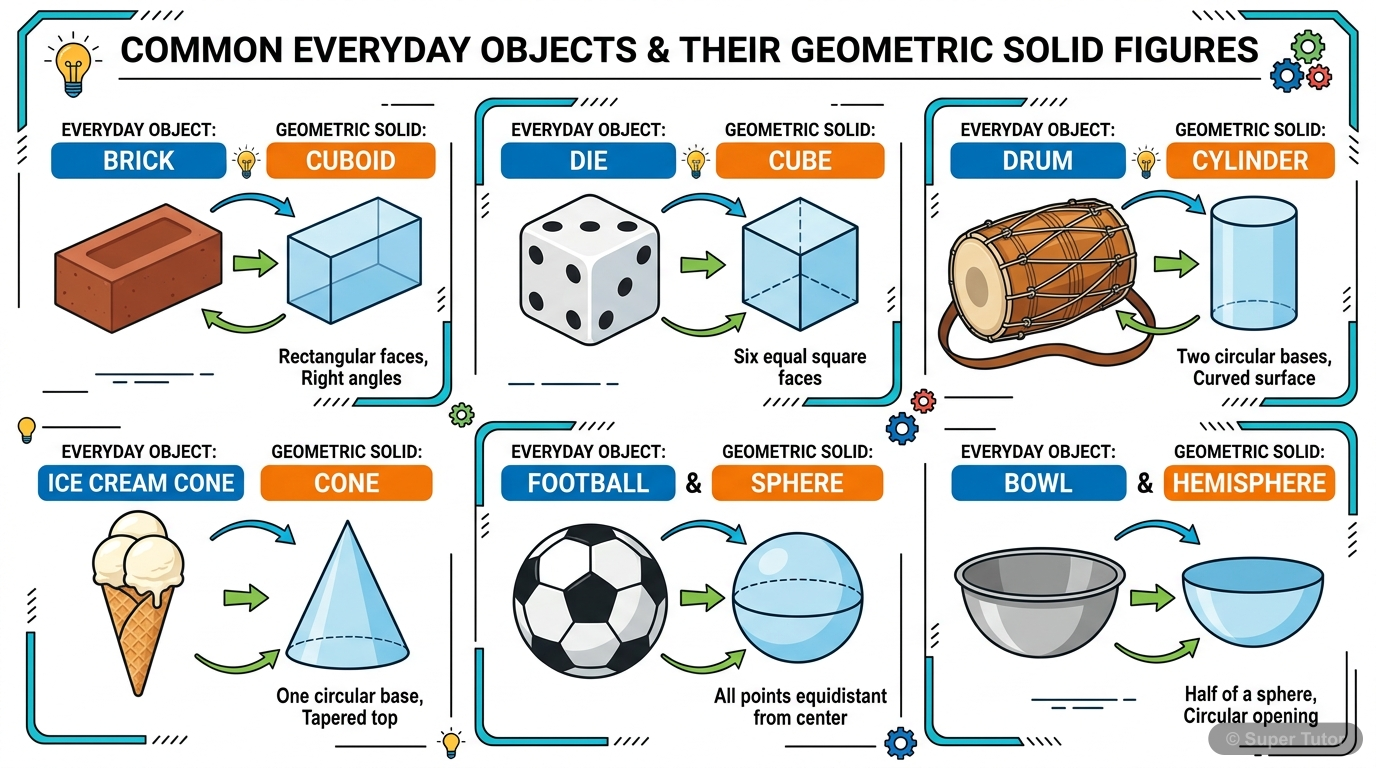
Super Tutor has 10+ illustrations like this for Surface Areas And Volumes Of Solid Figures alone — flashcards, concept maps, and step-by-step visuals.
See them allSample Questions
Find the slant height of a cone with base radius 5 cm and height 12 cm.
Show answer
13 cm
Step 1: Use Pythagoras theorem: slant height l = √(r² + h²) where r=5 cm, h=12 cm. Step 2: Calculate r² = 5² = 25 and h² = 12² = 144. Step 3: Add: r² + h² = 25 + 144 = 169. Step 4: Take square root: l = √169 = 13 cm. This forms a 5-12-13 right triangle, which is a common Pythagorean triplet.
What is the total surface area of a hemisphere with radius 14 cm? (Use π = 22/7)
Show answer
1848 cm²
Step 1: Total surface area of hemisphere = 3πr² where r=14 cm. Step 2: Calculate r² = 14² = 196. Step 3: Substitute: TSA = 3 × (22/7) × 196 = 3 × 22 × 28 = 1848 cm². Step 4: This includes curved surface (2πr²) plus flat circular base (πr²). Common mistake: Using only 2πr² which is just curved surface.
A cubical box has a volume of 216 cm³. What is the length of its edge?
Show answer
6 cm
Step 1: Volume of cube = a³ = 216 cm³, need to find edge length a. Step 2: Take cube root of both sides: a = ∛216. Step 3: Find factors: 216 = 6 × 6 × 6 = 6³. Step 4: Therefore a = 6 cm. To verify: 6³ = 6 × 6 × 6 = 216 ✓. Common mistake: Taking square root instead of cube root.
Find the volume of a cylinder with diameter 14 cm and height 8 cm. (Use π = 22/7)
Show answer
1232 cm³
Step 1: Volume of cylinder = πr²h. Given diameter = 14 cm, so radius r = 7 cm, height h = 8 cm. Step 2: Calculate r² = 7² = 49. Step 3: Substitute: V = (22/7) × 49 × 8 = 22 × 7 × 8 = 1232 cm³. Step 4: The volume is 1232 cm³. Common mistake: Using diameter instead of radius in the formula.
+30 more questions available
Practice AllFrequently Asked Questions
What are the important topics in Surface Areas And Volumes Of Solid Figures for NIOS Class 10 Maths?
How to score full marks in Surface Areas And Volumes Of Solid Figures — NIOS Class 10 Maths?
How many important questions are there in Surface Areas And Volumes Of Solid Figures?
Sources & Official References
Content is aligned to the official syllabus. Refer to the board website for the latest curriculum.
More resources for Surface Areas And Volumes Of Solid Figures
Practice Quiz
Test yourself with a quick quiz
Revision Notes
Key points for last-minute revision
Formula Sheet
All formulas in one place
Chapter Summary
Understand the chapter at a glance
Concept Maps
See how topics connect visually
Study Plan
Step-by-step plan to ace this chapter
Flashcards
Quick-fire cards for active recall
Syllabus
What topics to cover
NCERT Solutions
Every textbook question solved step by step
For serious students
Get the full Surface Areas And Volumes Of Solid Figures chapter — for free.
Quizzes, flashcards, AI doubt-solver and a step-by-step study plan for NIOS Class 10 Maths.