Surface Areas And Volumes Of Solid Figures — Chapter Summary
NIOS · Class 10 · Maths
Summary of Surface Areas And Volumes Of Solid Figures for NIOS Class 10 Maths. Part of the NIOS Class 10 Maths syllabus.
Interactive on Super Tutor
Studying Surface Areas And Volumes Of Solid Figures? Get the full interactive chapter.
Quizzes, flashcards, AI doubt-solver and a step-by-step study plan — built for chapter summary and more.
Free trial, no card needed.
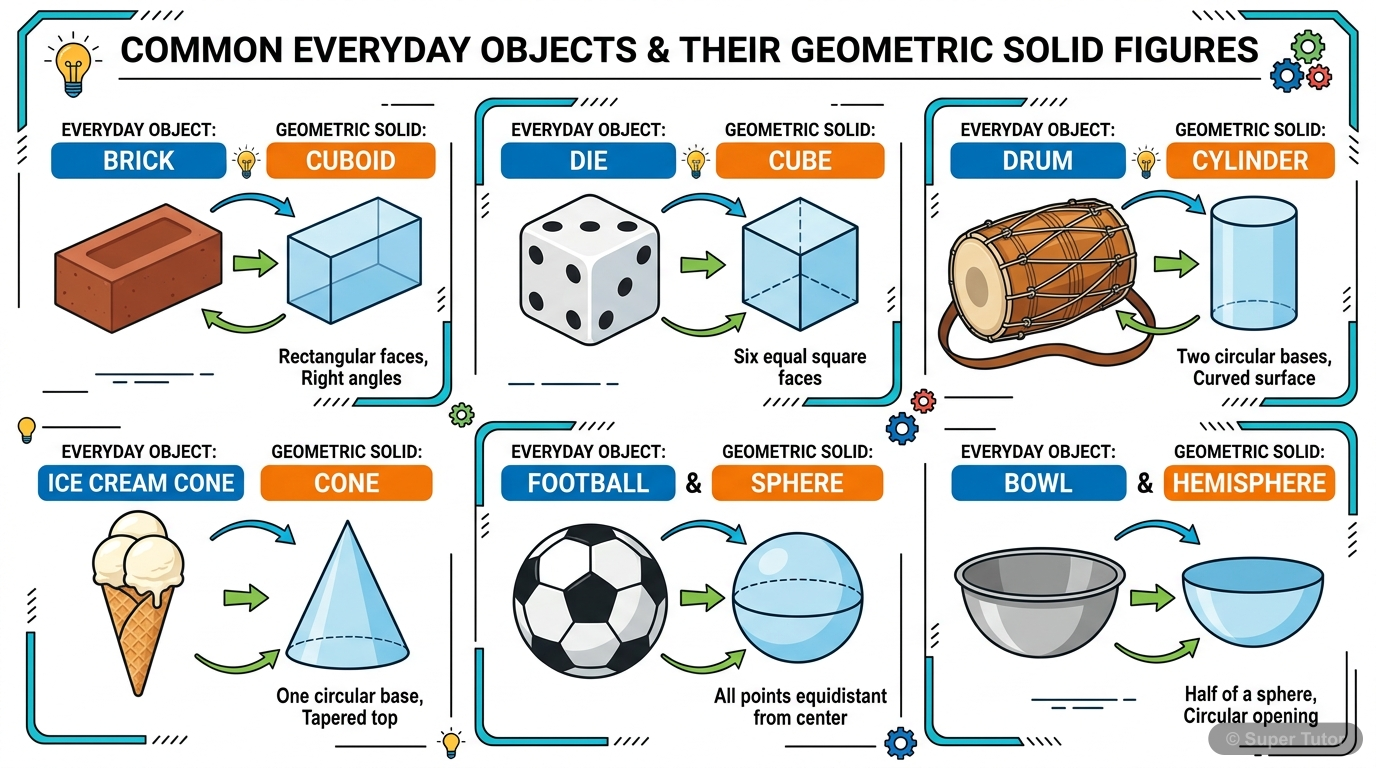
Learn better with visuals Super Tutor pairs illustrations like this with notes and quizzes for Surface Areas And Volumes Of Solid Figures.
Overview
Solid figures are three-dimensional objects with length, breadth, and height. Their study involves two main measurements: surface area, which measures the outer boundary, and volume, which measures the space enclosed. The chapter covers cuboids, cubes, cylinders, cones, spheres, and hemispheres, alo
Key Concepts
Solid figures are three
Solid figures are three-dimensional objects. They occupy space and have length, breadth, and height.
Surface area is the measure
Surface area is the measure of the boundary or outer surface of a solid figure. It is measured in square units.
Volume is the measure of
Volume is the measure of the space enclosed by a solid figure. It is measured in cubic units.
A cuboid has six rectangular faces
A cuboid has six rectangular faces and is defined by length l, breadth b, and height h. Its formulas are surface area = 2(lb + bh + hl), volume = lbh,
A cube is a special cuboid
A cube is a special cuboid where l = b = h = a. Its formulas are surface area = 6a^2, volume = a^3, and diagonal = a sqrt(3).
Learning Objectives
- Identify common solid figures and match them with real-life objects
- Distinguish between surface area and volume
- Use formulas for cuboid, cube, cylinder, cone, sphere, and hemisphere
- Find diagonal lengths of cuboid and cube
- Apply Pythagoras theorem to find slant height of a cone
Frequently Asked Questions
What are the important topics in Surface Areas And Volumes Of Solid Figures for NIOS Class 10 Maths?
How should I revise Surface Areas And Volumes Of Solid Figures for the NIOS Class 10 board exam?
Sources & Official References
Content is aligned to the official syllabus. Refer to the board website for the latest curriculum.
More resources for Surface Areas And Volumes Of Solid Figures
Practice Quiz
Test yourself with a quick quiz
Important Questions
Exam-style questions with answers
Revision Notes
Key points for last-minute revision
Formula Sheet
The chapter's formulas in one place
Concept Maps
See how topics connect
Study Plan
Step-by-step plan for this chapter
Flashcards
Quick-fire cards for active recall
Syllabus
What topics to cover
For serious students
Get the full Surface Areas And Volumes Of Solid Figures chapter — start free.
Quizzes, flashcards, an AI doubt solver and a study plan for NIOS Class 10 Maths. Free to start, no card needed.