Instalment Buying — Practice Quiz
NIOS · Class 10 · Maths
Try a 4-question quiz on Instalment Buying for NIOS Class 10 Maths: tap an answer to check it and see why. 29 questions in the full chapter test.
Interactive on Super Tutor
Studying Instalment Buying? Get the full interactive chapter.
Quizzes, flashcards, AI doubt-solver and a step-by-step study plan — built for practice quiz and more.
Free trial, no card needed.
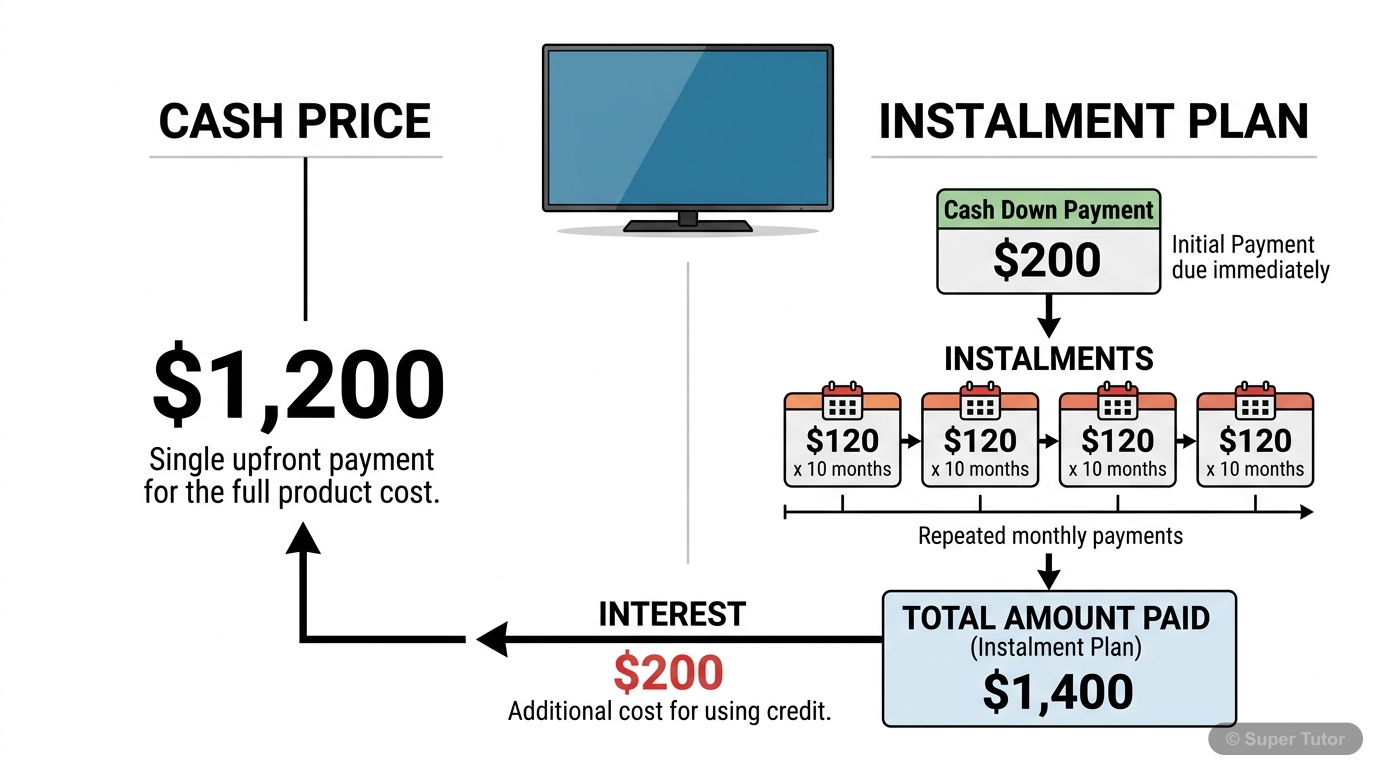
One of 6 illustrations for Instalment Buying in Super Tutor — alongside flashcards, concept maps and practice questions.
Quick Quiz: Instalment Buying
0/4Tap an answer to check it instantly. No sign-up needed for these 4.
A bicycle is sold for ₹2,400 cash or ₹800 cash down payment followed by 2 monthly instalments of ₹850 each. What is the total amount paid under the instalment plan?
In an instalment buying scheme, if the cash price is ₹10,000 and the total amount paid under instalment plan is ₹10,800, what is the interest charged?
A refrigerator is available for ₹25,000 cash or ₹8,000 cash down payment and 4 equal monthly instalments of ₹4,500 each. Which payment method is more economical?
In compound interest instalment buying, a product costs ₹12,000 cash or ₹3,000 down payment plus 2 equal half-yearly instalments at 20% per annum compounded semi-annually. What is the semi-annual interest rate?
Sample Questions
A laptop is sold for ₹50,000 cash or ₹20,000 cash down payment and 3 monthly instalments of ₹10,500 each. How much extra does a customer pay by choosing the instalment plan?
Show answer
₹1,500
Step 1: Calculate total amount paid under instalment plan: Cash down payment + Total instalments = ₹20,000 + (3 × ₹10,500) = ₹20,000 + ₹31,500 = ₹51,500. Step 2: Compare with cash price: Cash price = ₹50,000. Step 3: Find the extra amount: Extra amount = Total instalment payment - Cash price = ₹51,500 - ₹50,000 = ₹1,500. Step 4: This ₹1,500 represents the interest charged for the convenience of paying in instalments.
A mobile phone is available for ₹8,000 cash or ₹2,000 down payment and 2 monthly instalments of ₹3,200 each. What percentage of the cash price is paid as down payment?
Show answer
25%
Step 1: Identify the given values: Cash price = ₹8,000, Down payment = ₹2,000. Step 2: Use the percentage formula: Percentage = (Down payment ÷ Cash price) × 100. Step 3: Calculate: Percentage = (₹2,000 ÷ ₹8,000) × 100 = (1/4) × 100 = 25%. Step 4: This means the customer pays 25% of the total cash price upfront and the remaining 75% through instalments with interest.
In an instalment plan, if the balance after down payment is ₹15,000 and it's to be paid in 3 equal instalments, what is the amount of each instalment before adding interest?
Show answer
₹5,000
Step 1: Understand that without interest, instalments would be equal divisions of the balance. Step 2: Given: Balance after down payment = ₹15,000, Number of instalments = 3. Step 3: Calculate each instalment: Amount per instalment = Balance ÷ Number of instalments = ₹15,000 ÷ 3 = ₹5,000. Step 4: Note that in actual instalment plans, interest is added to this base amount, making the actual instalments higher than ₹5,000.
A computer is purchased for ₹800 down payment and 2 instalments of ₹1,200 each. If the cash price was ₹3,000, calculate the total interest paid (in rupees).
Show answer
200
Step 1: Calculate total amount paid under instalment plan: Down payment + Total instalments = ₹800 + 2(₹1,200) = ₹800 + ₹2,400 = ₹3,200. Step 2: Given cash price = ₹3,000. Step 3: Calculate interest paid: Interest = Total amount paid - Cash price = ₹3,200 - ₹3,000 = ₹200. Step 4: This ₹200 is the extra cost for choosing the instalment option over cash payment. Step 5: The interest represents the cost of financing the purchase over time instead of paying the full amount upfront.
+25 more questions on Instalment Buying (NIOS Class 10 Maths)
Practise AllFrequently Asked Questions
What are the important topics in Instalment Buying for NIOS Class 10 Maths?
How many practice questions are there for Instalment Buying?
Sources & Official References
Content is aligned to the official syllabus. Refer to the board website for the latest curriculum.
More resources for Instalment Buying
Important Questions
Exam-style questions with answers
Revision Notes
Key points for last-minute revision
Formula Sheet
The chapter's formulas in one place
Chapter Summary
Understand the chapter at a glance
Concept Maps
See how topics connect
Study Plan
Step-by-step plan for this chapter
Flashcards
Quick-fire cards for active recall
Syllabus
What topics to cover
For serious students
Get the full Instalment Buying chapter — start free.
Quizzes, flashcards, an AI doubt solver and a study plan for NIOS Class 10 Maths. Free to start, no card needed.