Number System — Practice Quiz
NIOS · Class 10 · Maths
Try a 4-question quiz on Number System for NIOS Class 10 Maths: tap an answer to check it and see why. 39 questions in the full chapter test.
Interactive on Super Tutor
Studying Number System? Get the full interactive chapter.
Quizzes, flashcards, AI doubt-solver and a step-by-step study plan — built for practice quiz and more.
Free trial, no card needed.
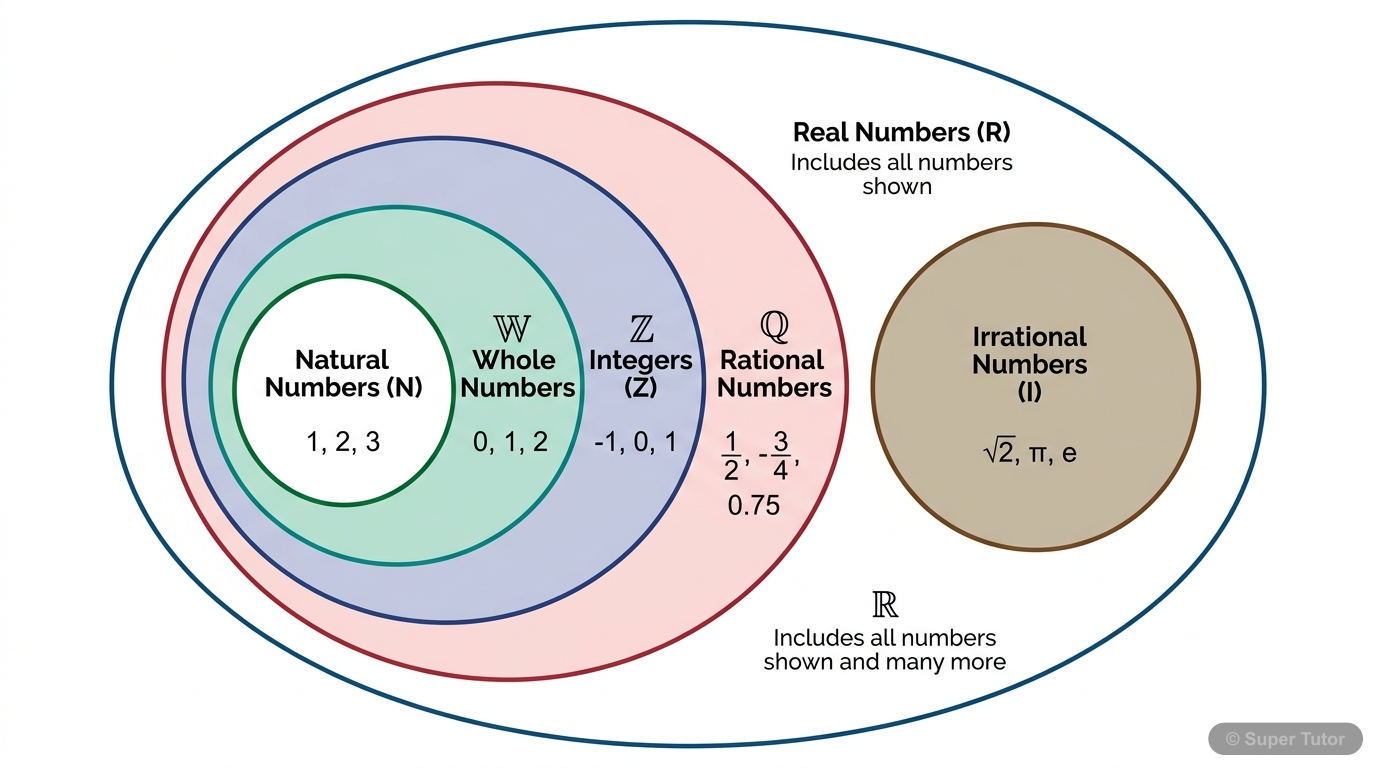
Learn better with visuals Super Tutor pairs illustrations like this with notes and quizzes for Number System.
Quick Quiz: Number System
0/4Tap an answer to check it instantly. No sign-up needed for these 4.
Which of the following is NOT a rational number?
Express 2/5 + 3/7 in its simplest form.
Which of the following represents a terminating decimal?
What is the decimal representation of 7/11?
Sample Questions
Between which two consecutive integers does √10 lie?
Show answer
3 and 4
Step 1: Find perfect squares near 10 to estimate √10. Step 2: We know that 3² = 9 and 4² = 16. Step 3: Since 9 < 10 < 16, we have √9 < √10 < √16. Step 4: Therefore, 3 < √10 < 4, so √10 lies between consecutive integers 3 and 4.
Which of the following is the standard form of the rational number -24/36?
Show answer
-2/3
Step 1: To express a rational number in standard form, ensure the denominator is positive and the numerator and denominator are coprime. Step 2: Find GCD of 24 and 36: factors of 24 = 1,2,3,4,6,8,12,24 and factors of 36 = 1,2,3,4,6,9,12,18,36. GCD = 12. Step 3: Divide both numerator and denominator by 12: -24/36 = (-24÷12)/(36÷12) = -2/3. Step 4: The denominator is positive, and GCD of 2 and 3 is 1, so -2/3 is in standard form.
What is 0.35̄ (0.353535...) expressed as a fraction?
Show answer
35/99
Step 1: Let x = 0.353535... = 0.35̄. Step 2: Multiply both sides by 100 (since the repeating block has 2 digits): 100x = 35.353535... Step 3: Subtract the original equation: 100x - x = 35.353535... - 0.353535..., so 99x = 35. Step 4: Therefore, x = 35/99. We can verify this is in lowest terms since GCD(35,99) = 1.
Which of the following operations on rational numbers always results in a rational number?
Show answer
Addition
Step 1: Check each operation with rational numbers a/b and c/d where b,d ≠ 0. Step 2: Addition: (a/b) + (c/d) = (ad + bc)/(bd), which is rational since ad+bc and bd are integers with bd ≠ 0. Step 3: Square root: √(a/b) may be irrational (e.g., √(1/2) = √2/2). Step 4: Taking reciprocal of zero is undefined, and raising to certain powers can yield irrationals. Therefore, only addition always gives a rational result.
+35 more questions on Number System (NIOS Class 10 Maths)
Practise AllFrequently Asked Questions
What are the important topics in Number System for NIOS Class 10 Maths?
How many practice questions are there for Number System?
Sources & Official References
Content is aligned to the official syllabus. Refer to the board website for the latest curriculum.
More resources for Number System
Important Questions
Exam-style questions with answers
Revision Notes
Key points for last-minute revision
Formula Sheet
The chapter's formulas in one place
Chapter Summary
Understand the chapter at a glance
Concept Maps
See how topics connect
Study Plan
Step-by-step plan for this chapter
Flashcards
Quick-fire cards for active recall
Syllabus
What topics to cover
For serious students
Get the full Number System chapter — start free.
Quizzes, flashcards, an AI doubt solver and a study plan for NIOS Class 10 Maths. Free to start, no card needed.